The future direction of St. Columba’s Anglican-United Church changed unexpectedly during an unusually cold winter in 2021. On Dec. 21, temperatures in Port Hardy, B.C., on the northernmost tip of Vancouver Island, fell to -5 C, then to -5 C again on Christmas Day. A few days later, they plunged to an unthinkable -12 C.
In other parts of Canada, these winter temperatures might be considered a warm spell. But in Port Hardy, that kind of frigid, foggy weather is rare; it penetrates through the usual West Coast winter uniform of wool, polar fleece, denim and cotton, seeping so deeply into skin and bones that even a bath or sauna can’t relieve the chill.
You may unsubscribe from any of our newsletters at any time.
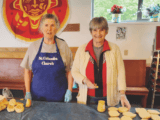
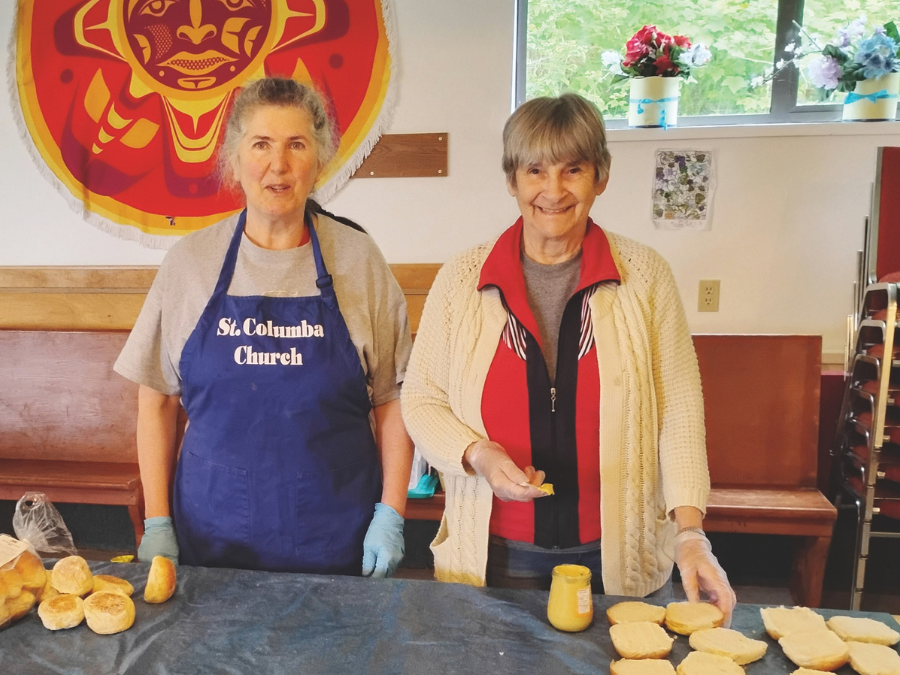
The cold snap put the town’s limited shelter system to the test. Its local Salvation Army, under contract to the province, was mandated to close at 7 a.m. each morning, casting residents out into the cold. Nowhere else welcoming opened until 9:30 a.m. That two-and-a-half-hour gap led to the creation of St. Columba Sanctuary, a daily drop-in program. Since Christmastime nearly five years ago, the church has welcomed about 15 people each morning for a hot breakfast and a listening ear.
The Sanctuary exists in a region with its own complicated relationship to the church. The poorer part of the North Island that St. Columba serves is about 40 percent Indigenous. Until the 1970s, The United Church of Canada ran the now-infamous Kuper Island and Alberni Indian Residential Schools, while the Anglican Church of Canada ran St. Michael’s Residential and Day School at Alert Bay.
“Some of the older [Indigenous] people in the community, even though they had bad experiences at the residential schools, still think of themselves as Anglican,” says Judy Fykes, the long-time treasurer and a lay leader at St. Columba’s. “But of course, the other response is that people don’t want to have anything to do with church or Anglicans or United people.”
Against that backdrop, St. Columba’s has tried to build something different. Today, the church employs two ministers part time: Rev. Bob Gilbert, who is semi-retired, and Rev. Sheila Cook, a recent graduate of the Vancouver School of Theology and a member of the Cree Nation, who is also the daughter of a residential school survivor. The congregation now defines part of its outreach work as reconciliation. “We take the TRC calls to action to heart,” said Fykes.
More on Broadview:
- A decade after the TRC, Canadian churches still have some homework
- Marie Wilson, commissioner on TRC, found truth, some reconciliation
- How Canadian churches can live out this TRC call to action
In a community where the church’s history is complicated, St. Columba’s is working to redefine what it means to be a place of welcome. It replaced its red exit lights with green ones after learning that the old ones evoked memories of residential schools for some community members. Alongside the Sanctuary — initially called “O’ma̱n’s ‘Na̱m’a,” a Kwak’wala phrase that translates to “we are one” — the church serves a community lunch on Sundays and set up a “Blessing Box,” which is similar to a tiny free library, but with nonperishable food instead of books. Every Sept. 30, after the walk for the National Day for Truth and Reconciliation, St. Columba’s feeds about 500 locals. It has also taken on broader work, including efforts to decolonize worship services and deepen congregational education about residential schools.
The outreach is funded by a patchwork of grants from the Anglican Church, United Church, Lions and Rotary service clubs, United Way and even other Vancouver Island congregations. They also receive deli meat donations from the local grocery store, which volunteers make into sandwiches and distribute at the Sanctuary.
Fykes says the church’s work in food security and outreach to marginalized communities has proved attractive to funders. “We find it’s not that difficult to find money for the outreach work that we do,” she says.
That mission has taken on new weight as the congregation itself has grown smaller. Fykes and her husband, Robert, raised their three children on the North Island. They remember a profoundly different time when the region’s mills and mines brought professionals around the world to work there and the Sunday schools, pews and church bank accounts were full. As the mining and forestry industries boomed and then busted, the region morphed in population and demographics. The most poignant shift was in 1996, when Port Hardy’s largest mine shut down and the once 8,000-strong community abruptly dropped to just 4,000. “It affected every congregation, business and school,” remembers Robert Fykes, the mine’s former lab technician.
Now, the congregation attracts about 16 worshippers on a Sunday and a similar number of non-worshipping volunteers through the week.
Fykes maintains some nostalgia for St. Columba’s bigger congregation, when she didn’t have to wear so many hats. But belonging to a smaller congregation brings her joy, since relationships between the congregants are deeper. And, in this era, the mission of the church is clear.
“We’re working on many generations of healing,” she says.
***
Pieta Goudron is a journalist in Powell River, B.C.
This article first appeared in the September/October issue of Broadview with the title, “Healing beings here.”
Thanks for reading
Independent journalism rooted
in faith and justice is under threat
Broadview is the only media organization in Canada offering thoughtful, values-driven journalism from an inclusive, progressive Christian perspective. But our work depends on your support. If you value what you've just read, please act now.
A gift today helps keep this journalism alive tomorrow.
With gratitude,