The origins of Christianity invite many questions: who wrote the Bible? Why are there four different biographies of Jesus? How was early Christianity influenced by Greco-Roman culture?
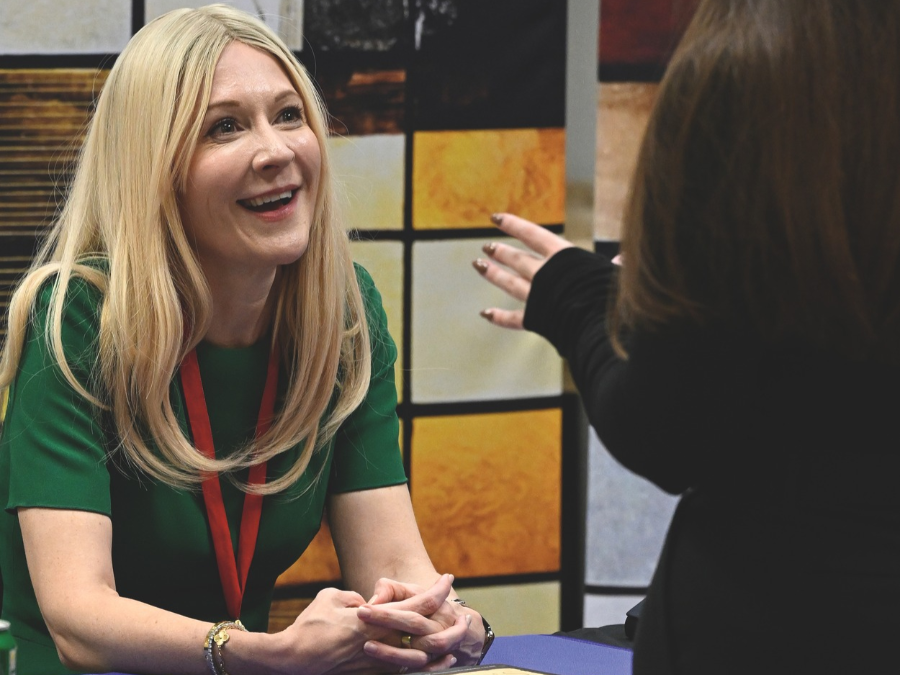
Experts have spent years investigating these topics — and Candida Moss has become adept at explaining them to the wider public. A New Testament scholar, Moss is regularly featured on the BBC and in the Washington Post as an expert voice on early Christianity. Her newest book, God’s Ghostwriters: Enslaved Christians and the Making of the Bible, takes a closer look at the people who wrote the New Testament — and not just the famous ones, but all of the nameless scribes, messengers and communities whose presence is hidden in the text.
You may unsubscribe from any of our newsletters at any time.
Moss was the recipient of the 2026 Grawemeyer Award in Religion, a prestigious international prize that celebrates ideas with “world changing potential.” Brett Potter spoke with Moss from her home in New York City.
Brett Potter: You’ve spent a lot of time looking at how the story of Jesus, and the whole of the New Testament, was written. How did it make it onto the page?
Candida Moss: When we think about the Gospels, we have this physical object on the page — the written text. But that isn’t how most people encountered that story in the ancient world. They heard it performed aloud, and that performance would vary based on so many things. Who was doing the telling? Who is the person performing? Tone of voice, emphasis, hand gestures and who you lock eyes with when you’re telling the story are all important, too.
One of the things I thought about when I was writing God’s Ghostwriters was how people have always been reshaping, adapting and working with the story of Jesus every time they read it aloud or copied it out. People get anxious in modern church communities about the idea you might be changing something, because that would be a problem. But that was happening from the very beginning with these stories.
BP: You encourage us to see and acknowledge the enslaved and socially marginalized people who acted as biblical scribes. How does awareness of these invisible authors shape how we read the story of Jesus?
CM: Anyone who takes an interest in the New Testament today is told that it really matters who wrote these texts. They’re a product of their communities, and so of course the authorship matters. Were they Jewish or not Jewish? Where and when were they writing? Had the Temple been destroyed yet? These are the things that are shaping their world as they tell this story.
So when people ask, “What does it matter if there were enslaved co-authors behind these texts?” I ask, “How could it not matter?” Sometimes what I hear in response is, “Well, these scribes were just mouthpieces.” The reason we think that they’re just mouthpieces and not people who contribute to the text is because that’s what Roman enslavers tell us. But if we’re willing to say they’re just mouthpieces or instruments, we’re signing up to a way of thinking about humans I don’t think any of us would willingly want to sign up for.
BP: You’ve demonstrated that we can, in fact, see traces of these enslaved people in the way the story is told or even the vocabulary that’s chosen — for example, the term doulos.
CM: Doulos is our standard Greek word for slave or enslaved person; doule is the feminine enslaved woman. If that is what the word means, then surely we always translate it as slave or enslaved person, right? No, we do not. We do not translate it that way when it makes us uncomfortable.
For example, when Mary uses that word of herself (in Luke 1:38), we say “handmaiden.” It’s a very flowery term that no one uses in any other context now. Or “servant.” Sometimes people say it’s not meant literally; it’s a metaphor for her obedience.
To be clear, I don’t think the historical Mary was enslaved. But whenever we’re hearing this language, we need to make sure we’re translating it consistently.
BP: What is the most compelling thing about Mary?
CM: The amazing thing about Mary, and so many women who appear in the Gospels, is how unsupported they are by their family members. In Mark, the earliest Gospel, she has children, but she’s alone and is supporting a son who seems to have been roundly rejected by his broader community. It doesn’t seem like other people in Nazareth are on board with this Messiah thing.
Unlike many other Greco-Roman stories, the Gospel of Mark does not let you look away from the brutality of the crucifixion. I think the character of Mary, as a mother who went through this profound loss of her child, would have been really powerful for other women who lost everything, particularly when you think about it in relation to these Greek texts where heroes don’t die like this. This is not how Achilles dies. It’s powerful in its humanity; it’s distinctive, significant.
More on Broadview:
- In the Bible, does ‘mankind’ include women?
- How the word ‘homosexuals’ entered the Bible — and the minister who challenged it
- How reading the Bible differently changed the way theologian Brian McLaren wrote about the climate crisis
BP: Joseph was a carpenter, or better yet, a construction worker — a tektōn. What are the implications of this for how we think about Jesus as the “son of a carpenter”?
CM: Like everyone who grew up in a Christian context, I have this image in my head of Jesus and Joseph building an artisanal table together. But the minute you say “construction workers,” it doesn’t sound the same as “artisanal craftsmen.” Construction workers weren’t highly regarded. This is blue-collar work.
When we think about artisanal carpentry, we think about skill — not backbreaking labour. Of course, all of these jobs involve skill. That’s another conceptual problem we have. But the thing to know about construction work in the ancient world is that they don’t have cement, so when they’re trying to keep things together, they’re using animal manure. This is a dirty, difficult kind of work.
We think similarly about labour now. This is the same kind of labour that ends up being done by migrants or the most marginalized members of our society. I think that we should see that with Jesus. I’m not suggesting the Son of God couldn’t have produced an elegant console table if he tried. But what Joseph was doing, this was low-status work.
BP: In your earlier books, you’ve talked a lot about bodies: disabled bodies, bleeding bodies, resurrected bodies. Jesus, after his resurrection, appears with his scarred hands and is recognized by the disciples. Can you connect this idea of “scar tissue” to your discussion of enslaved bodies?
CM: One of the things that’s interesting about that story of Jesus is that he has a lot of scars on him. We see the scars on his hands and feet; there’s the famous reference to the wound in his side. But nobody talks about the fact that he would have had scars all over his back from the whipping. The reason we don’t talk about them — the reason John doesn’t talk about them — is that those are slavish marks. In Roman law, if you have been whipped or shackled and you have these scars, you can never really be a citizen, even when you’re freed.
Scars and body marks are important for how people think about identity. And here it’s clear that enslaved people would have borne the same scars as Jesus did on their backs — just as Paul did, because he was beaten.
Scarring visually marked someone as enslaved or criminal in a really permanent way in the ancient world. The fact that scars survive in the resurrection says a lot about the way that we should read bodies.
BP: Okay, just for fun, I know you get asked about Christmas a lot. Can you settle it once and for all: is Christmas a pagan holiday?
CM: No, no.
BP: Maybe that’s enough of an answer!
CM: It’s so facile to say Christians stole it from the Romans. For example, there are baptism-like rituals in traditions other than Christianity, but the meaning of something isn’t determined by its original instantiation. Things change! Just because there are other holidays around the solstice that also deal with the theme of light, it doesn’t mean that Christmas was stolen from the pagans.
BP: You’re one of the few religion scholars who is also a columnist for popular media outlets. Why is this important to you, and what are the stakes?
CM: I never intended to be a public scholar, but how we read the Bible is important. To understand the text in its original context is important.
More broadly, it is important for people to be religiously literate. The public knowing more about religious traditions helps us pursue a more just and ethical society.
BP: In Canada, we don’t have a lot of venues left for public discourse about religion. What happens when we lose that dialogue in mainstream media?
CM: Someone is going to teach the public about religion. With investment in religious journalism on the decline, if it’s not us, that “someone else” might be a little terrifying.
If you care about that project of educating people about biblical literacy, and understanding the complexity beyond “the Bible says this”; if you think theological literacy is important and someone asks you if you will participate in it, then you have a moral responsibility to do it.
It’s obvious to us every day why we need to keep the humanities alive, and that people need critical thinking skills.
***
Brett Potter is an assistant professor of theology and religion at Huron University in London, Ont. He is currently teaching a course on Jesus in pop culture.
This interview has been edited for length and clarity. It first appeared in the November/December 2026 issue of Broadview with the title “The Bible’s Uncredited Authors.”
Thanks for reading
Independent journalism rooted
in faith and justice is under threat
Broadview is the only media organization in Canada offering thoughtful, values-driven journalism from an inclusive, progressive Christian perspective. But our work depends on your support. If you value what you've just read, please act now.
A gift today helps keep this journalism alive tomorrow.
With gratitude,