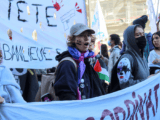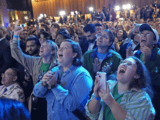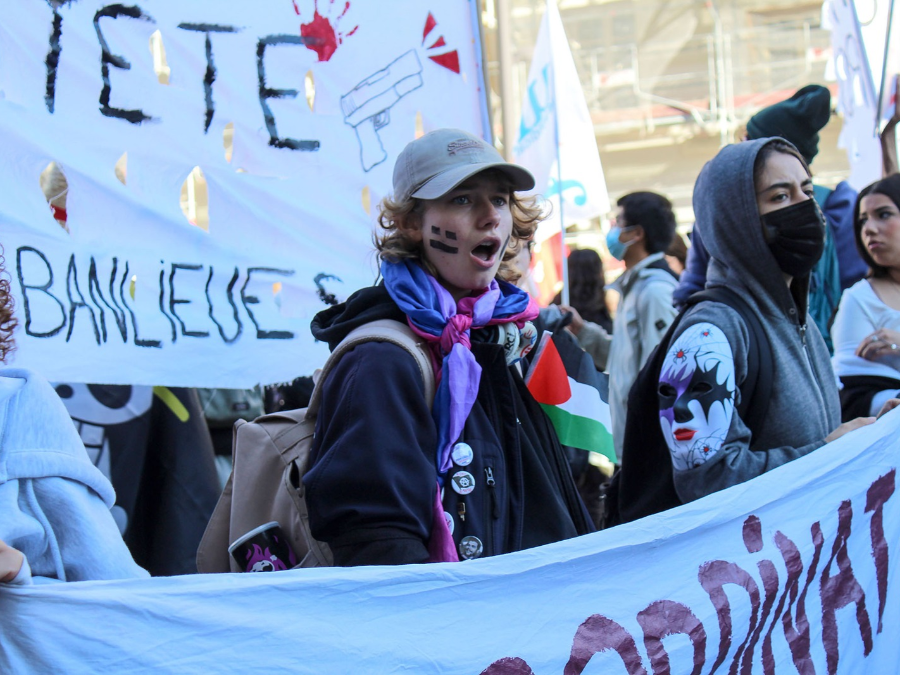
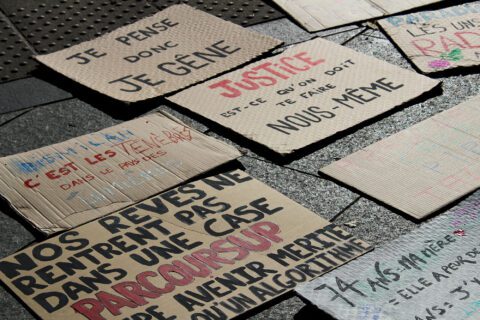
A sign reading “Halloween dressed as an angry citizen.” A decapitated Marie Antoinette. Marianne, the allegorical figure representing France, waving a French flag. A jazz band playing Bella Ciao, the famous Italian protest song. These were just a few of the images on display last Saturday in Paris as part of protests that have swept France.
As France entered its third weekend of nationwide protests, between 320,000 and 500,000 people rallied across the country on Oct. 31 against the rising cost of living and a growing national debt that threatens the country’s social safety net. The movement has now brought together organizations and political factions following five weeks of student-led protests that began in high schools in the Paris suburbs. Those initial demonstrations called for increased education funding and raised concerns about teacher shortages and deteriorating school facilities.
You may unsubscribe from any of our newsletters at any time.
“I am here to continue the fight, to support the people who are fighting for their rights and their demands of the government that is not listening to us,” Robin Pimond, a 26-year-old data scientist, told Broadview. “We believe we deserve to be heard by the government and we are here to show we are still here.”
Like the previous weekend, the Paris march stayed on the outskirts of the city, far from the seats of power and affluent neighbourhoods, rather than taking place at the symbolic Place de la Bastille, a longstanding gathering place for France’s revolutionary movements.
Following the massive demonstrations and riots that engulfed various French cities on Oct. 17 and overwhelmed an unprepared police force, the government deployed 70,000 law enforcement officers across the country on Oct. 24 and 31. Some cities, including Lyon and Marseille, banned demonstrations last week.
“It has become a crucial moment and at the end of this day, [the government] will wait to see if this is a movement that will continue to grow or if, once again, the repression, the unresponsiveness, the disregard will have the upper hand,” said Karl Ghazi, co-secretary general of the Paris branch of the Confédération générale du travail (CGT), one of France’s largest labour federations, on Oct. 24.
More on Broadview:
- Germany’s churches reckon with AfD’s rise
- How one community leader is fighting for food security in Newfoundland and Labrador
- High cost of compassion threatens to shutter Christian home for people with HIV in Winnipeg
The national unrest reflects broader cost-of-living pressures and growing discontent with President Emmanuel Macron. Since he took office in 2017, annual inflation reached an estimated 3.4 percent in October 2026, compared with 1.1 percent when Macron took office.
“It’s really a frustration that has exploded everywhere in France,” said Léna Guerrier, spokesperson for L’Union Étudiante, a major French student union, on Oct. 24.
“Macron and his government are afraid of the demands that emerged from both the youth and the rest of the population because they are trying to silence the movement in every possible way and to systematically send us a repressive response toward legitimate demands,” Guerrier said.
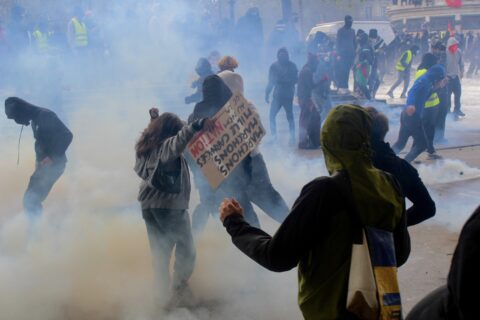
Organizers say most demonstrations have been peaceful, with some drawing up to 800,000 people. But images of rioters accused of looting and setting fire to public property have dominated media coverage. Police have used tear gas, stun grenades, rubber bullets and water cannons to disperse protesters. Hundreds of people have reportedly been injured since the movement began, some left with life-changing injuries.
Police tactics have drawn sharp scrutiny, with more than 4,000 people arrested since Oct. 17.
After the Oct. 17 demonstrations turned violent, French Prime Minister Sébastien Lecornu expressed support for law enforcement and blamed far-left groups, including the political party La France Insoumise, for encouraging violence.
“To those who clearly want to make these acts of violence ‘a warm-up lap’ ahead of the presidential elections, I will say it clearly: we will not be intimidated. No one will impose their political agenda with violence,” Lecornu wrote on X on Oct. 17.
In an effort to ease tensions and address protesters’ demands, Macron and Lecornu met with students in late October. But student union leaders dismissed the government’s proposed measures as “crumbs”. Further protests and nationwide strikes were scheduled for Nov. 3 and Nov. 5.
***
Sandra Sadek is a French-Lebanese award-winning multimedia journalist covering global affairs, economics, and culture.
Thanks for reading
Independent journalism rooted
in faith and justice is under threat
Broadview is the only media organization in Canada offering thoughtful, values-driven journalism from an inclusive, progressive Christian perspective. But our work depends on your support. If you value what you've just read, please act now.
A gift today helps keep this journalism alive tomorrow.
With gratitude,