A three-hour-long documentary that has become both the year’s most enthralling film and its unlikeliest box-office hit, You Can See Everything was born out of an idea that qualifies as extremely ill-advised even if it didn’t involve the parties at hand. At the very least, the film will dissuade anyone who ever thinks it wise to invite a camera crew into his or her home to document everything that’s said or done in the spirit of “radical transparency,” as one participant calls it. No life could withstand that scrutiny, no matter how hard we may try to stop all our flaws, foibles and self-delusions from spilling into view.
For the people who come together in a Californian beach house for the events captured here, the circumstances are even stranger because of who they are. Elizabeth Holmes became a superstar of Silicon Valley and raised hundreds of millions of dollars based on technology by her company Theranos that promised to revolutionize medical testing. Alas, journalists and federal investigators revealed the company was misleading investors and regulators about the efficacy of said tech, eventually leading to Holmes’s conviction for fraud and related charges.
You may unsubscribe from any of our newsletters at any time.
As the head-spinning saga of You Can See Everything begins in 2023, she’s just a few weeks away from starting an 11-year prison sentence and is living in a rented home in Del Mar, Calif., with her two young children and husband Billy Evans, a fellow entrepreneur who met her after her ruse collapsed.
The couple want to counter the public perceptions of Holmes from media coverage and The Dropout, a 2022 TV series starring Amanda Seyfried that depicts Holmes’s rise and fall. Such representations painted the tech founder as a deceiver and manipulator uniquely able to warp reality to meet her needs.
Yet one of this film’s great mysteries lies in the couple’s choice of documentarian to live with them and help show the “real” Elizabeth to the world. A Vancouver-born comedian, actor and filmmaker, Nathan Fielder is best known for his TV series Nathan for You and The Rehearsal, bold satires in which he blurs the line between fiction and documentary by applying elements of improv comedy and his own deadpan on-screen persona to real-life situations. The resulting encounters essentially become experiments in behavioural science.
More on Broadview:
- How preacher’s kid Ins Choi gave up the pulpit for the stage
- How Anne of Green Gables became a Japanese obsession
- The gospel according to Malcolm Gladwell
Needless to say, this combination of personalities (and pathologies) sends this situation in very unpredictable directions. Directed by Fielder and Lance Oppenheim, You Can See Everything has become the season’s most talked-about film because it gives viewers so much to talk about.
Questions about culpability are muddied by suggestions about the extent to which Holmes understands her own deceptions as such. Fielder dangles the tantalizing possibility that she could be a neurodivergent individual with an unconventional approach to language, at one point exposing her to the classic Abbott and Costello comedy routine “Who’s on First?” to her utter bafflement. Holmes could also be seen as a vulnerable woman under the sway of domineering men, the first being her Theranos partner and then-boyfriend Sunny Balwani and now Evans, whose actions can sometimes be very concerning.
As the twists and turns get wilder, You Can See Everything becomes something greater than an investigation of Holmes and her case. Instead, it’s a remarkably deft inquiry into the mutability of truth and identity that is gripping, hilarious and profound in equal measures.
Fielder’s hardly an objective bystander in all this, what with the many ways he subverts the conventions of storytelling in order to better convey his experience in all its dizzying complexity. He also reckons with the feelings that inevitably arise during his intense relationship with his film’s subject.
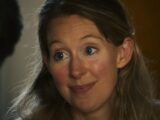
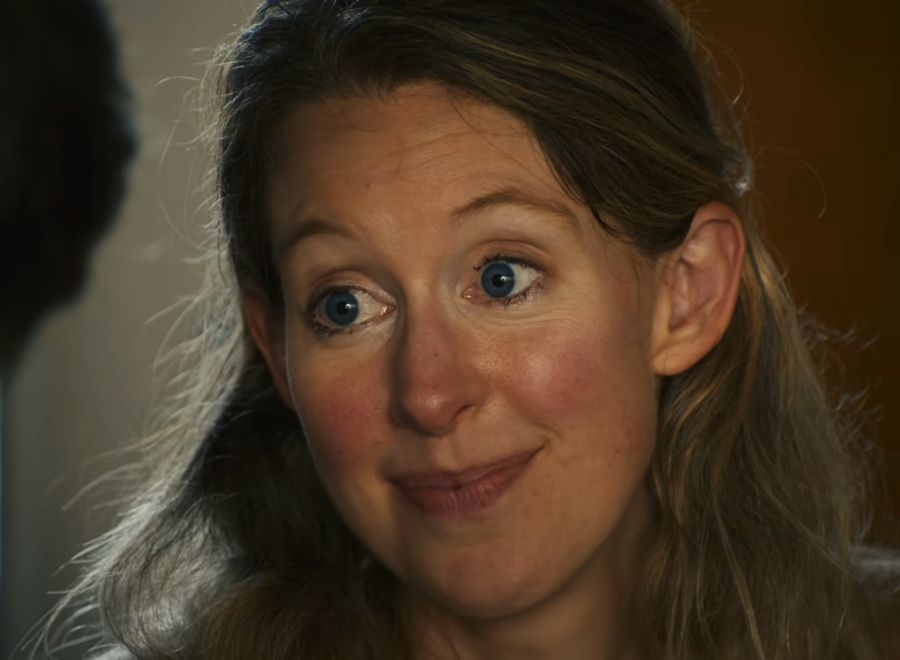
Viewers may be equally perplexed by their own responses after watching Holmes so closely and for so long. More than once does her face fill the screen with a wide-eyed expression of such earnestness and vulnerability, it’s heartbreaking. And it’s never easy to look away.
You Can See Everything is now playing in theatres across Canada.
***
Jason Anderson is a writer and film programmer in Toronto.
Thanks for reading
Independent journalism rooted
in faith and justice is under threat
Broadview is the only media organization in Canada offering thoughtful, values-driven journalism from an inclusive, progressive Christian perspective. But our work depends on your support. If you value what you've just read, please act now.
A gift today helps keep this journalism alive tomorrow.
With gratitude,