

The lights go up, and the stage is set. The audience begins to fill the assembly, and an anticipatory buzz fills the room. Backstage, you adjust your outfit, warm up your voice and rehearse the cues one last time before it’s “show time.” You notice the time and step out onto the front stage, your heart aflutter and the audience looks on with expectancy.
You may think I’m describing a drag queen’s performance. In fact, I’m talking about a Sunday morning for many ministers.
You may unsubscribe from any of our newsletters at any time.
The word performance may unsettle some churchgoers, conjuring images of fakery. But there is a fascinating intersection between ministry and drag that has less to do with pretending and more to do with liberation. At their best, both can become acts of transformation.
This became clear to me as I worked toward a Master of Divinity over the last three years. I grew up poor, queer and undiagnosed with ADHD in the early 1980s, so attending university let alone seminary — for a professional graduate degree — was so far out of my realm of imagination growing up. But after a life lived fully, and at times scratching the bottom of the gas tank while navigating addiction recovery, I encountered unforeseen challenges in learning to navigate this world.
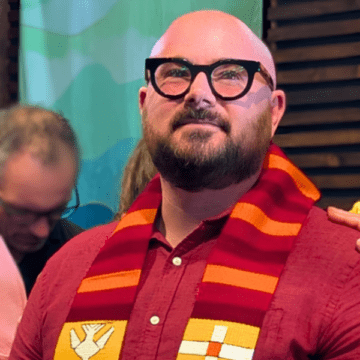
You see, a certain degree of performativity shapes how we all move through society. That said, the church world and — indeed, the seminary world — demanded an intensification of social performance far beyond what I expected. How straight or queer, masculine or feminine presenting we are expected to appear? Do we perform middle-to-upper classness appropriately? Are we masking our neurodivergence to fit within the boundaries of neurotypical worship and learning environments? Many days, I felt like a plate spinner, watching each one with hypervigilance to ensure it kept moving at the expected speed.
So, when I heard professors and speakers say “bring your whole self to ministry,” I would often guffaw, a sound that would echo through a silent room until all eyes turned to me. In fact, many clergy I networked with demonstrated the same tension. Some ministers described talk of vulnerability and authenticity as platitudinous. “They say be yourself, until the self you reveal doesn’t match the expectation.” I recall one minister introducing me to her colleagues with a tight smile and describing me as “rough around the edges” when what she meant was: he acts and talks like a poor person (read, not “like us”).
Surely this was not what was expected of me? To snap in a tab collar and turn down the queer, neuro-spicey, scrappy Scottish working-class background felt like a betrayal of myself. That seems less like ministry and more like performing the hegemony of whiteness. That is fakery, not liberation. That’s not the gospel.
Where does this come from?
More on Broadview:
- How the word ‘homosexuals’ entered the Bible — and the minister who challenged it
- In Winkler, pride finds a place in church
- Why bisexual Christians still feel unseen in affirming congregations
In their book Intersectional Theology: An Introductory Guide, Grace Ji-Sun Kim and Susan M. Shaw examine the church’s supposedly “neutral” model of ministry and how it often reflects the norms of educated, heterosexual, white Western men. If you happen to find yourself at the intersection of queerness, class difference, disability, or racism, the strain is not personal failure but the cost of surviving within a model never designed to hold us.
I would argue that this is also the inheritance of colonialism. Settler-colonial missionaries demanded that Indigenous peoples perform whiteness in order to be recognized as Christian. In this, we see a contorting of the true gospel; a confusion of Christianity with white Protestant norms designed to erase culture, language and relationship to land.
No matter how much dismantling we think we’ve done, that colonial script still lingers quietly shaping whose bodies and expressions are treated as legitimate.
So, when I refer to ministry as Drag, I need to clarify the performance being demanded. This is not about fakery but discerning what is performed for liberation and what is performed as a result of oppression. Drag is one of the most theological phenomena I can think of because it exposes the scripts that shape us (gender, class, race, ability) and uses exaggeration to reveal the truth and dismantle the lie. It does not invent a new self, but magnifies the one already there, crowning the “too-muchness” we were taught to hide.
It speaks truth to power. It is prophetic.
In the very beginning, before the world imposed stigma and shame, the Creator called us not only good, but very good. In Jesus, that blessing becomes liberation — not salvation as abstraction but liberation from whatever keeps people small. Good Friday reveals God’s solidarity with the wounded, not as a demand for redemptive suffering. Easter Sunday declares that shame and erasure do not get the last word. This is a God who calls us out of concealment and into whole-hearted living through the Spirit.
If the Creator of the Universe calls us very good, if Jesus’ ministry liberates publicly and without apology, then Christian ministry cannot be a performance of assimilation. The gospel invites a different narrative. The evangelista, the proclaimer of the gospel, ought to be a liberatory performance of revelation.
Christian ministry at its best does what drag does at its best: it takes something true, turns the volume up and refuses to hide it. It is a joyful, Spirit-soaked revelation of the gospel that sets people free.
***
Christopher Clark McBain is a recent Master of Divinity graduate of Vancouver School of Theology and serves as Lead Pastor of Awaken Church, a 2SLGBTQIA+ affirming Baptist church in Calgary, Alberta — part of the Canadian Association for Baptist Freedoms.
Thanks for reading
Independent journalism rooted
in faith and justice is under threat
Broadview is the only media organization in Canada offering thoughtful, values-driven journalism from an inclusive, progressive Christian perspective. But our work depends on your support. If you value what you've just read, please act now.
A gift today helps keep this journalism alive tomorrow.
With gratitude,







This is a beautiful connection to make, thank you!