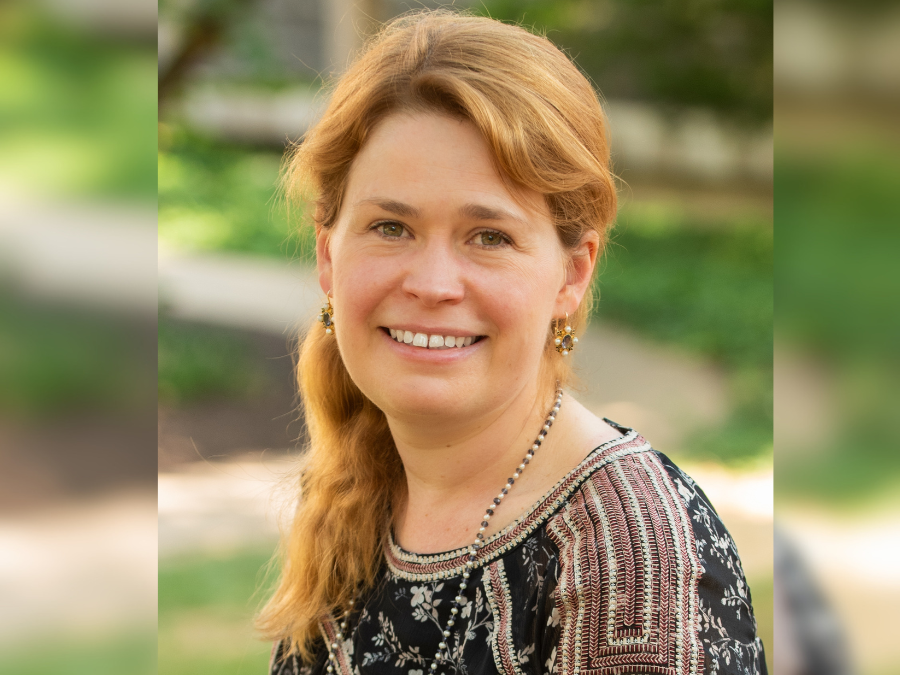
Elizabeth Schrader Polczder didn’t set out to build a career in academia based on textual anomalies in the Gospel of John. In fact, she didn’t set out to be an academic at all; back in 2011, she was simply a musician interested in learning more about Mary Magdalene for an album project.
Her research led her to a digital version of Papyrus 66, a second or third-century manuscript that is the oldest near-complete copy of the Gospel of John — the gospel that features Mary Magdalene most prominently. It was written in Greek, a language that Schrader Polczder couldn’t read, but still, she could see that the copyist had made changes to his own document.
You may unsubscribe from any of our newsletters at any time.
In the story of Lazarus of Bethany, it appeared that initially he had one sister, Maria, but some instances of her name had been altered to say Martha. One sister, it seemed, had become two, which is the version that was added to the canon of the New Testament. The story of Lazarus and his two sisters, Mary and Martha, is the version that appears in Bibles today.
Schrader Polczder decided to follow this thread and try to figure out what might have happened, eventually enrolling in a Master of Arts program at the General Theological Seminary in New York City. Through her studies there, she discovered that it wasn’t just Papyrus 66 that had inconsistencies surrounding Lazarus’ sister(s).
“I found that [approximately] one in five Greek manuscripts had a problem around Martha, so that’s a lot,” says Schrader Polczder. “And one in three of the old [pre-Vulgate] Latin manuscripts also had problems around Martha.”
She submitted an article based on her findings to the Harvard Theological Review, where it was published under the title Was Martha of Bethany Added to the Fourth Gospel in the Second Century? In it, Polczder discussed her work on ancient manuscripts; the possibility that Mary of Bethany was, in fact, Mary Magdalene (which several early church fathers also believed); as well as her novel theory: Martha had been added to the story of Lazarus in order to diminish Mary’s importance.
“I argued that Martha was added to make sure that the Christological Confession, that is the thesis statement of John’s Gospel, does not go to Mary,” says Schrader Polczder. “[Because if Mary Magdalene] confesses Jesus as the Christ, she anoints him, she stands at the cross, she goes to the tomb by herself on Easter morning, and then she gets the first commission to announce the resurrection — oh, that’s a major character, and those are roles that Peter was sort of competing for in the Christian imagination.”
It was a radical idea.
Shortly after her article was published, one of Schrader Polczder’s professors disclosed to her that he had been one of her peer reviewers and encouraged her to send a copy to the committee that oversees the Nestle-Aland Novum Testamentum Graecum.
More on Broadview:
- Unravelling the myth of Mary Magdalene
- The Virgin Mary was a prophet too, some experts say
- Diana Butler Bass’s viral sermon changed the way thousands think about Mary Magdalene
The Nestle-Aland is the preeminent edition of the New Testament in Koine Greek — the Roman-era language in which it was originally written — and, since 1898, has been compiled by comparing various ancient New Testament manuscripts in an effort to get as close to the original as possible. Set to publish its 29th edition later this year, it forms the basis of most modern biblical translations, is on the curriculum in many seminaries and is used to create study Bibles. To have one’s work recognized in the Nestle-Aland is a very, very big deal.
Schrader Polczder was then invited by Holger Strutwolf, the head editor of the Nestle-Aland, to present her work to him and his colleagues at the University of Münster. She did so, and also spoke about supporting evidence that she’d found since publishing her article — including the fact that there are many examples of ancient Christian artwork that depict Lazarus with only one sister. The feedback was highly positive, and in 2025, Strutwolf invited Schrader Polczder to present to the Nestle-Aland committee.
In January 2026, the committee voted to include a footnote about the changes made to Lazarus’ story in Papyrus 66.
“[This] doesn’t affect the main text of your Bible, nor should it, because every copy that we have of John’s Gospel in the world has Martha in it,” says Schrader Polczder. “But the footnotes will show that there are major problems around Martha’s presence, and that means that people who create … the Harper Collins Study Bible, or the Oxford Study Bible, or the New Revised Standard Version of the New Testament [might include that information in future editions].”
Schrader Polczder is aware that her discoveries can be seen as controversial, particularly by people who believe that the Holy Spirit had a hand in shaping the New Testament canon. But she also thinks a similar argument could be applied in the opposite direction.
“You could also say the Holy Spirit has a hand in us discovering these ancient manuscripts that were lost, right?”
***
Anne Thériault is a journalist in Kingston, Ont., and co-host of the Broadview podcast And Also Some Women.
Thanks for reading
Independent journalism rooted
in faith and justice is under threat
Broadview is the only media organization in Canada offering thoughtful, values-driven journalism from an inclusive, progressive Christian perspective. But our work depends on your support. If you value what you've just read, please act now.
A gift today helps keep this journalism alive tomorrow.
With gratitude,