
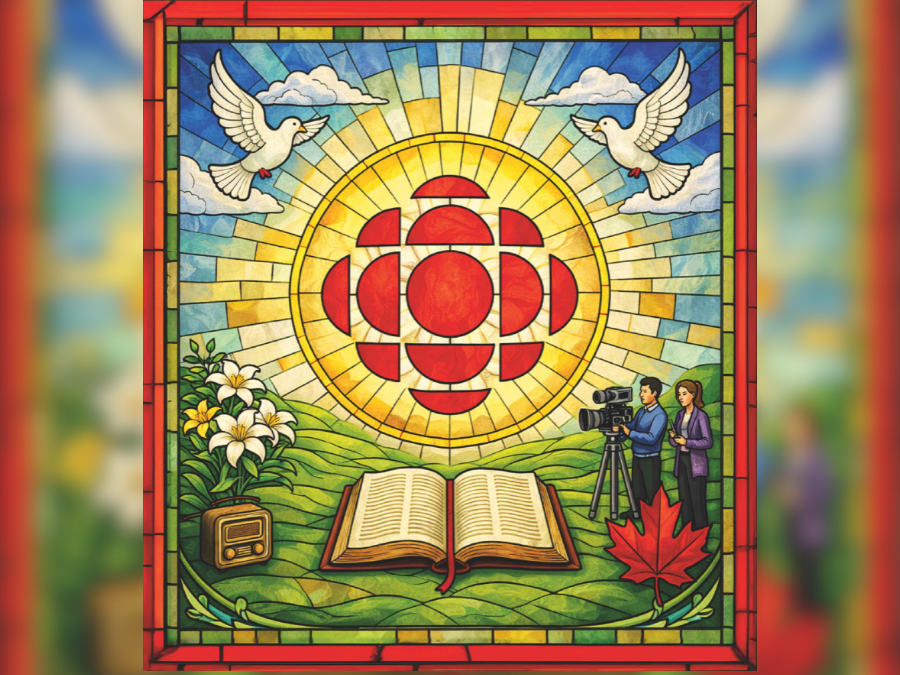
Michael W. Higgins recalls, with some bemusement, the time the CBC sent a radio crew to the wrong event. He and a colleague had organized a symposium on the life, work and legacy of the monk Thomas Merton, which the public broadcaster planned to record for a possible documentary. But on the day of the event, the crew never arrived. A frantic producer for CBC Ideas later called wondering where the scripts were. The reason soon emerged: the crew had completely bungled the assignment, confusing “monasticism” with “monsters” and returning instead with tapes about Sasquatch. With airtime to fill, the corporation turned to Higgins to write — and eventually narrate — a five-part radio series called Thomas Merton: Extraordinary Man.
The mix-up was revealing, suggests Higgins, a longtime CBC documentarian and commentator, now president and vice-chancellor emeritus at St. Jerome’s University in Waterloo, Ont. It hinted at a deeper problem: a public broadcaster that could recognize religion as a category without quite knowing what it was looking at.
You may unsubscribe from any of our newsletters at any time.
That was 1978. The uncertainty, he believes, has only deepened since. While Canadians continue to argue about the CBC — its funding, its mandate, its politics — the national broadcaster has quietly abandoned programming devoted to religion and spirituality. A few exceptions remain: occasional features and a lone freelance contributor covering a faith beat. But they stand out precisely because the wider landscape has thinned so dramatically. What has diminished is the nuanced, contextual work of helping Canadians understand the ideas, traditions and moral vocabularies that shape religious life beyond the news cycle.
Higgins sees this less as a militant secular purge than institutional confusion. “It’s out of ignorance more than malevolence,” he says. Executives sense a gap, he argues, but lack the religious literacy to name it. The disappearance of dedicated spirituality programming — from Man Alive to Tapestry — reflects, in his view, a failure of imagination. “They’re dealing with competing statistics and algorithms, not ideas,” he says. “It’s a tragic misjudgment.”
Religion has always had a complicated place at the CBC. Norm Fennema, who teaches history and Canadian studies at the University of Victoria, argues that the public broadcaster has long worked to contain religion’s more unruly voices, shaping them into something palatable, safe and comfortably mainstream.
Debates over religion on Canadian airwaves predate the CBC itself. Even before the corporation existed, regulators were deciding which preachers could speak, which movements were too controversial and how to balance freedom of expression with fears over national unity.
The CBC was born, in part, as an instrument of containment. In the late 1920s, the Bible Students movement that would evolve into the Jehovah’s Witnesses had begun using radio to spread their message. Their broadcasts alarmed politicians, who feared the new medium could become a megaphone for religious warfare. In 1928, the federal government refused to renew the group’s broadcasting licences, igniting a backlash framed as a test of free expression. “Protest meetings were formed where petitions were signed in favour of freedom of the airwaves,” says Fennema. “Some 458,000 signatures were gathered — an astonishing number for a country whose population was then just shy of 10 million.”
When the Canadian Broadcasting Act of 1936 established the Canadian Broadcasting Corporation, it granted the network sweeping authority “to control the character of any and all programmes broadcast by Corporation or private stations.” Religion appeared only indirectly, tucked into a clause forbidding “abusive comment on any religion, race or creed.” Religious groups were refused their own broadcasting licences, and access to the public network remained tightly controlled.
Religion has always had a complicated place at the CBC.
To manage this tension, the CBC created the National Religious Advisory Council in 1938, drawing largely from Canada’s mainline Protestant churches. A rule limiting representation to groups with more than 500,000 adherents excluded minority faiths — including Jews and evangelical Christians. The council allocated limited “sustaining time” for music, prayers and short addresses designed to emphasize shared Christian truths. “It was about national unity,” says Fennema.
More than two decades later, in 1959, the CBC formalized its religious programming with the creation of the Religious Broadcasts Department — an arrangement that proved to be fragile. By 1962, CBC Montreal had cut its Sunday morning services, prompting protests from more than 100 Protestant congregations — to no avail. Five years later, an internal review called for a new direction away from conventional worship and toward programming that explored “the varieties of religious experience, culture, commitment and ferment in Canada and beyond.” Commentary formats gradually replaced traditional services.
Then came Man Alive. Launched in the late 1960s, it became the CBC’s most popular religious TV program — except it wasn’t actually religious. In a 1978 interview for Maclean’s, the show’s host, Roy Bonisteel, defined religion as “a faith in oneself, in one’s fellow man, a feeling in general that people want to do what is right, what is fair, what is honest, what is good.” The category had been retained, but the content had transmuted.
A memorable episode opens not in a church, but on a river. It is 1973. Bonisteel sits low in a crimson canoe with one of his children; naturalist Wayne McLaren paddles nearby. The water is calm, the conversation unhurried. At one point, Bonisteel invokes Wordsworth — “a sense sublime / Of something far more deeply interfused.” And McLaren recalls a Jesuit priest’s insight: nomadic Indigenous Peoples needed no church building — “the sky was every bit as good as the vault of the church.” The moment captures the program’s spirit, treating religion as an attentiveness to mystery, nature and ethical responsibility.
Half a century later, the sensibility feels familiar — a template for what would later be called “spiritual but not religious.” The church isn’t rejected so much as bypassed. The sacred has migrated from sanctuary to shoreline, from creed to consciousness.
Behind the scenes, the vision was shaped by Rev. Brian Freeland, an Anglican priest who supervised CBC religious programming while serving at St. Thomas’s Anglican Church in Toronto. He helped create what he later coined “CBC Religion,” meant to be secular, balanced and politically correct.
Freeland, who died in 2022, had presided over the Religious Broadcasts Department only to survive its demolition in 1971, the same year Statistics Canada began recording a rise in Canadians claiming no religious affiliation. Yet the programming style that the bureau was created to oversee outlived it.
Man Alive became its visible expression — a religious show that didn’t need to mention God. Bonisteel, who died in 2013, put it simply: a religious broadcast is “any program that makes a person aware that he is responsible to his fellow man.”
The show deliberately positioned itself against American evangelical televangelism. “They want a clear-cut, simplified, ‘telling me what to do so I can accept God and carry him around in my hip pocket,’” Bonisteel said. “We don’t do that.…We put doubts in your mind, and we don’t give you pat answers.”
Freeland also produced more conventional programming with the same pragmatism. Asking what religious people normally did, he arrived at two answers: they liked to worship — thus Meeting Place (1973-1997), a weekly television broadcast of services across denominations; and they liked to sing — hence Hymn Sing (1965-1995), a half-hour of choral music. Even these emphasized shared experience over doctrine.
Meanwhile, CBC Radio revealed the same secularizing pull. By the 1970s, the once-flagship religious program Concern had become a patchwork of documentary-style features. The Press Review observed that “God has been dropped from the program,” replaced with a “gab-bag” of topics including jogging and eating — the latter serving as the Christmas special.
Taken together, these programs reveal the character of CBC religion in that era. Faith was recast as humanistic inquiry. Religion remained present on the airwaves, but in a moderated, watered-down form that was broadly civic in tone. Not all Canadians stayed tuned.
As early as the 1970s, U.S. evangelical broadcasters were booming in Canadian homes. “Much of the religious programming done here is out-and-out dull,” confessed former CBC executive Harry Boyle in 1975, observing that American evangelical content flourished in the void.
Pressure from evangelicals to open the airwaves only grew. In 1981, the Canadian Radio-television and Telecommunications Commission (CRTC), established under the Broadcasting Act of 1968, held hearings on such requests. The commission maintained that conventional radio, television and cable channels couldn’t be owned by single-faith groups.
Populist pushback persisted. Beginning in the early 1980s, “guerrilla” broadcasters in the West illegally rebroadcast American fare like the Trinity Broadcasting Network — home of Paul Crouch and other televangelists.
More on Broadview:
- How HBO’s The Pitt portrays faith in a non-preachy way
- Russel Brand, Andrew Tate and the performance of faith
- Christianity isn’t just in decline — it’s become obsolete, says sociologist
The conflict culminated in the high-profile Miracle Channel case, as an Albertan Christian broadcaster fought the CRTC over its religious broadcasting restrictions. By the early 1990s, public pressure and challenges under the Canadian Charter of Rights and Freedoms forced the CRTC to carve out a limited space for single-faith broadcasters, provided they offered alternative viewpoints.
The regulator mandated balance “on each individual licensee, which is impossible in religion — because religion is inherently imbalanced,” says Fennema. “You can’t say, ‘Jesus Christ is your Saviour and Lord’ and then say, ‘Stay tuned for Muslim hour,’ which is how the CRTC wanted to play it.”
Today the landscape has shifted again. Traditional broadcasting has largely given way to narrowcasting and streaming, Fennema notes, yet religious broadcasters are still required to reflect diverse perspectives. The approach represents a uniquely Canadian compromise — natural to many Canadians, but to others a sign their traditions have been softened or marginalized.
In 2023, Tapestry — the CBC’s last remaining show dedicated to religion, offering in-depth interviews on faith, doubt and the search for meaning — came to an end. Its penultimate episode, a tribute broadcast, quickly turned emotional. Listeners phoned in from across the country, voices sometimes breaking as they described not merely a radio program, but a presence in their lives. One man from Calgary, who was facing health problems and grieving the loss of several friends, said that for people like him, “who don’t have a church and don’t have a community,” Tapestry had been “a very warm place.” Others described a refuge, a companion, an inspiration. Despite calls to replace the show, nothing has emerged to fill the gap.
But why does it matter whether religion and spirituality are given space on the airwaves at all?
For John Longhurst, the CBC’s national freelance religion contributor and a Winnipeg-based journalist — who is careful to note that he speaks only for himself, not the corporation — the answer is straightforward. The CBC’s mission, he observes, is to “accurately reflect the range of experiences and points of view of all citizens.” By that measure, the numbers tell a story the CBC has yet to fully absorb. According to Statistics Canada, millions of Canadians — 54 percent — say religion or spirituality is important to them. They pray, meditate, walk the labyrinth, attend a church or mosque or gurdwara. “They probably don’t see that reflected in the national broadcaster,” he says.
Longhurst has spent decades reporting on faith communities, first as a columnist and then reporter at the Winnipeg Free Press and, more recently, through radio commentary that began airing on CBC Manitoba in February 2025. Last August, CBC Radio invited him to test the work with a national audience. After a successful three-month run, they asked him to continue informally on a regular once-a-month schedule. The initiative suggests an openness to expanding religion coverage, but it remains provisional rather than a sustained national commitment.
CBC editor-in-chief Brodie Fenlon declined an interview with Broadview but provided a written statement. The broadcaster, he said, still covers religion within the rhythms of the news cycle. Stories about the death of a pope, rising antisemitism or Quebec’s secularism laws regularly bring religious questions into coverage, while programs like The Current occasionally go deeper.
“We sometimes hear from people who feel the mainstream media, including the CBC, don’t cover their faith communities well enough or only when something bad has happened,” Fenlon wrote. “Sometimes religion as a topic is overshadowed as a priority by a news cycle that has been rather unprecedented over the last six years through COVID-19, Donald Trump, wildfires, climate change, wars in Ukraine, the Middle East, Sudan and more.”
From its earliest days, religion was never simply aired. It was managed.
He adds that the broadcaster’s new strategic plan identifies “non-users and dissatisfied users” as audiences it hopes to reach, with religion offering “lots of opportunity.” Fenlon frames the issue largely as a market problem, but for Longhurst and Higgins, it’s a matter of mandate — obligation, not opportunity. Where the corporation sees a demographic it might attract, its freelance contributors appear to see citizens it has a responsibility to reflect. Asked what the broadcaster might do next, Higgins imagines something simple: a format built around listening where people across the spectrum of belief and doubt explore life’s largest questions without adversarial tone.
The history of religious broadcasting at the CBC suggests how difficult that task may be. From its earliest days, religion was never just aired; it was managed. But religion rarely co-operates with that impulse. At its most vital, faith is controversial, disruptive and often uncomfortable, raising questions about authority, morality and the meaning of communal life. When those tensions are pushed outside mainstream institutions, they don’t disappear; they move elsewhere.
Maybe the question, then, isn’t whether the CBC should revive its religious programming, but whether it’s willing to attempt something harder: making room for far-reaching conversations about belief, doubt and moral life that don’t resolve neatly into consensus.
***
Julie McGonegal is a journalist in Elora, Ont.
This article first appeared in Broadview’s July/August 2026 issue with the title “Tuned Out.”
Thanks for reading
Independent journalism rooted
in faith and justice is under threat
Broadview is the only media organization in Canada offering thoughtful, values-driven journalism from an inclusive, progressive Christian perspective. But our work depends on your support. If you value what you've just read, please act now.
A gift today helps keep this journalism alive tomorrow.
With gratitude,








Thank you for Julie McGonegal’s illuminating and well-researched article, “What happened to religion on the CBC?” (July 9, 2026). The CBC is doing a disservice in failing to recognize that the Canadian people are fully capable of thinking beyond the confines of both rigid fundamentalism and puritanical secularism.
Is the goal of CBC is to reflect all of Canadians and all of who they are, we need to recognize the importance of not only body and mind but also our spirit/soul. I miss the soul/spirit of who we are. It is foundational to our values and our relationship with each other. It is interesting that in Ukraine, when the war broke out the churches were expanding? Why? Something to think about.