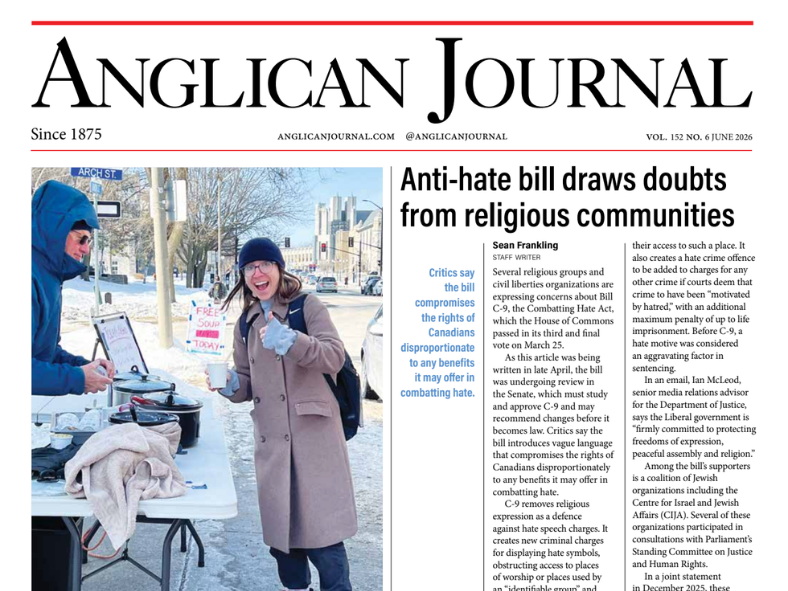
Following decades of tension between the Anglican Church’s national leadership and the editorial staff of the Anglican Journal over how much “journalistic independence” should be permitted in the church newspaper, the Council of General Synod has made a decision. The 151-year-old paper will no longer publish journalism, but will ensure that writing in the Journal “unequivocally supports the mission of the church.”
At a June 12 meeting of the Council of the General Synod (CoGS), the Anglican Church’s executive body that carries out the work of the General Synod between meetings, the group of about 30 people voted unanimously to make the Anglican Journal “the voice of the Anglican Church of Canada and part of its larger communications strategy rather than a separate journalistic enterprise.”
You may unsubscribe from any of our newsletters at any time.
According to the Anglican Church’s official meeting highlights, the intent is “to ensure that the Journal, like all tools that Anglicans are paying for, unequivocally supports the mission of the church and is accountable to CoGs, General Synod and leadership at Church House.”
The meeting summary also notes that in his presentation, Jamie Tomlinson, a member of the committee developing a new mandate and strategy for the national church’s communications, said that the Journal’s new role would “ensure strategic alignment, effective risk management and responsible stewardship.”
The changes to the Anglican Church’s communications are part of a broader plan to reshape the denomination’s structure and operations in the face of declining membership and funding.
The Anglican Journal itself has yet to report on the change, and the Anglican Church did not respond to requests for comment by Broadview’s deadline.
Current Journal editor Tali Folkins has been on a leave of absence since late 2025 and was not present for the CoGS vote. Director of Communications Henrieta Paukov assumed the role of Journal editor earlier this year in Folkins’ absence.
According to the June 12 meeting summary, CoGS members asked how moving away from journalistic integrity would affect accountability and transparency. Paukov is paraphrased as having affirmed the importance of both, but noted that embedding a journalistic function in an organization is not a recognized best practice in the corporate or non-profit sectors. Tomlinson is paraphrased as adding that it is no longer possible to sustain the tension between corporate communications and independent journalism, a situation he said came with potential institutional risks that could not be effectively managed.
It is unclear whether the Council of General Synod has final authority on this vote or whether it has to go to General Synod, the larger body of the church, which next meets in 2028.
The Anglican Journal — first published under the name Dominion Churchman in 1875 — is a free print and digital newspaper, published 10 times a year. In its most recent iteration, it offered news, opinions and features about the Anglican church and religion in Canada more broadly.
As recently as last year, the Journal’s role was described in an appendix to the Canons of the General Synod as “fact-based, fact-checked and in-depth, tackling important issues, asking and answering difficult questions.” There is no reference to the word “independence,” but the document states the Journal “is committed to representing the widest possible diversity of information and opinion across the Anglican Church of Canada. It promotes informed engagement by Anglicans in the life of their church, and nurtures healthy self-reflection, respectful dialogue and constructive debate.”
The appendix also makes clear the General Synod is the Journal’s publisher and the editor reports to the Executive Director of Communications, while also receiving advice and input from a communications committee.
More on Broadview:
- An aging congregation bets its future on the next generation
- Michael Blair announces fall retirement as United Church general secretary
- I found my way back to the Anglican Church, imperfections and all
Since 2008, the Journal has had eight editors, a higher than average turnover for Canadian Christian media editors.
Kristin Jenkins, Journal editor from 2009-2012, said “the whole time I was at the Journal I had to fight for its very existence. I was always told that it was on the chopping block.…and the Journal might be closed.” Jenkins said. “Honestly, that was why I left. I thought my job was going to go any day. I was given the impression that the whole thing could be shut down at any time.”
On the transition from journalism to corporate communications, Jenkins said: “It’s too bad for people in the pews because I think those are the people that I really wanted to reach out to or take them into the conversation with The Journal…I had never received so much positive feedback as I did from the readers of the Anglican Journal.”
Matthew Townsend was Journal editor from 2019 to 2021. He left following a public dispute with the Anglican Church over the treatment of sources on a piece covering sexual violence in the church. Hearing the CoGS reasons for removing journalism from the Journal, Townsend said he took issue with the notion that doing so constituted “effective risk management.”
“One of the questions I come back to a lot is how is danger managed? How is risk managed? And for me, transparency is very key to that.” Townsend cites the work of American journalist Upton Sinclair, who wrote in the early 20th century about workplace safety, inspiring changes to the law.
“The more transparent any kind of community organization can be about its strengths and its weaknesses, the more likely it is to prevent danger, to prevent harm, and to manage those dangers effectively,” Townsend adds. “Truth-telling is a very key part of risk management and if you’re reducing the amount of truth-telling in the system, you may see an increase in abuse: abuses of power, abuses of people, abuses of trust.”
Jenkins recalls that financial pressures were a constant concern throughout her tenure. Today, the Anglican Journal reportedly operates with an annual deficit of approximately $500,000. It is unclear how changing the Journal’s mandate will reduce the deficit.
With the change of strategy, the Journal will almost certainly lose access to one major grant supporting its work — annual funding from Aid to Publishers, a component of the Canada Periodical Fund, managed by the Department of Canadian Heritage. The fund supports print magazines, print community newspapers and digital periodicals in Canada.
In the 2025-26 funding cycle, the Journal received $157,099. A condition of that funding is that publications must “maintain an editorial function with an appointed editor.” Ineligible publications include those that are “mainly produced to report on the activities or promote the interests of an organization.”
The Journal also functioned as a delivery mechanism for local diocesan newsletters and papers, which were inserted into the larger paper to save on postage. It is unclear how changes to the Journal will impact the delivery of diocesan communications.
Townsend worries that for a denomination already in decline, this may be just one more step toward its demise. Journalism and truth-telling provide “a load-bearing function within a community,” he says. “When you remove it, you’re left to just take everyone for their word, and maybe that’s not how we should operate. Maybe we can’t actually be a community without that truth-telling.”
***
James Adair is an intern at Broadview.
Thanks for reading
Independent journalism rooted
in faith and justice is under threat
Broadview is the only media organization in Canada offering thoughtful, values-driven journalism from an inclusive, progressive Christian perspective. But our work depends on your support. If you value what you've just read, please act now.
A gift today helps keep this journalism alive tomorrow.
With gratitude,