
Bill C-9, formally titled the Combatting Hate Act, passed on June 4. As Broadview reported in December 2025 the bill “aims to better protect communities from hate-motivated conduct and improve public safety, including for faith groups. It would criminalize intimidation or blocking access to schools, places of worship and other community spaces; ban the public display of certain hate and terrorism symbols; and streamline the process for laying hate-propaganda charges.”
But critics, including The United Church of Canada, Canadian Labour Congress, Independent Jewish Voices, the Canadian Muslim Public Affairs Council, and others argue the bill could criminalize peaceful protest, chill free speech and hinder religious expression.
You may unsubscribe from any of our newsletters at any time.
“It is Canada’s most significant attempt in a generation to restrict protest and silence dissent,” read a joint statement released in December. “It protects institutions from accountability, expands punitive policing, and criminalizes the democratic expression of communities across Canada.”
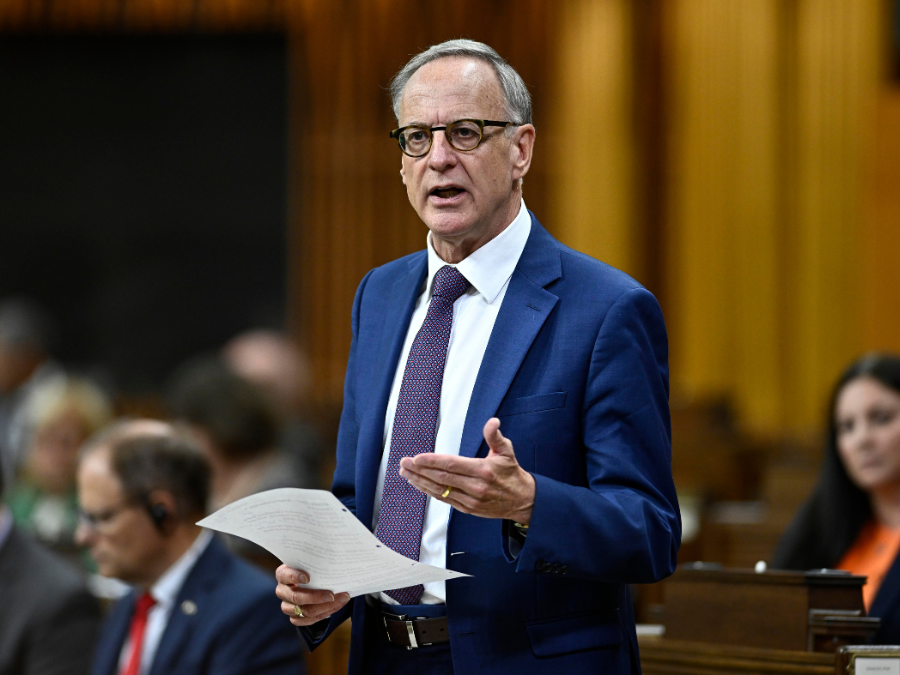
Rev. Rob Oliphant, the Liberal MP for Don Valley West in Toronto, a United Church minister and a longtime advocate for 2SLGBTQ+ inclusion, disagrees. Broadview journalist James Adair spoke with him earlier this month, three days before the bill passed, about his perspective on Bill C-9.
James Adair: Could you explain how you view the bill and its place in the current Canadian political context?
Rob Oliphant: The bill is attempting to do a major revision of how we address hatred and intimidation based on the various grounds protected under human rights law – particularly religion, ethnicity, sexual orientation and other characteristics that make people targets of hate.
The history of the United Church is one where antisemitism has, at times, been profound. I can remember occasions at General Council — when I was a commissioner — where I felt I had to stand up for Jewish people because others were not doing so.
That’s why I think the United Church should be supporting this bill. As a church and as a faith community, we should be standing against hatred. I have not been satisfied with the United Church’s position on this issue because I don’t think it was the appropriate position.
We have rising hate crimes across this country. A place of worship in my riding, Temple Emanu-El, had 20 bullets shot through its windows. That does not happen at United Churches. Jewish people are consistently among the most targeted groups in hate crime statistics. Rarely are Christians the victims of hate crimes in the same way.
When that is the reality, I would hope my church — The United Church of Canada — would support Bill C-9 as an appropriate measure to help safeguard people and ensure that we actually name hate crimes for what they are.
In fact, I have an even stronger position. During a debate in the House of Commons, some Conservatives were waving their Bibles and suggesting that this legislation was a threat. I don’t think they understand the ways Scripture can be used to promote hatred.
As someone who has personally faced discrimination and hatred because of my religion and because of who I am, I think this bill is important.
JA: Civil society groups that opposed the bill argue that it could prevent religious institutions from facing protesters. One example that was raised was a church making antisemitic statements or denying the history of residential schools. Critics — including the United Church — argue that the legislation could restrict protests directed at those churches. What is your perspective on that concern?
RO: Two things happened during the legislative process.
The bill was originally written in a certain way. Then the Bloc Québécois introduced an amendment that removed what some people called the “religious shield.” We agreed with that amendment because we don’t think religious communities should be exempt from laws against promoting hate.
At the same time, we added a clarification clause. The wording essentially states that the existing protections for religious freedom contained in our constitutional framework continue to apply.
The Bloc’s amendment removed the existing religious defence attached to the criminal offences, but we then added a “for greater certainty” clause. The purpose was to make clear that offences relating to the wilful promotion of hatred do not criminalize legitimate religious declarations, sermons, teachings or good-faith discussion of Scripture. Freedom of religion remains protected under the Charter.
So there is a balancing act. We’re not creating a blanket exemption for religious institutions, but existing protections for religious freedom continue to exist.
Generally speaking, though, I think the United Church should push governments even harder to ensure that no faith community can promote hatred under the guise of religion.
This is a very personal issue for me. I still need protection from that kind of rhetoric. Human rights can be chipped away through changing attitudes, conversations and people using scripture — whether the Bible in my case or other sacred texts — as either a shield or a sword.
I’ve experienced both.
JA: But criminalizing hate speech doesn’t necessarily address where hate comes from in the first place. Can you speak to the broader efforts governments are making to address those roots, rather than simply prosecuting someone who crosses a legal line?
RO: Many years ago, when I was minister at Whitehorse United Church, I served as a member — and eventually chair — of the Yukon Human Rights Commission.
What you realize, again and again, is that many people hold attitudes that are harmful without actually breaking the law. They’re not denying services. They’re not necessarily violating legislation. But they regularly diminish other people.
More on Broadview:
- Canadian faith and civil-liberties leaders push back against Bill C-9
- Why Quebec’s prayer ban under Bill 9 worries me
- Mark Carney’s antisemitism announcement sparks mixed reactions from Jewish Canadians
That’s where education, conversation and dialogue become important. It’s also important to say clearly that those attitudes are not acceptable. Where hatred comes from is still something that eludes me. I don’t fully understand it.
I think we have seen the diminishment of mainline denominations, like the United Church, for example, which was a significant force in our country. I think we’ve lost a force that promoted generosity, inclusion and love. That’s what churches should be doing.
Legislation has a role to play. Take same-sex marriage. The law created a legal framework. People could get married or not get married.
But after the law changed, attitudes began to change too. I was walking down the street years ago and a gay couple was holding hands. And this small kid said something homophobic, and the mother turned to her kid and said, “They can get married now so it’s not okay to say that.”
There is a role for law.
At the same time, you need education, engagement, dialogue and opportunities for people to meet one another. That’s how attitudes actually change.
JA: What do you think the church is getting wrong about Bill C-9?
RO: I can’t speak for the United Church officially, but I think part of it is a knee-jerk reaction to anything they believe could hinder free speech or religious freedom.
I think they’re missing the point.
The purpose of this legislation is essentially to establish guardrails. Your freedoms extend until they begin to infringe on another person’s freedoms or rights. That’s where the line is. There are necessary limits on our freedoms because we live in community with other people.
People are absolutely free to say what they want to say. They can hold whatever attitudes they want to hold. But when those attitudes become the promotion of hatred against another person or group, then you have to stop.
I think the government has a responsibility to ensure that minority faith communities, particularly those that are increasingly targeted, can worship safely and attend their places of worship without fear.
JA: Have you heard any criticisms that you think are valid or that give you pause?
RO: I would say that we always need to keep authorities in check.
One aspect of Bill C-9 gives police additional authority and removes some of the existing requirements involving the Attorney General in relation to hate propaganda charges.
I think safeguards are important and should remain in place.
We need to ensure that throughout the administration of justice there are checks and balances at every stage. We need police to be empowered to act when necessary, but we also need accountability and oversight.
I do worry about whether we’ve fully achieved that balance.
That concern becomes particularly important when we’re talking about peaceful protest.
At the same time, I had a peaceful protest directed at me last summer. The police didn’t seem to have the authority — or perhaps the willingness — to intervene, and that left me concerned.
People shouldn’t physically touch others. They shouldn’t crowd them, block their movement, hover over them or put a megaphone directly in someone’s face or ear. There needs to be some ability to stop that kind of behaviour because, frankly, I was afraid.
So for me, the answer is checks and balances. We need the ability to respond to genuine threats and intimidation, but we also need safeguards to prevent abuses of authority.
***
James Adair is an intern at Broadview.
This interview has been edited for length and clarity.
Thanks for reading
Independent journalism rooted
in faith and justice is under threat
Broadview is the only media organization in Canada offering thoughtful, values-driven journalism from an inclusive, progressive Christian perspective. But our work depends on your support. If you value what you've just read, please act now.
A gift today helps keep this journalism alive tomorrow.
With gratitude,









“…push governments even harder to ensure that no faith community can promote hatred under the guise of religion.” Define hate, this is the real issue. “any advocacy of national, racial or religious hatred that constitutes incitement to discrimination, hostility or violence.”(ICCPR) If you tell me “God loves you”, depending on the day I’m having, I could misconstrue your intentions because there is no “God”.
Today’s culture relies on feelings, not truth. Can I now press charges if someone tells me I’m a white, heterosexual, privileged male?
I understand, people can get pretty nasty, but please, what are the consequences if we cross that line which is not definitive.
2 years imprisonment?
Rob Oliphant is a thoughtful Parliamentarian and church member. His comments about the need to balance rights and accountability are well-taken. This is always the messy work of government, and it should be messy work for the church too. Easy statements — as he describes them, “knee-jerk” defences of free speech — are not helpful. In the United States, free speech is regarded as an absolute. In Canada it is viewed as one good that needs to be balanced in relation to others. Our understanding is superior, in my view. Oliphant has it right.
I think the definition of hate that applies here has to do with encouraging others to attack someone verbally and/or physically because of who they are (gay, black, Jewish, or even “white, heterosexual, privileged male”. So if someone labels you AND encourages others to attack you, that would be a hate crime.
This might be an opportune time for progressive churches to prune its scriptures of hateful passages.
Excellen interview with Rob Oliphant on C-9.