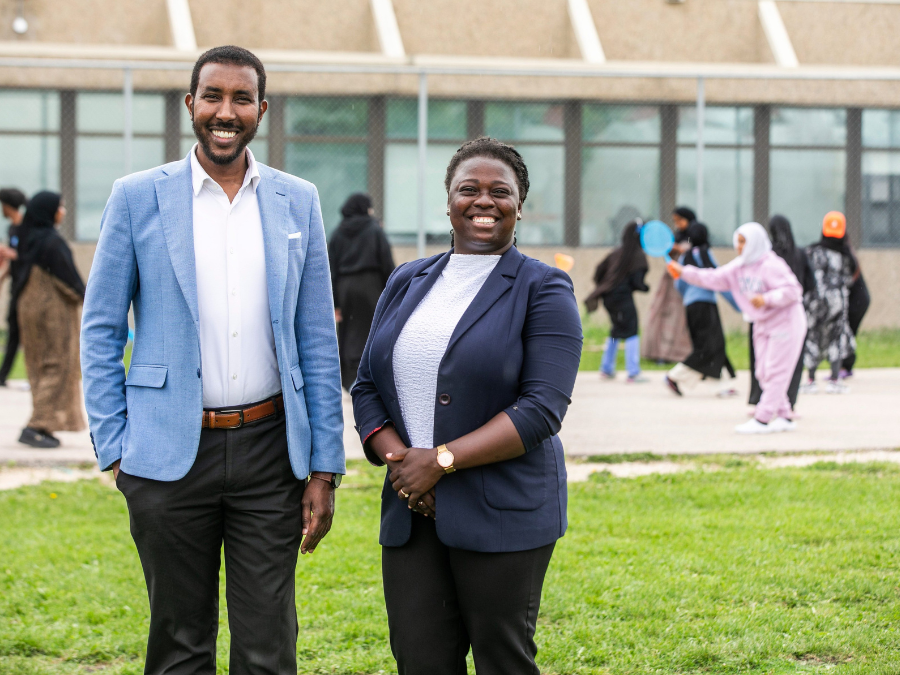
The Masjid Bilal is a chunky grey building just off Logan Avenue surrounded by warehouses and railyards. It looks more like a bunker than a mosque.
But on a Friday afternoon in late June, its green-and-white carpeted interior is humming with activity. Two men in white robes and flat woolen caps are seated on the carpet poring over a copy of the Qur’an. A few young boys dodge through hallways, poking curious noses into open doors. At the back, next to a table piled with prayer mats, two girls in hijabs share schoolyard chatter. In the kitchen, women are cooking up pots of rice and chicken for people who will soon arrive for Friday prayers.
You may unsubscribe from any of our newsletters at any time.
The Masjid Bilal is a community hub for members of Winnipeg’s African diaspora as well as Muslims from many other countries.
It’s also home to the Bilal Community and Family Centre, an innovative, community-centred nonprofit that is meeting vital needs for newcomers in this city.
Francis, who prays regularly at the mosque, fled his native Chad two years ago because of threats to his safety. He made his way to Minnesota, then crossed the border into Manitoba by night, stumbling over muddy fields to claim asylum in Canada. (Francis asked to use a pseudonym for this story because he doesn’t want his family in Chad to read online about what happened to him.)
Francis soon found himself living alone in Winnipeg, isolated and struggling with depression. His wife in Chad, unaware that he was barely making ends meet, cut off contact with him because he wasn’t sending enough money home. Francis turned to alcohol and, one night, in a desperate state, stole a bottle of whiskey from a liquor store.
When police showed up at his door, Francis was mortified. He tried to explain to the officers that this was not who he was. Francis was given a court date. The judge chastised him for behaving so irresponsibly, for failing to think of his children and for putting his asylum claim at risk.
“I’ve never done this in my life,” Francis said. “Right now, I’m not even sleeping, I’m too stressed.”
The judge asked Francis if he was religious. When Francis said he was Muslim, the judge referred him to the Bilal Community and Family Centre’s restorative justice program. If Francis completed the program, the judge said, he wouldn’t have a criminal record.
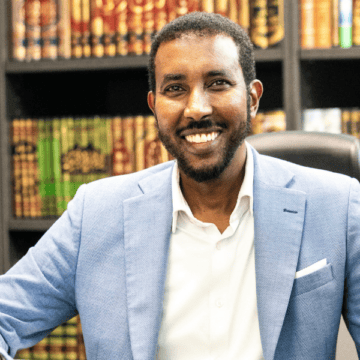
The restorative justice program is the brainchild of Muhaidin Omar, a lanky, gregarious man who dresses in crisp blazers, laughs often and speaks with an earnest intensity.
Omar is one of the imams at Masjid Bilal and executive director of the Bilal Community and Family Centre. He was born in Somalia, the son of a religious scholar, but left home at age 12 to get an education. He graduated with academic distinction from Al-Azhar University in Egypt with degrees in education and Islamic studies.
Omar came to Winnipeg with plans to learn English. He soon found himself leading prayers and teaching weekend classes at the Manitoba Islamic Centre. As a part-time imam, he often mediated conflicts or counselled families in crisis. Eager to sharpen his skills, Omar enrolled in a social work degree at the University of Manitoba.
“I realized that I was already doing social work,” he said.
Omar founded the Bilal Community and Family Centre in 2017 in response to needs he saw in the newcomer community in Winnipeg. The centre currently runs about eight programs that provide newcomers with mentoring, tutoring, mental-health support, language classes, resettlement support, youth soccer games, summer activities for children and a restorative justice program. About 3,000 people avail themselves of the centre’s programming every year.
The centre has nine full-time staff, including a mental-health clinician, and more than 20 part-time staff. About half of the employees are Muslim, some are Christian, and a few aren’t religious. Staff speak Amharic, Tigrinya, French, Swahili, Kinyarwanda, Somali, Turkish and several dialects of Arabic.
“We hire a lot of people from different cultures and faiths,” Omar said. “We try to create a space where people feel safe, psychologically and interpersonally, to make mistakes, to ask questions, to express their own ideas.”
Omar’s office is lined with books. Volumes in Arabic on Islamic jurisprudence stand shoulder-to-shoulder with English books on leadership, counselling and organizational culture.
“Islamic teachings teach you to listen to people. And social work teaches you to listen,” he said. “When you blend those two fields, one provides a spiritual framework, the other one provides the theoretical framework and the technical skills to provide actual counselling. I think they go together very well.”
“Muhaidin is amazing. He’s very open,” said programs director Felicia Masenu, who wrote her doctoral thesis on non-governmental organization practices. She’s not Muslim herself, but feels at home in the organization, thanks to Omar’s efforts to foster intercultural understanding.
The idea of a restorative justice program came to Omar a few years ago. He was hearing from families worried about their children getting into trouble with the law. He also noticed a disproportionate number of newcomer youth in the justice system.
“When people come to a new country, they have no idea what supports and services are available for them to integrate into the system. That’s when they get recruited by problematic groups,” Masenu said.
Anteneh Abraha, a caseworker in the restorative justice program, points out that many refugees have been treated brutally by police in their countries of origin. “When they end up in the justice system, there is a whole lot of trauma.”
Omar submitted a proposal for a restorative justice program to the federal government in 2020. He received a one-year grant that allowed him to build the program and train staff and volunteers.
The centre is now recognized by Manitoba’s Restorative Justice branch as one of its community justice committees. Newcomer youth or adults charged with minor offences can be referred to the program by probation officers, prosecutors, police or the courts.
Abraha and a team assess each referral to see if they have the resources to take it on.
“We have to do this very diligently and carefully because these are people’s lives,” he said.
When the team accepts a case, they meet with the individual and together draw up a plan for how the person can repair the harm they’ve done, address the issues that led to the incident and be reintegrated back into their community.
Each plan is unique, Abraha said. Plans can involve the offender meeting with the person they’ve harmed to hear their story, doing community service, providing financial restitution, taking anger management classes or receiving addictions treatment or counselling.
Francis performed community service hours at the Masjid Bilal shovelling snow, cleaning carpets and scrubbing bathrooms. He also enrolled in an addictions program and received mental-health support.
Francis says the work helped calm the chaos in his head. “I came home tired, I ate, I slept. It really helped give me relief.”
Abraha also helped Francis sort out problems with his housing payments and get a work permit so he could apply for jobs. Now he’s helping Francis find an immigration lawyer.
Restorative justice differs from the traditional justice system because it allows the offender to take responsibility for the harm they’ve done and come up with a restoration process that matches the crime. The centre’s program was modelled after other restorative justice initiatives in Manitoba, but it is uniquely tailored to the experiences of immigrants and refugees.
“Every client that comes to us has three questions in mind,” Omar said. “Do you care about me? Can I trust you? Can you help me?” Building trust often involves speaking the client’s language, he said.
More on Broadview:
- How restorative justice can heal communities
- What is restorative justice? On this First Nation, a tool to keep youth out of court
- Can restorative justice end bullying? These schools are giving it a try.
The program also includes the option of spiritual care. Clients can ask to be connected with an imam, priest, pastor or elder, depending on their faith. Including spiritual care in the program was important to Omar.
“There is a lot of internal guilt,” he said. “[We want to] help them navigate through that so they know it’s not the end of the world. You can write your own chapter.”
After Francis completed the requirements of his program, Abraha sent a report to the courts and Francis’s charges were dropped. Francis still comes to the Masjid Bilal every Friday for prayers. “I’ve become part of their family,” he said.
Thirty clients have completed the restorative justice program since it started five years ago.
The program is run on volunteer hours. It receives no operating funding aside from $1,200 per year from the Manitoba Restorative Justice branch that covers costs such as printing and stamps. Abraha and other staff manage cases alongside their full-time responsibilities with other programs at the centre.
The program could accept more clients if they had more funding, Omar said. He likes to list the ways the program benefits both individuals and society at large: “One, we are saving the lives of those individuals. Two, they are contributing back to the community; they will be taxpayers tomorrow. Three, the community is safer, we’re combating crime. Four, we are saving public money. And, five, we are bringing communities and families together.”
Earlier this year, the centre hosted a series of events that brought together faith leaders from different traditions — Christian, Muslim, Jewish, Sikh and Indigenous — to talk about rising hate crimes and discuss solutions. In one session, police officers came to the mosque to talk about what kinds of acts are considered hate crimes and how to report them. Omar is planning another interfaith conference on combating hate through community dialogue in October.
The centre has outgrown its space at the Masjid Bilal and is in the process of moving some of its offices to a new location on St. James Street. But much of the programming continues to operate out of the mosque.
These days the building is raucous with the voices of about a hundred children taking part in summer programming. Twenty-five community youth have been hired to run the programs. For many of them, this is their first job, Masenu pointed out, a stepping stone to further employment.
“We’re in a mosque, but we offer services to a lot of people who are not Muslim or not African,” she said. “As long as you’re a newcomer or refugee, it doesn’t matter where you come from — our doors are open to everyone.”
***
Josiah Neufeld is a writer in Winnipeg and the author of “The Temple at the End of the Universe.”
This story was produced in conjunction with Winnipeg Free Press, as part of a joint Religion in the News partnership covering issues of faith in Manitoba and nationally.
Thanks for reading
Independent journalism rooted
in faith and justice is under threat
Broadview is the only media organization in Canada offering thoughtful, values-driven journalism from an inclusive, progressive Christian perspective. But our work depends on your support. If you value what you've just read, please act now.
A gift today helps keep this journalism alive tomorrow.
With gratitude,