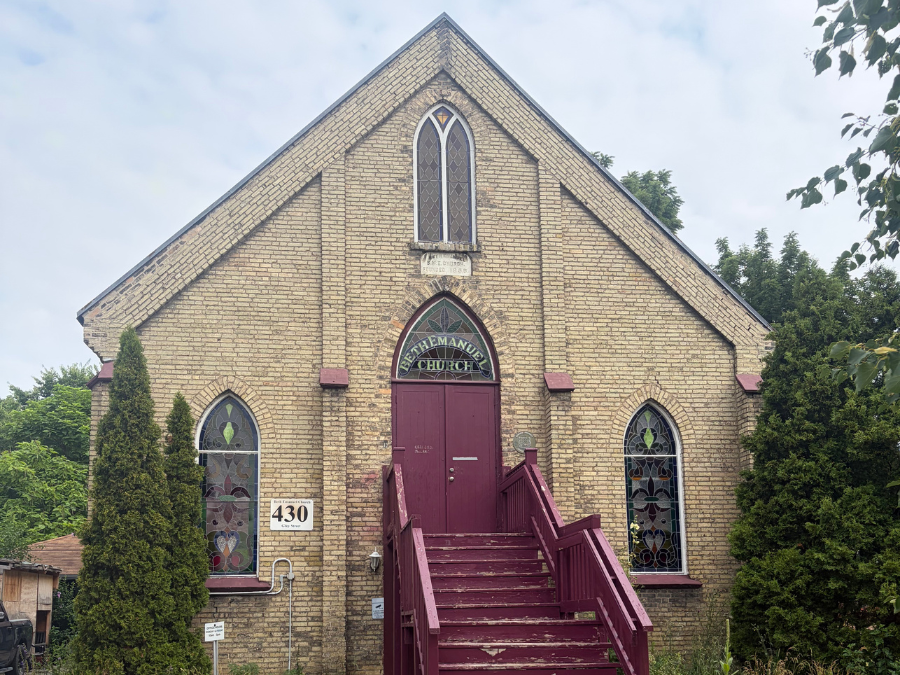
Concerned about losing another historic church built by Canada’s founding Black community, London, Ont. residents have been rallying over the last month to stop the British Methodist Episcopal Church of Canada (BMEC) from removing Beth Emanuel British Methodist Episcopal Church’s heritage status.
The BMEC applied to repeal Beth Emanuel Church’s heritage designation in March, after the church was listed on the market for $1.2 million in September.
You may unsubscribe from any of our newsletters at any time.
The repeal application, signed by the BMEC’s assistant director, Rev. Maurice Hicks, included a long list of concerns with the building, including: requiring major repair costs; limited accessibility; the church’s location in a high-crime neighbourhood, a lack of church services over the past nine years; limited seating capacity and high maintenance costs.
The application also argued that the heritage held little value to the community, because the Black community had “no interest in the church.”
In the end, a conditional offer to buy the church stopped the application.
Sandie Thomas, senior pastor of Spiritual Blessings Lighthouse Ministries in London, Ont., made a $900,000 offer for Beth Emanuel in May. The offer included the church at 430 Grey St. and an adjacent vacant lot at 432 Grey St. — and the condition that gave BMEC 10 business days to revoke its request for the City of London to repeal the by-law designating Beth Emanuel Church as a heritage building, or the deal would fall through.
“They did it within 24 hours,” Thomas says. “I got an email from the city that it was removed.”
Thomas is also the founder and executive director of W.E.A.N Community Centre, a city hub addressing social, economic and educational disparities affecting Black and marginalized communities.
She says Spiritual Blessings Lighthouse Ministries plans to use the property to host food and clothing drives, run after-school and men and women’s programs, and establish a Black museum and library. They also plan to build 40 units of affordable housing that community members could invest in through community bonds.
“This is why it’s important for us to continue to save these spaces and places,” Thomas adds. “So that not just the Black community, but all communities can understand the importance of Black history – that Black history is just history.”
Weeks before the sale offer was made, Black community groups and their allies had begun mobilizing to preserve the church’s heritage value, which was designated in 1983 as part of the Ontario Heritage Act.
More on Broadview:
- Meeting Black youth where they are
- These 4 historic churches are finalists in national heritage competition
- United Church defends museum’s Nakba exhibit amid backlash
The London Black Heritage Council, a volunteer-led organization dedicated to raising awareness about the city’s Black community’s history and culture, organized a Community Action Day in May to explain how residents could help. Under Ontario law, municipalities must publish a notice when a property owner applies to repeal a heritage destination, and members of the public have 30 days to object.
Christina Lord, vice-chair of the London Black Heritage Council, said members were shocked when they learned of the application in April. “We got the sense right away that the folks at the Heritage Planning Department weren’t excited about removing the heritage designation.”
The event attracted 80 to 100 people. “Everybody just kicked into gear,” she says. “And not just the Black communities, but historians, the community around where Beth Emmanuel Church is located. There was a lot of interest in saving the church, saving the heritage designation.”
Bridging gaps between Beth Emanuel Church’s past, present and future
The Black Londoners Project, a research team that digitally maps the lives of formerly enslaved Black people who settled in the region, also wrote a letter supporting the effort.
“I really think this is vital to the fact that they’re still descendents of those who settled here,” says Ronique Gillis, a project research assistant. “For their descendents to see the spaces that their ancestors were in and occupied — that’s important to their own history as well.”
Community members also hosted an open house at Beth Emanuel Church in May, inviting community members to learn about the church’s role in Black people’s lives since the mid-1800s.
At the city’s request, the Museum London published a report about the history and significance of Beth Emanuel Church, intending to show how the property meets the provincial heritage interest criteria. The report was featured at Fanshawe Pioneer Village’s Emancipation Day celebration on July 26.
Struggling to sell or preserve Black history
This isn’t the first time the BMEC’s local church existence has been threatened. In 2022, the London, Ont. community raised money to have the African Methodist Episcopal Church (also known as the Fugitive Slave Chapel) repaired and restored at Fanshawe Pioneer Village to avoid demolition.
In 2018, North Buxton Community Church, a member of the BMEC until 2003, was asked to leave its 1866 church built by formerly enslaved people. The congregation wrote a letter appealing to the BMEC to co-create a solution so the community could maintain the church they inherited from their ancestors. The church board says it did not receive a response. After years of property disputes, the Ontario Superior Court vested the property in the BMEC in March.
Meanwhile, in 2011, the BMEC put Bethany Baptist Church (formerly known as Guelph British Methodist Episcopal Church) up for sale. Built in 1880 by formerly enslaved people, the church was ultimately purchased by community members. They established the Guelph Black Heritage Society, renamed the building Heritage Hall and continue to operate it as a cultural centre.
The BMEC would not respond to questions from Broadview about why it wanted to repeal Beth Emanuel’s heritage status or how it intended to use the proceeds from the sale.
For Thomas, preserving Black history begins at home, by teaching children and communities about the significance of these sites. “We have a right and we have a due diligence as Black leaders to make sure that this remains intact for years and centuries to come,” she says.
***
Sherlyn Assam is a freelance writer and editor based in Toronto.
Thanks for reading
Independent journalism rooted
in faith and justice is under threat
Broadview is the only media organization in Canada offering thoughtful, values-driven journalism from an inclusive, progressive Christian perspective. But our work depends on your support. If you value what you've just read, please act now.
A gift today helps keep this journalism alive tomorrow.
With gratitude,