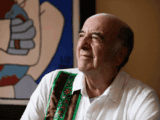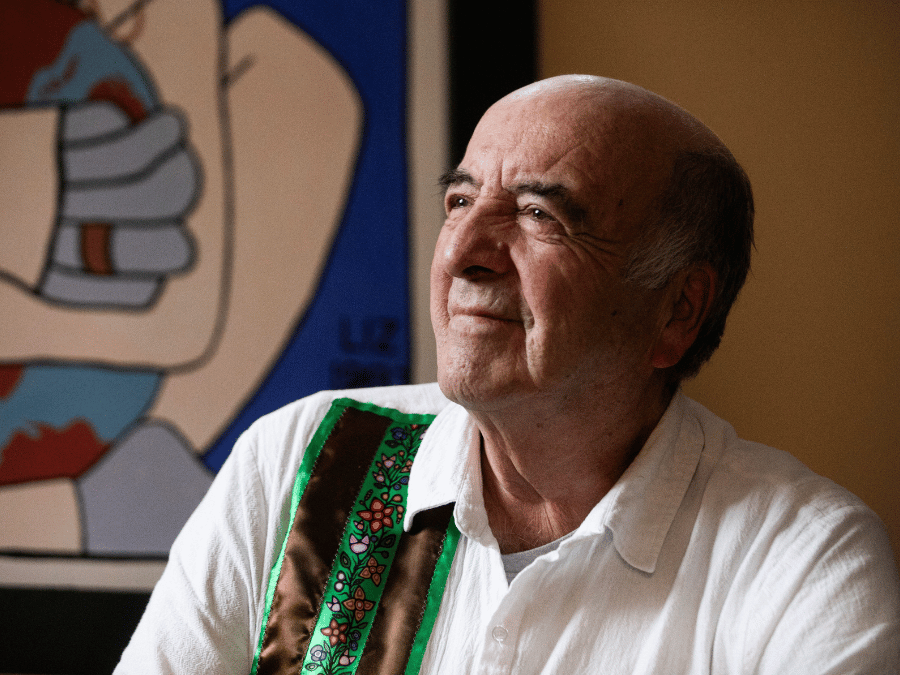
The Very Reverend Stan McKay is a Cree elder and spiritual leader from Fisher River Cree Nation. In 1992 he became the first Indigenous person to lead the United Church of Canada. Before serving as moderator of the United Church, he helped prepare the groundwork for the United Church’s historic apology in 1986 for its role in the residential school system.
Josiah Neufeld interviewed him in Winnipeg.
You may unsubscribe from any of our newsletters at any time.
Josiah Neufeld: Thank you for taking time for an interview with the Free Press and Broadview. What does your life look like these days?
Stan McKay: We’ve retired in Fisher River. We moved there seven years ago. We have monthly gatherings of knowledge keepers in the community. Between 40 and 60 elders sit together every month. We have our own business and then we meet with our chief and council. We’re a form of senate, in my mind. We raise questions and they bring reports to us. For an Indigenous community, I think it’s unique. It was one of the things that attracted us to move here.
JN: How is your community doing?
SM: We’re on very limited land, marginal land. Our population has grown tenfold since the late 1870s, but we have not been allowed any further land. Municipalities, when they grow, are given more land; we’ve never had that. There’s limited land for housing, and our river has been polluted by farms and cattle operations to the south of us. What used to be a very rich source of food is no longer usable. When I was a child we could drink out of the river; now our children can no longer swim in it.
JN: In your lifetime, you’ve witnessed the United Church of Canada’s apology for residential schools and later the federal government’s formal apology. You’ve also witnessed the Truth and Reconciliation Commission, Idle No More and the discovery of unmarked graves related to the residential school system. Do you feel like progress has been made towards truth and reconciliation?
SM: I think there is a greater awareness, but I’m getting a little impatient with the lack of action. The United Church apologized 40 years ago. The day after the apology, church leaders came to Indigenous elders and said they would like a reply. Two years later, the elders came back from their communities and said: “We have decided we will acknowledge the apology, but we’re not accepting the apology until we see some action that indicates there’s going to be change.” That was 40 years ago. There’s been very little change, in my opinion. In fact, with the restructuring of the United Church, we’ve taken huge steps backwards in terms of self-governance for the Indigenous church.
When the United Church of Canada started discussing restructuring, they didn’t include us in Indigenous territory in the discussions. They unilaterally removed all the presbyteries and conferences and developed regions. They said we could either join one of the non-Indigenous regions that were being developed, or we could form our own region. We’ve been asking questions these many years: How? Who do we talk to about forming our own region? And we don’t have any answers.
In statements I’ve read, the General Council of the United Church of Canada has said the Indigenous church is not ready for self-governance.
We used to have the All Native Circle Conference. I was involved with the Keewatin Presbytery in northern Manitoba. We were looking after ourselves. We had strong communication. We had the annual consultations that built strong leadership and collaboration across much of the country. But we don’t have that anymore. It’s all abolished.
JN: What would you like to see?
SM: The United Church held regional consultations with Indigenous communities, but the only subject discussed was the election of members for a national Indigenous council. Last summer, we had a meeting in Ottawa. About 80 Indigenous leaders arrived in Ottawa from across the country. We had three days of meetings. But the agenda was already drawn up when we got there. The whole process was predetermined. We had no opportunity to discuss freely what we would like to see.
The colonial structures remain very strong. There’s this assumption that we’re not ready to be self-governing.
I don’t know where we begin to address this, because I see no hope under the present system of there ever being a real consultation for Indigenous churches to determine what’s next for us.
More on Broadview:
- Building reconciliation, one Indigenous-led project at a time
- Truth before reconciliation
- Toronto church honours reconciliation with reimagined Norval Morrisseau painting
JN: That must leave you feeling hurt or sad. You’ve contributed so much to the United Church.
SM: A few weeks ago I spent some time at the Sandy Saulteaux Spiritual Centre with a new class of Indigenous leaders who are training for ministry. But I don’t know whether there will continue to be funding for our people in ministry.
The graduates of our program who are ministering in isolated communities in Northern Manitoba and Ontario are on call 24-7. Addictions are a problem. Drugs are being hauled into the north and dealers are ever-present. Families are suffering and there are tragic deaths. Indigenous people in ministry are beginning to burn out. They have local support and are overseen by good boards, but when they come to a major problem, there’s no resource, not even a phone number of a person who they could contact.
The fact is, the current United Church regions don’t have a budget for Indigenous ministries. They have no resources to offer. We have about a dozen Indigenous staff in Toronto, but they’re doing the bidding of the General Council office, not really working to support our communities and their challenges.
JN: What else are you working on?
SM: I’m part of a small group that’s looking at moving from land acknowledgments to action. Land acknowledgments have become something that happens at a Winnipeg Jets game with a lot of lights and sound but very little education or acknowledgment of our treaty relationships. It’s empty talk when we don’t have enough land on which to live.
We’re calling for land back. This is not a new idea, but the call to action is a very important one. Often we have problems with water, problems with neighbours around us. We need land to grow to be healthy.
JN: You’ve spoken recently about “liberation” needing to replace “reconciliation.”
SM: We learned a great deal through the reconciliation process. Schools have developed elements in their curriculum that deal with the history of injustice towards Indigenous Peoples.
But the response of society and institutions has been almost non-existent. Canada hasn’t responded to the Calls to Action in any significant way. We grow tired of the discussion. Reconciliation has brought us to the point of knowing what some of the issues are, but hasn’t really resulted in any change in terms of power and the racism and genocide that are part of colonial exploitation.
I’ve said to my friends that I think I’ve had enough of reconciliation. I want liberation.
JN: What would liberation look like?
SM: It would mean action where we take a stand as Indigenous people and say: This is what has to change. The treaties need to be honoured. We can’t take generations to address the poverty and the trauma. Winnipeg’s many encampments, the many people who are incarcerated, the people who suffer from addictions of all kinds — these things are linked to the trauma of our experiences.
I have a friend in ministry in northern Manitoba who said: “I don’t think anyone in the church wants to know how I understand the gospel. I don’t think anyone wants to know what it means to me as an Indigenous minister to be involved in good news when we have this colonial history and this ongoing system of oppression, marginalization and poverty.”
JN: How do you understand the gospel in that context?
SM: Indigenous culture has elements of the gospel, as most cultures do. We have some wonderful theologians who know the land is sacred, the water is sacred and ecology is not about science, it’s about love and faithfulness. Because the Earth is our mother, we know what it is for the creator to care for us and provide for us.
We are respectful and humble and try our best to live out justice. And that makes us victims of a system that’s adversarial and aggressive. The trauma of my relatives on the street in Winnipeg is really based on the loss of hope, the loss of a dream. I was in residential school and it confused me and in many ways silenced me. But afterwards I was able to find Indigenous people who restored my dream.
JN: Premier Wab Kinew created a bit of a stir with his recent comments about abolishing the Indian Act. What are your thoughts?
SM: Our treaty relationship with the Crown has a lot of history. And I think the spirit and the intent of the treaties have not been understood. The Indian Act is problematic, but at the moment it’s all we have. So I think the work of seriously restructuring the relationships with the federal government is very difficult because Indigenous leaders certainly are very concerned about dismantling anything that might weaken their treaty relationship with the federal government. Wab’s comment created a bit of excitement, but also a lot of concern.
JN: Prime Minister Mark Carney has introduced Bill C-39 which contains legislation to fast-track mines, pipelines and major development projects, and weaken protections for species at risk, water quality and fisheries. Many Indigenous leaders have likened it to to former PM Stephen Harper’s omnibus bill that triggered the Idle No More movement. Do you feel like conditions are ripe for another Indigenous-led uprising?
SM: I don’t know. Of late, Indigenous communities have made a number of compromises to fit into economic action. I think we’re seeing the fruit of years of education. I began my career as a teacher in the North. The classroom was wonderful, the students were wonderful, but I was expected to teach them to be aggressive and individualistic. Measuring the value of life as how much you can accumulate is not the Indigenous understanding, nor is it the Biblical understanding.
I’m trying to retire, but I can’t put out the fire in me. I think it is about gospel. I think it’s the fire that comes when there is real trauma. I think Jesus’s disciples at times had trouble understanding the Messiah because they wanted to be aggressive and to take on the powers. They hoped for a king who would have power in terms of the world’s evaluation of who was important. But they were taught that you just live who you are. And for 84 years I’ve been trying to do that.
***
Josiah Neufeld covers issues of faith in Manitoba and nationally for the Free Press and Broadview as part of a joint Religion in the News partnership.
This story was produced in conjunction with the Winnipeg Free Press, as part of a joint Religion in the News partnership covering issues of faith in Manitoba and nationally.
Thanks for reading
Independent journalism rooted
in faith and justice is under threat
Broadview is the only media organization in Canada offering thoughtful, values-driven journalism from an inclusive, progressive Christian perspective. But our work depends on your support. If you value what you've just read, please act now.
A gift today helps keep this journalism alive tomorrow.
With gratitude,