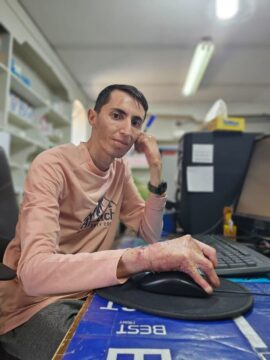
Adel Zadeh is a 34-year-old Iranian biomedical engineer in Ardabil, in northwestern Iran, living with what some U.S. dermatologists call “the most painful disease you’ve never heard of.”
He has epidermolysis bullosa (EB), a rare genetic disorder that makes the skin so fragile it blisters at the slightest touch. Daily life involves constant pain, hours-long wound care and the risk of serious complications.
You may unsubscribe from any of our newsletters at any time.
As violence escalates between the United States, Israel and Iran, Zadeh says managing his disease has become even harder. “The cost of living, even for food and basic clothing, has been rising for years, but especially in the last few months,” he says. “I have been unemployed since January and have almost no income. Support and aid are diminishing.”
His situation reflects a broader crisis across the Middle East where people living are facing mounting danger and disruption, while Canadian aid organizations scramble to provide relief.
The Humanitarian Coalition, composed of 12 Canadian aid organizations, is currently helping people in Lebanon and Syria. “We are deeply alarmed by the escalating military violence that is shattering lives throughout the region,” says executive director Tiffany Baggetta. “Humanitarian needs are rising by the hour.”
On Feb. 28, the United States and Israel launched a joint strike campaign against Iran, killing Supreme Leader Ayatollah Ali Hosseini Khamenei and other senior regime figures. The ongoing conflict has so far resulted in over in the region, according to an Al Jazeera live tracker.
Iran and the United States agreed to a two-week ceasefire deal on Tuesday. U.S. President Donald Trump said this agreement does not extend to Lebanon, with Israel launching strikes on central Beirut just after the ceasefire announcement.
The Humanitarian Coalition continues to call for a definitive ceasefire in Iran, Lebanon and the wider region. “We urge all parties to respect international humanitarian law,” Baggetta says. “Our member organizations continue to rush life-saving essentials including clean water, food, shelter and medical care for children and families caught in this brutal conflict.”
The International Organization for Migration reports over one million people have been displaced from Lebanon since the Israeli military expanded its attack on what it says are Hezbollah targets over the past month. More than 200,000 people have fled to Syria since March 2.
Plan International Canada is one organizations partnering with the Humanitarian Coalition to provide relief to people in Lebanon. As of March 30, they have been able to reach over 76,000 affected people.
More on Broadview:
- How Quebec’s secularism law is forcing young women to rethink their futures
- Paralysis, fear and faith under Cuba’s blockade
- Canada’s oldest organ builder and the sound of Canadian history
“We’re providing everything from your basic services such as food, clean water, soap, mattresses, blankets — what we call essential items,” says Nadine Grant, Vice- President of International Programs at Plan International Canada. “But we also work on trauma counselling because a lot of the children will have experienced a good deal of trauma as they were displaced in a very abrupt manner.”
Part of the organization’s mission is to focus on the needs of children — particularly girls — amid war zones. Grant adds that when a conflict hits, girls are often the first ones to be pulled out of schools and social or child protection networks.
“Schools are no longer operating normally as a school. We’re going to start to see quite a major, knock-on impact, in terms of children falling out of their regular school routine,” she says.
“When girls fall out of school for an extended period, they’re less likely to return. And they might be involved in other chores at the household level, or they might be at risk of exploitation.”
The Humanitarian Coalition is currently accepting donations that will go toward providing food packs, water trucks with clean water, blankets, pillows and supporting emergency health services and protection programs.
“Ironically, it’s not children that start wars, right? They’re the ones who pay the highest price. And I think that’s a message that any Canadian can understand,” adds Grant. “We do think that Canadians [are] generous and that they are compassionate, and they can see that when people are suffering, it’s our turn to step up.”
For Adel Zadeh, the consequences are immediate and personal. “Stress and discomfort are very bad for those of us who have a chronic illness,” he says. “They make the wounds more severe, meaning we need more medicine and dressings.”
Canadians can donate to The Humanitarian Coalition at www.together.ca or by calling 1-855-461-2154 or UNICEF Iran.
***
With files from Shenaz Kermalli
Sarah Grishpul is an intern at Broadview.
Thanks for reading
Independent journalism rooted
in faith and justice is under threat
Broadview is the only media organization in Canada offering thoughtful, values-driven journalism from an inclusive, progressive Christian perspective. But our work depends on your support. If you value what you've just read, please act now.
A gift today helps keep this journalism alive tomorrow.
With gratitude,