
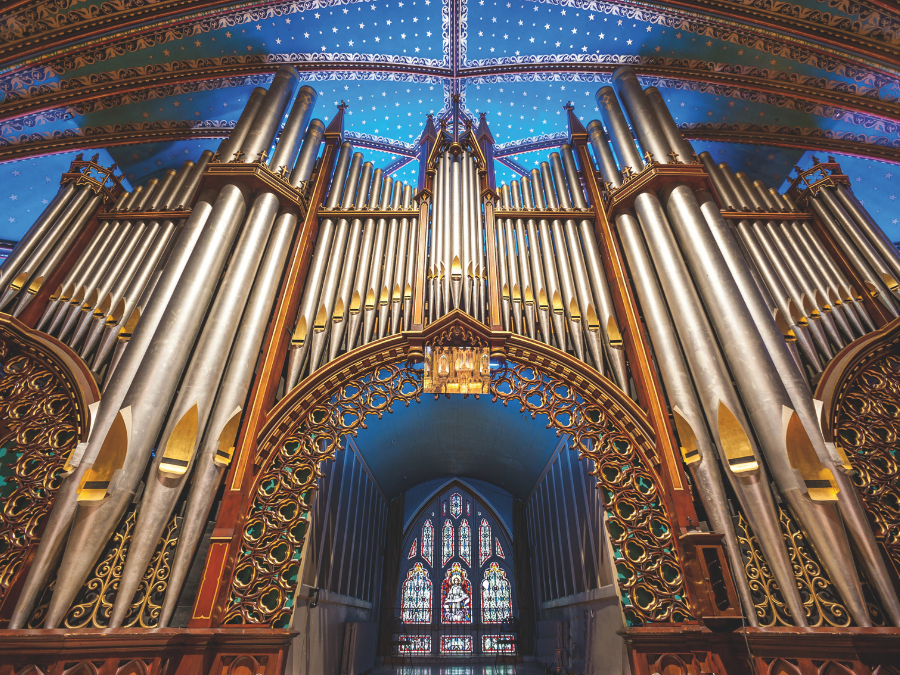
The wooden furniture in the Supreme Court of Canada’s main courtroom was installed in 1948 as a side quest by a company much more revered for its speciality: pipe organs. Based in Saint-Hyacinthe, Que., Casavant Frères was founded in 1879 by the sons of Joseph Casavant, a former blacksmith whose passion project was building organs.
Joseph, a music lover, began studying the mechanism of the organ at age 27 under the direction of his college priest. His sons, Claver and Samuel, took over the craft after their father’s death, sailing for Europe to learn new techniques before returning to Quebec to construct pipe organs for clients like the Notre-Dame Basilica in Montreal. Over the years, Casavant organs have been installed in churches, cathedrals and concert halls across Canada and the United States, and as far afield as Jamaica, Rhodesia (now Zimbabwe), Japan and Australia.
You may unsubscribe from any of our newsletters at any time.
Simon Couture, the current vice-president of Casavant Frères, says the company has managed to remain the oldest organ manufacturer still operating in Canada because of “the firm’s capacity to renew itself.”
“Organists expect different sounds at various points. In the 1950s and ’60s, Casavant was building organs with a romantic sound because of that desire by Chopin musicians. Now, we build organs with a more classical sound,” he says.
More on Broadview:
- This Montreal musician is creating digital instruments for people with disabilities
- Photographer shows that women of colour skateboard too
- Ukulele church brings a whole new meaning to joyful worship
According to Couture, each organ takes 18 to 36 months to build, since every piece is handmade in-house using raw lumber and tin at the Saint-Hyacinthe shop. Currently, Casavant has a three-year backlog, with most of its new contracts coming from the United States.
While the company no longer makes furniture, a third of its business is restoring and maintaining its existing instruments as well as organs built by other manufacturers.
“It’s really humbling, because these guys really knew what they were doing,” Couture says, mentioning a 1930s Casavant organ he had recently assessed, built around the same time the firm was awarded the Grand Prix at the International Exhibition in Belgium. “The fact the organ still plays after a century and can be restored, to me is still very impressive.”
***
This article first appeared in Broadview’s May/June 2026 issue with the title “Pulling Out All the Stops.”
Ghazal Azizi is a writer and fact-checker in Montreal.
Thanks for reading
Independent journalism rooted
in faith and justice is under threat
Broadview is the only media organization in Canada offering thoughtful, values-driven journalism from an inclusive, progressive Christian perspective. But our work depends on your support. If you value what you've just read, please act now.
A gift today helps keep this journalism alive tomorrow.
With gratitude,







The congregation I currently worship with has a recently restored 100-year-old Casavant organ. I would be interested to hear how other United Churches use their organs to serve congregational worship and communities. I feel torn between honouring fine classical music and skilled organists and grieving the loss of emphasis on simple congregational hymns and choruses as a way of enhancing a sense of oneness in worship, opening us to be more aware of divine presence within us as we face very practical problems coping with change in every direction. Many of the powerful new insights about the Aramaic teachings of Jesus have not yet been incorporated in congregational singing. Is there also a place for finding new words for favourite hymn tunes that may connect with young children, families, youth and young adults as well as the increasing number of seniors in society?