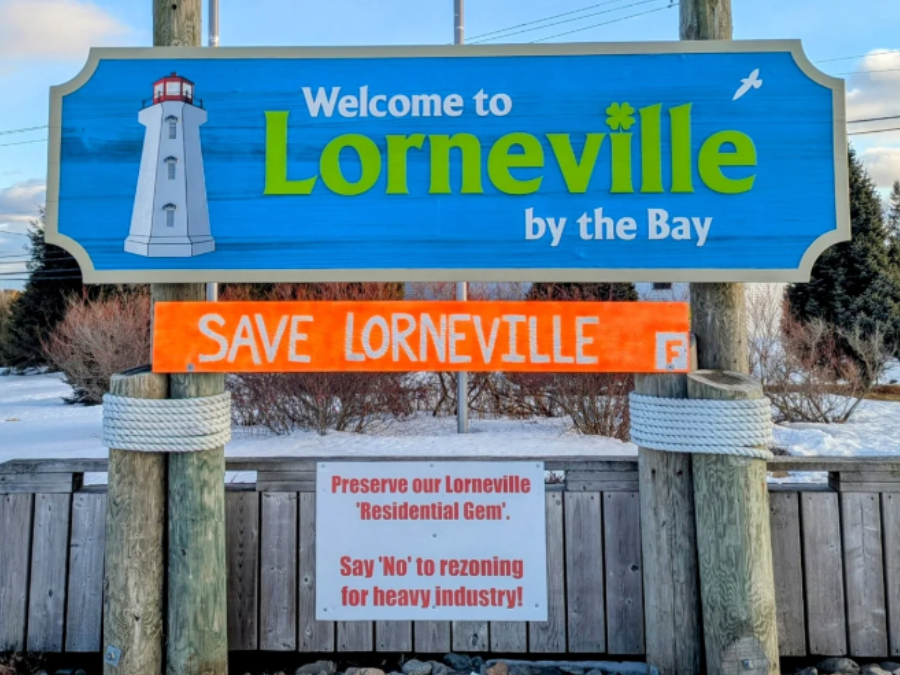
One of Leah Alexander’s earliest memories is of driving around Lorneville, N.B., in a van with her mother and neighbours, handing out flyers in an effort to stop a landfill from being built in their community.
“I was her age,” Alexander says, gesturing to daughter Wrenna, 2.
You may unsubscribe from any of our newsletters at any time.
Nearly 30 years later, Alexander spent her maternity leave doing much the same thing. With Wrenna strapped to her chest, she and her then-two-year-old son distributed flyers protesting a proposal to build a hyperscale data centre in Lorneville.
“I was just like, ‘We’re doing this again,’” she says, tears welling in her eyes.
The proposal, from Alberta-based Beacon Data Centers and Texas-based VoltaGrid, calls for a 400-megawatt data centre occupying 120 hectares of land. According to a recent environmental impact assessment (EIA), the project would account for 6.6 percent of the province’s greenhouse gas emissions.
The companies have promoted the development as an economic boost that would create jobs. Residents acknowledge there would be construction work, but argue that most of those jobs would disappear once the facility was complete — along with sensitive wetland and old-growth forest habitat.
Speaking to Broadview during a protest of 150 people outside the New Brunswick legislature in Fredericton in June, Alexander said the proposed development has left her uncertain about the community’s future and worried about its environmental impact on her children. When the area was initially rezoned to allow the data centre to be built, advocates “were told [by the city] no smoke stacks; we were told no emissions. But that seems like where we’re headed.”
“That’s why we’re here, because if we just sat back and went on those restrictions or those guidelines or those environmental impact assessments, who knows where we’re going to end up,” she added.
The fight unfolding in Lorneville reflects a broader debate taking place across Canada.
According to a recent report by The Breach, 194 data centres are operating across Canada, and local residents have raised concerns about their environmental impact. In Alexander’s hometown, Save Lorneville signs are displayed throughout the community.
A public hearing in spring 2025 spanned four days to accommodate everyone who wanted to speak. Despite opposition, neither the city nor the province has backed away from the project.
More on Broadview:
- Tzeporah Berman on how the fossil fuel industry hijacks climate discussions
- What would a ‘degrowth church’ look like?
- David Suzuki still believes change is possible
Although Lorneville feels like its own distinct rural community, it is part of the Saint John municipality. In June 2025, Saint John city council approved amendments allowing the expansion of the community’s Spruce Lake Industrial Park, paving the way for the proposal.
“It’s gone from a community fight to a province-wide fight,” says Chris Watson, a member of advocacy group Save Lorneville. The group launched a judicial review, arguing that councillors did not approach the rezoning decision with open minds.
Saint John Industrial Parks and the provincial Regional Development Corporation are co-ordinating the expansion. Neither returned Broadview’s request for comment.
Residents also believe the data centre will harm wetlands and old-growth forest, degrade air and water quality and increase noise and light pollution. Working with Mount Allison University’s Acadian Forest Dendochronology, residents identified a 400-year-old tree and discovered water courses that they say were not documented in the environmental assessment.
“Any development on that piece of property is environmental destruction,” Alexander says.
According to Beacon Data Centers, the development would include a natural gas plant that would generate about half the electricity needed to operate the facility. The remainder would come from NB Power, raising concerns among residents about the province’s electrical capacity and the possibility of higher rates.
The EIA estimates that, if completed as proposed, the facility would become New Brunswick’s third-largest emitter of greenhouse gases behind the Irving Oil refinery — also in Saint John — and a coal-burning generating station in Belledune.
Beacon Data Centers did not respond to Broadview’s request for comment.
At the protest in June, Wolastoq Grand Council Grand Chief Ron Tremblay addressed the crowd. “We as the two-legged are only stewards here. We’re only here temporarily, and if you look worldwide, how much destruction we have done. We need to do better, because we know better.”
In an open letter, Tremblay wrote that Indigenous people had not been consulted about the development, which is a treaty and UN Declaration on Indigenous Rights violation. He urged officials to preserve the land for the next seven generations.
A motion in the legislature to consider a moratorium on data centres was introduced by the Green Party and supported by the opposition Progressive Conservatives, but the Liberal government declined to hold a vote before the legislature adjourned for the summer.
The EIA must still undergo further review, and additional public consultations are expected, although it remains unclear what form they will take. The Department of Environment and Local Government says no decision on the project will be made until all technical issues have been addressed.
Watson says these developments give him reason for optimism. “I’m hoping we can kill this data centre somehow,” he says.
***
Sarah Ratchford is a writer and editor in Menahqesk (Saint John), N.B.
Thanks for reading
Independent journalism rooted
in faith and justice is under threat
Broadview is the only media organization in Canada offering thoughtful, values-driven journalism from an inclusive, progressive Christian perspective. But our work depends on your support. If you value what you've just read, please act now.
A gift today helps keep this journalism alive tomorrow.
With gratitude,