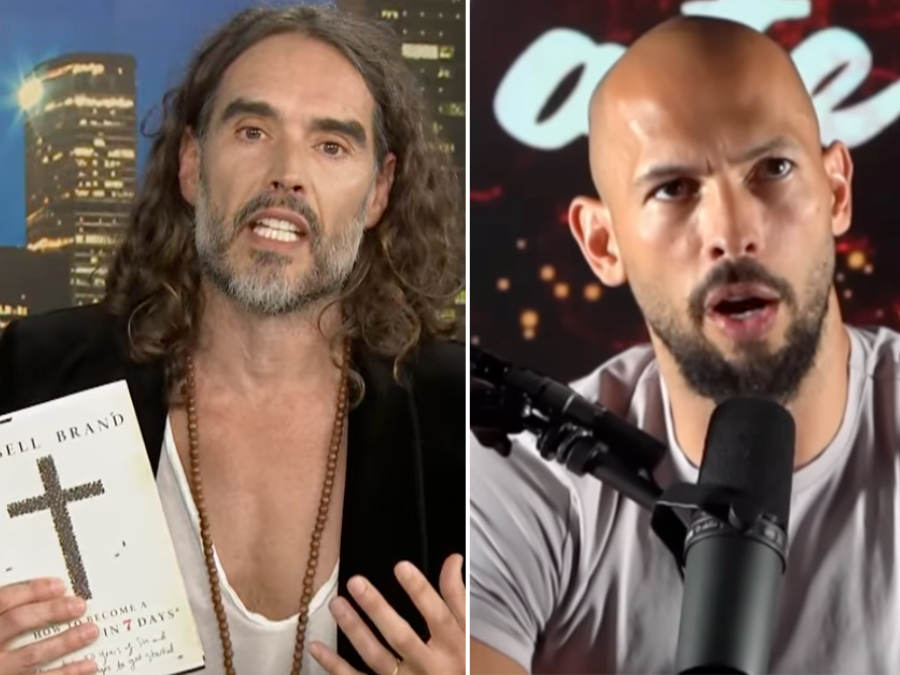
In April, Piers Morgan conducted an extraordinary interview with comedian-turned-vlogger Russell Brand that has since racked up millions of views. Wearing his signature low-cut shirt and oversized cross with a book-marked Bible in tow, Brand’s appearance brings to mind that of the scribes and the Pharisees who “make their phylacteries wide and the tassels on their garments long” (Matthew 23:5) in order to be seen by others.
Gesturing to the same holy book Brand has brandished in court amid rape and sexual assault allegations — which he denies — Morgan asks whether he can point to a passage relevant to his case. What follows is more than 90 seconds of painful floundering in which Brand cannot find a passage, name one, or even gesture vaguely at what one might say.
You may unsubscribe from any of our newsletters at any time.
This viral clip confirms what many observers suspected — that Brand’s 2024 baptism by TV survivalist host Bear Grylls in the polluted River Thames months after being accused of sexual assault might have just been a performance.
Brand’s case is not unique. Religious conversion is traditionally understood as an act of humility: a reckoning with the self and reorientation toward a higher truth. But for some high-profile figures, public declarations of faith can look less like spiritual transformation and more like strategic rebranding.
In 2022, a video circulated on social media showing manosphere influencer Andrew Tate praying in a Dubai mosque. Tate’s purported conversion to Islam — following social media bans for misogynistic hate speech and a police investigation into human trafficking and rape — has likewise been subject to skepticism.
Like Brand, Tate has attempted to deflect accusations brought against him by wielding religious scripture in court. Both men have characterized the allegations against them as an establishment conspiracy and have publicly defended one another.
A former member of Tate’s marketing team, who calls himself EliXAnpa, has since alleged that the influencer’s highly publicised conversion was a calculated branding exercise, according to reporting from The News Movement. “All of a sudden he starts to do business with sheikhs; all of a sudden he’s Muslim.” Even Tate himself admitted in 2022 on the Full Send Podcast that “In Dubai I’m happy to be Muslim, in Romania I’m happy to be Christian.”
It’s not known whether Tate’s supposed conversion has led to greater riches but two years after the announcement of his turn to Islam, a cyberhack exposed how his online platform, The Real World — which promises to teach paying subscribers how to get rich — was generating the equivalent of CAD $7.77 million in monthly revenue. At the same time, young Muslim men have been signing up in droves according to Canadian journalist and educator Dr. Safiyyah Ally.
Becoming a Christian ‘in seven days’
Russell Brand’s own purported conversion and accompanying rightward political shift has also proven lucrative. In the 2010s, his content was decidedly left-wing and drew heavily on Eastern religions. Then, during the COVID-19 pandemic, it increasingly veered into misinformation, even though he continued to frame himself as progressive with a nebulous interest in spirituality.
After the 2023 allegations, however, Brand was demonetized on YouTube and sponsors pulled their ads from his Rumble channel. He then rebranded as a conservative evangelical Christian and moved to Florida.
More on Broadview:
- United Church General Secretary on the ‘awful’ situation in Cuba
- The gospel according to Malcolm Gladwell
- Russia’s religious push into Africa
Despite the demonetization, his broadcast company managed to increase its assets from the equivalent of CAD $14.9 million at the end of 2023 to CAD $22.3 million at the end of 2024 — the same year he announced his conversion. On top of that, Brand has made money hawking Christ-themed wellness supplements, “magical amulets” to ward off evil and, more recently, a book: How to Become a Christian in Seven Days.
Brand’s leveraging of his newly professed faith apparently goes beyond financial gain, by helping to rehabilitate his reputation. His conversion reframes the past behaviours as generalized ‘sin’ absolved through divine grace, rather than as an alleged pattern of abuse against women and girls — accountability to whom, and forgiveness from whom, are conspicuously absent from the narrative.
As Rev. Dr. Helen Paynter, director of the UK’s Centre for the Study of Bible and Violence, has warned, conversion “does not exculpate the individual from the earthly consequences of their wrongdoings.” Conversely, baptism rests on repentance: “facing up to sin and the harms we have done — not a get-out-of-jail-free card”, she adds.
Tate described as ‘munāfiq’
Tate has also faced criticism from within Muslim communities, who say he is indoctrinating impressionable young men and boys with misogynistic ideas while advancing a caricature of Islam to legitimize male chauvinism and impunity. For example, despite there being no Quranic basis for stoning, Tate has said, “I’m gonna find myself a nice Islamic ass wife… I’m gonna build up a big pile of rocks… as soon as I catch her cheating, there’s gonna be no delays. Inshallah.”
The influencer claims to have donated millions of dollars to Islamic charities, but some of the organizations he’s named have publicly disputed that any money was given. This gap between professed faith and public behaviour has led some Muslims to describe him as a munāfiq — a religious hypocrite who proclaims belief instrumentally, rather than submitting to its moral demands. Indeed, the Quran warns of such figures: “They have made their oaths a shield, and so hinder others from the way of God. Evil indeed is what they do” (Surah Al-Munāfiqūn 63:2).
While Brand and Tate seem more motivated by grift than grace, their conversions illustrate the ways that right-wing political movements seize on religious traditions to justify masculinist and, in some cases, racist beliefs while gleefully ignoring calls to love one’s neighbour as oneself.
It is no coincidence that both men have publicly supported Donald Trump, a leader who himself faces longstanding allegations of sexual abuse and who claims Christian faith while repeatedly acting in ways that contradict the teachings of Jesus.
The Bible’s archetypal conversion story is that of Paul the Apostle, whose encounter with God on the Road to Damascus marked a decisive break from a violent, prideful past. The Quran similarly frames genuine conversion as tawbah: a rupture with one’s former life marked by humility, repentance, and ethical change, exemplified in the conversion narrative of Pharaoh’s magicians. In these traditions, conversion is by definition transformative.
By such standards, the recent public turns of Brand and Tate ring all the more hollow, for their longstanding patterns of self-aggrandizement have yet to be broken.
***
Mary Newman is a Toronto-based award-winning multimedia journalist
Thanks for reading
Independent journalism rooted
in faith and justice is under threat
Broadview is the only media organization in Canada offering thoughtful, values-driven journalism from an inclusive, progressive Christian perspective. But our work depends on your support. If you value what you've just read, please act now.
A gift today helps keep this journalism alive tomorrow.
With gratitude,