
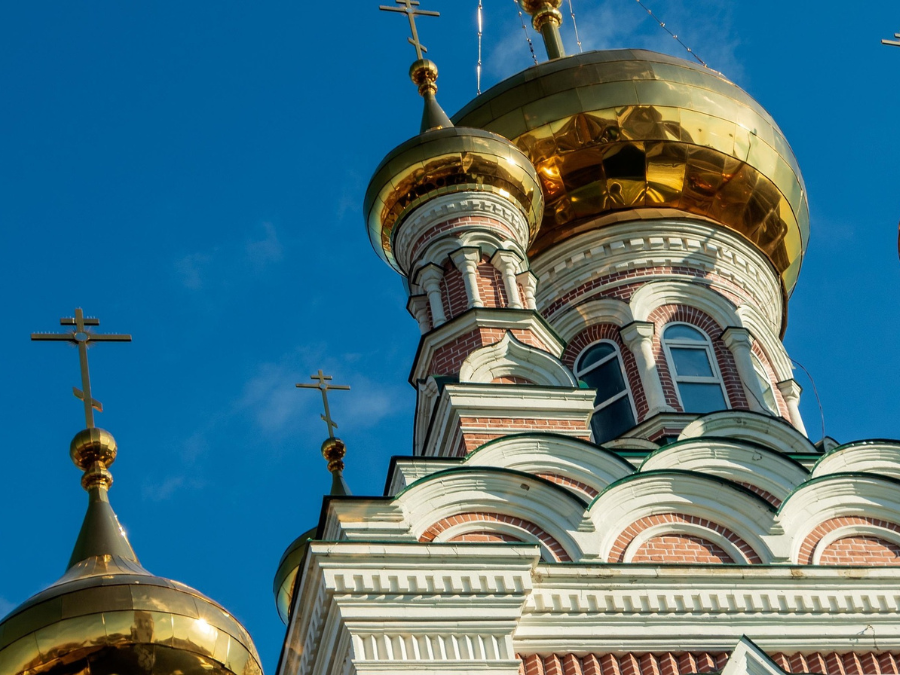
Russia has found a new way to expand its reach into Africa — and it doesn’t involve soldiers.
In the face of crippling Western sanctions and a need for international allies, Moscow has been working through the Russian Orthodox Church to expand its reach, says Bishop Joshua Dhube, the retired head of the United Baptist Church in Zimbabwe, and a former government minister.
You may unsubscribe from any of our newsletters at any time.
“The Russian Orthodox Church is the ‘Trojan Horse’ for the Kremlin’s agenda to win hearts and minds in Africa.”
Dhube argues it is no coincidence that the Russian Orthodox Church has recorded strong growth on the continent over the last decade.
The Russian Orthodox Church, for instance, expanded its presence from four to 34 African countries between 2022 and 2025, according to a mapping by Bloomberg. The number of parishes across the continent has grown to about 350 based on figures from the the Religious Information Service of Ukraine, which cites statements from Patriarch Kirill, the head of the Russian Orthodox Church. The church has also reportedly attracted clergy away from the Greek Orthodox Church by offering higher salaries, faster promotions and funding for new buildings.
By positioning itself as a defender of ‘traditional conservative family values,’ Russia is seeking to embed its worldview in both rural and urban conservative communities — particularly in influential, populous countries, such as South Africa and Kenya.
The Kremlin’s key goal
Russia is particularly interested in how African countries vote at the UN General Assembly and how the war is viewed by the broader public across the continent, says Irina Filatova, a research fellow at the University of Cape Town in South Africa and former history lecturer at Russia’s National Research University Higher School of Economics.
“The Russian Orthodox Church functions closely with the state and is not a separate institution. The church has wholeheartedly supported the Ukraine war and says that killing in war is not a crime.” It’s one of the key reasons why the Kremlin has blessed its expansion across Africa, she adds.
And it’s a message that resonates with some.
“The Russian Orthodox Church is attractive to me; they’re the only one still standing steadfast on faith, family and God,” notes Vin Prinsloo, a young Christian mechanic in Johannesburg, South Africa. Prinsloo was raised Anglican but left after the Archdiocese of Southern Africa approved prayers for same-sex couples.
“I sort of drifted into Catholics, Methodists and Calvinist churches until I found a home in the Russian Orthodox Church in 2022,” he says.
Prinsloo says five of his Christian friends have also left their Anglican, Catholic and Presbyterian upbringings to join the Russian Orthodox Church in South Africa. One is training for priesthood after attending a two-month youth fellowship in St Petersburg in Russia.
Beyond the pulpit
Russia is investing heavily in cultural infrastructure and outreach, says Prophet Anele Hele, a popular televangelist and pro-Moscow cleric in South Africa. Russian language centers (‘Russian Houses’) have opened in Namibia, Ivory Coast and Zimbabwe.
There has also been a surge in academic scholarships awarded to young Africans to train as doctors, engineers and Russian language experts who move to work in Russia. According to Russian figures, scholarships for African students have tripled since 2020, to more than 5,300.
Meanwhile, the Kremlin’s state-owned Sputnik news service plans to launch bureaus in South Africa and Tanzania to offer what it calls a ‘balanced alternative’ to legacy Western media.
“The Kremlin is going for broke to shift the minds and perceptions of young Africans … and Russia is also aware that the Chinese are seeking to capture Africa to its ideological viewpoints,” Hele says.
Analysts say Russia is actively filling the ‘soft power’ gaps left by the West through religious outreach alongside military assistance, particularly in fragile and coup-prone nations like Guinea, Burkina Faso and Niger.
“It’s a clever tactic,” Hele adds. “For the Kremlin, a parish in a rural conservative district of South Africa isn’t just a place of worship—it’s a de-facto diplomatic station.”
More on Broadview:
- Classroom antisemitism in full swing, U.S. academic tells Winnipeg synagogue
- People in war-torn Sudan ‘are left with nothing’
- How restorative justice can heal communities
Risks
Others warn the strategy carries deeper risks.
Bishop Ancelimo Magaya, a dissident Zimbabwean cleric, points to allegations that Africans are being recruited to Russia with promises of work, only to be redirected into military or defence-related roles.
Recent reports from Zimbabwe indicate that at least 15 of its citizens have died while fighting for Russia against Ukraine. Ukraine estimated last year that over 1,400 Africans were currently enlisted in the Russian military.
Under the Alabuga Start programme, young African women have been recruited with promises of ‘hospitality’ jobs in Russia — but many are ultimately sent to work in factories producing bullets and drones for the war in Ukraine.
“Who knows what’s being whispered by priests to jobless, financially desperate young congregants inside the Russian Orthodox Church’s parishes in Johannesburg (South Africa) or Nairobi (Kenya),” says Bishop Magaya, calling for closer scrutiny by African authorities.
“As I speak to you today, a dozen of young Zimbabwean men are boarding flights to Moscow — despite seeing their peers returning in coffins,” he adds.
Filatova cautions there is no clear direct evidence linking church activity in Africa to recruitment for the war. But Russia has used politically aligned actors, including South Africa’s formerly militant MK Party to encourage enlistment.
The Russian Orthodox Church, Patriarchal Exarchate of Africa — Diocese of Southern Africa, and the Russian embassy in South Africa did not respond to Broadview’s request for a comment. Despite its ambitions, the Russian Orthodox Church’s footprint in Africa remains relatively modest compared with Catholicism or Anglicanism or Protestantism in Africa.
“Still, Russia is using all possible channels for increasing its popularity in Africa,” Filatova says. “The propaganda of the church and the expansion of the Russian Orthodox Church is simply one part of it.”
***
Deogracious Kalima is a freelance writer covering Southern Africa.
Thanks for reading
Independent journalism rooted
in faith and justice is under threat
Broadview is the only media organization in Canada offering thoughtful, values-driven journalism from an inclusive, progressive Christian perspective. But our work depends on your support. If you value what you've just read, please act now.
A gift today helps keep this journalism alive tomorrow.
With gratitude,



When religion becomes a tool of the State , bad things happen. It is a major argument for sepsaration of State and religion. What is so sad about this story is the use of “conservative values” against women and LGBTQ to create a 21st century colonialism. The real agenda of notably, America and Russia is political and financial power. Africa embodies so many cultures and values of their own. They need to own their agenda. In art and music I have seen that rise.