
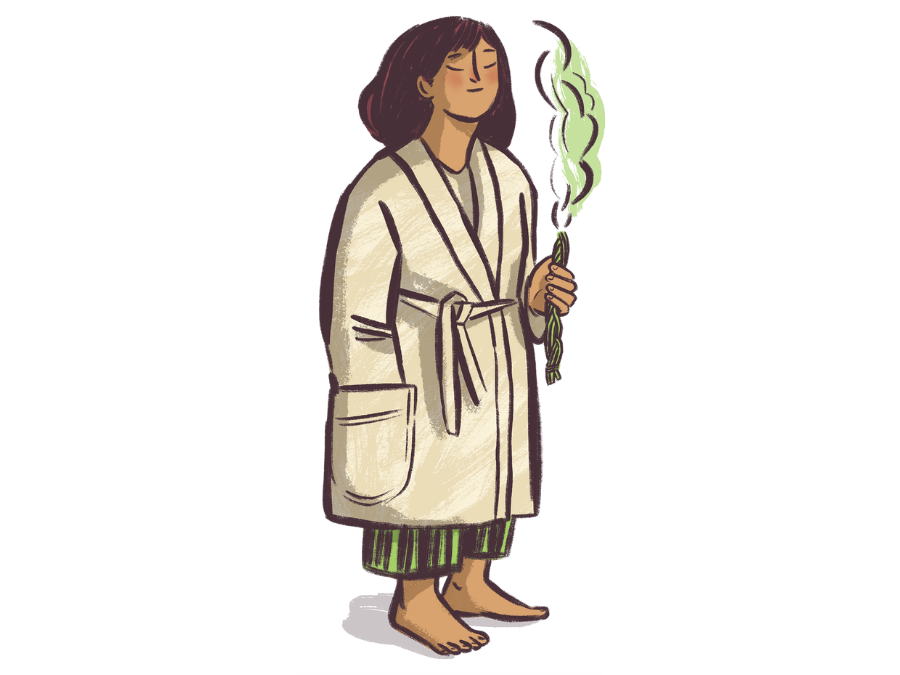
Each morning during Lent, before the world fully wakes, I step outside and place my feet on the cold ground. I light a braid of sweetgrass and let the smoke rise like a prayer, curling upward into the early light. This simple act is a sacred conversation between Spirit, land and breath. It is how I remember who I am.
In the soft hush of dawn, I stand in ceremony with Creation. I listen to the Earth’s heartbeat beneath my feet, to the whisper of the ancestors carried on the wind, to the steady rhythm of my breath. The smoke rises slowly, becoming a sacred bridge that lifts my prayers to the Creator while grounding me in the teachings I carry as a Two-Spirited Indigenous minister.
You may unsubscribe from any of our newsletters at any time.
Lent is often framed through sacrifice and discipline, but in my tradition, the season is also about relationships. We remember that we are part of something living and sacred. Each breath is a prayer, each step an o“ering, each sunrise a resurrection.
In these quiet moments, I don’t ask for answers. Instead, I listen. I let the smoke and the silence teach me. And slowly, what once felt heavy begins to rise and lift away.
This sacred practice reminds me that resurrection does not arrive all at once. It begins quietly, in the soil, in the roots, in the breath. It begins when we make space to simply be with the Spirit.
More on Broadview:
- What if Lent began with a question?
- Why I chose to ‘do nothing’ this Lent
- Canada’s children are breathing the climate crisis
How to …
- Approach this practice with reverence. Begin by finding a quiet outdoor place at sunrise.
- Stand with your feet on the ground and take slow breaths, allowing yourself to feel connected to the land beneath you.
- If you choose to incorporate sweetgrass or another sacred medicine, it’s essential to understand that these are not just objects, but sacred gifts. Purchase them directly from Indigenous artisans or small businesses, not mass-market retailers.
- Offer a moment of gratitude and tobacco to the land, the people and the traditions from which these medicines come.
- Light the braid gently, allowing the smoke to rise slowly. Let your prayer be listening, not asking.
- If you are not Indigenous, consider reaching out to local Indigenous Elders, Knowledge Keepers or organizations for guidance and respectful learning.
- Remember, this is not about copying or claiming a tradition but about honouring the Spirit’s movement and supporting Indigenous communities.
- Stand in stillness for a few minutes, breathing with the Earth. Let the smoke, the air and the quiet shape your prayer.
- When you are finished, offer a word of thanks and extinguish the medicine carefully.
***
Rev. Shane Goldie is a Two-Spirit Indigenous theologian, writer and spiritual leader. He is the youngest ordained minister in The United Church of Canada and serves at St. Andrew’s United in Spruce Grove, Alta.
This story first appeared in Broadview’s March/April 2026 issue with the title “Offerings of smoke and sweetgrass.”
Thanks for reading
Independent journalism rooted
in faith and justice is under threat
Broadview is the only media organization in Canada offering thoughtful, values-driven journalism from an inclusive, progressive Christian perspective. But our work depends on your support. If you value what you've just read, please act now.
A gift today helps keep this journalism alive tomorrow.
With gratitude,







If I’m allowed to be honest, can anyone see what is Biblical in this presentation? If so please note your Bible verses to support the answer. If you can’t, my I ask why the United Church is ordained if they are not preaching or following God’s Word?
Thank you for your honesty. I want to receive your words with the same care and seriousness that you are asking for. Scripture matters deeply to me. Christ matters deeply to me. This is not a conversation I take lightly.
I am an ordained Christian minister in The United Church of Canada. I hold both a Bachelor’s degree in Theology and a Master of Divinity. My life, my call, and my ministry are rooted in Jesus Christ, in Scripture, and in the living presence of God. I also walk with and honour Indigenous spirituality, and I do not see these as competing paths, but as places where the fullness of God’s truth is revealed more deeply.
If the question is whether creation, the land, and practices that draw us closer to God through the physical world are biblical, the answer is yes, profoundly so.
Scripture begins with creation. “In the beginning God created the heavens and the earth” (Genesis 1:1). Again and again in Genesis 1, God calls creation “good.” Not separate from God, not disposable, but good, sacred, and worthy of care.
Psalm 24:1 reminds us, “The earth is the Lord’s and everything in it.”
Psalm 19:1 declares, “The heavens proclaim the glory of God; the skies declare the work of his hands.”
Romans 1:20 teaches that God’s invisible qualities are understood through what has been made.
Creation is not outside of God’s revelation. It is one of the primary ways God speaks.
When we pray with the land, when we pay attention to the wind, the water, the fire, the soil, we are not leaving Scripture behind. We are stepping into it.
Even Jesus teaches this. “Consider the lilies of the field… look at the birds of the air” (Matthew 6:26–30). Jesus consistently points people back to creation as a way of understanding God’s care, provision, and presence.
Now regarding the use of physical elements in prayer, this is also deeply biblical.
In the Old Testament, God commands the use of incense in worship:
“Let my prayer be counted as incense before you” (Psalm 141:2).
In Exodus 30, incense is prescribed as part of holy worship before God.
In the New Testament, this continues:
In Revelation 8:4, “the smoke of the incense, with the prayers of the saints, rose before God.”
Incense, smoke, scent, physical elements that engage the senses are part of biblical worship. This is not foreign to Christianity. It is embedded in it.
In many Christian traditions, including Anglican and Catholic churches, incense is still used today as a symbol of prayer rising to God. When Indigenous peoples use sage or other sacred medicines in a prayerful way, it is not outside of this pattern. It is another expression of the same deep truth, that our whole being, body, breath, senses, and spirit, is invited into prayer.
God is not limited to one cultural expression.
Scripture affirms this clearly.
In Acts 17:28, Paul says, “In him we live and move and have our being.”
In Acts 10:34–35, Peter declares, “God shows no partiality, but in every nation anyone who fears him and does what is right is acceptable to him.”
And in Revelation 7:9, we are given a vision of heaven that includes “every nation, tribe, people and language” worshipping before God. Not erased into sameness, but brought fully as they are.
God meets people where they are, within their culture, their language, their land.
As for the name “Creator,” this too is deeply biblical. God is named Creator throughout Scripture. Isaiah 40:28 says, “The Lord is the everlasting God, the Creator of the ends of the earth.” Many names are used for God across Scripture, each revealing something of God’s nature. Using the name Creator is not abandoning Christianity. It is affirming one of the most foundational truths about who God is.
So when I speak of Creator, when I honour the land, when I engage practices that draw me into prayer through creation, I am not stepping away from Christianity. I am stepping deeper into a biblical understanding that God is present in all things, revealed through all creation, and not confined to one cultural form of worship.
I follow Jesus Christ. I preach the Gospel. I believe in the life, death, and resurrection of Christ as central to our faith.
And I also believe that the Spirit of God has been moving long before any church structure existed, and continues to move in ways that call us to humility, to listening, and to deeper relationship with God, one another, and the earth.
This is not about making Christianity optional. It is about recognizing that God is bigger than any one expression of Christianity.
If we are going to be biblical, then we must also be honest about this truth: God’s presence cannot be contained, controlled, or limited. As Scripture says, “Do I not fill heaven and earth?” (Jeremiah 23:24).
There is room in the body of Christ for both deep commitment to Jesus and deep respect for the ways God is revealed through creation and culture.
I share all of this not to argue, but to invite. To invite a broader, deeper, more expansive understanding of the God we both seek to follow.
You’re clearly right, this has nothing to do with anything Biblical. But the United Church is so intent on being maximally inclusive that Christianity is (literally) optional now for its ordained.
Judge not, lest you yourself be judged.
This minister, who carries two spiritual traditions, has chosen to share one of them with us, in the hope that it will provide a different way than many are used to for connecting to the Spirit, to Creator, to God — however we wish to name that force. It is a generous gift for an Indigenous person to share, and I am appalled by these two most ungenerous and racist responses to that gift.
To – S. Bond
“Watch out for false prophets. They come to you in sheep’s clothing, but inwardly they are ferocious wolves. By their fruit you will recognize them.” Matthew 7: 15-16 How can I watch out for false prophets, if I don’t use judgement.
The same chapter which you conveniently quote verse 1 means – Don’t judge others until you are prepared to be judged by the same standards. I’m prepared to be called out if I’m twisting God’s Word to mislead others.
BTW – no one has answered my challenge.
Sara – “That which is born of the flesh is flesh, and that which is born of the Spirit is spirit.” (John 3:6) One Spirit.
God will not fight or share with another spirit. “I am the LORD; that is My name! I will not yield My glory to another or My praise to idols.” Isaiah 42:8
I’m appalled that you do not understand ““I am the way, the truth, and the life. No one comes to the Father except through Me.” John 14:6
If I call someone out for theft (a sin) does that make me ungenerous and racist? Christianity is NOT based on animistic or pantheistic theology, to teach Christians otherwise is a sin.