
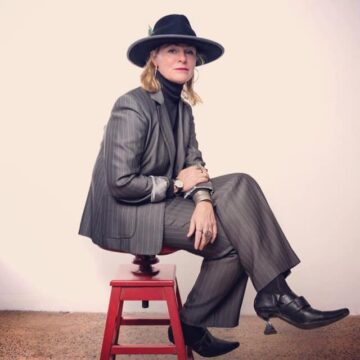
Kiki Keskinen is a witch. She’s also a former adjunct journalism professor at Carleton University, an entrepreneur and a former PR professional, but it’s the reference to witchcraft that always raises a few eyebrows. She jokes that she often pauses after introducing herself, giving people a moment to process the “I’m a witch” job description. Witchcraft has shaped her life since childhood and now she runs Witch School — believed to be the only program of its kind in North America — from her home in Chelsea, Que.
Witchcraft is enjoying a cultural moment, with social media flooded by #witchcore content and NBC News declaring 2025 the year of the Etsy witch. While there’s no reliable way to measure how many Canadians identify as witches, census data shows a steady rise in people identifying with alternative spiritual practices, including Pagan and Wiccan traditions. Still, Witch School isn’t just a trend.
You may unsubscribe from any of our newsletters at any time.
Keskinen’s school urges participants to “learn and play at the intersection of feminist Witchcraft, earth-based spirituality and natural healing.” The hybrid online-and-in-person model begins with museum visits, archaeology and artwork in the first semester. In the second semester, students explore practices such as sacred circle dancing, drumming and tarot reading. The third semester focuses on personal leadership and empowerment. The average cohort is 13 students.
Brianna Donaldson is one of the 800 or so people who count themselves among Witch School’s alumni, which opened in 2017. She told Broadview: “I found Witch School before COVID, but I wasn’t in a place to really jump in as a single mama; fast forward four years, and in postpartum with my last, I was ready. The program is amazing for beginner witches looking for community and connection. It jump-started my next endeavours by allowing me to slow down and focus on my intentions.”
Keskinen says prospective students tend to share three things in common: a feeling that the timing is right, a desire for community and a sense of curiosity. Her students come from diverse backgrounds, including Jewish, Christian, Indigenous and secular traditions.
Canadian witches haven’t always been met with acceptance. Canada engaged in witchcraft persecution as recently as 1920, when Margaret Pollock was convicted of “telling fortunes” under Section 365 of the Canadian Criminal Code. This law — covering witchcraft, sorcery and fortune-telling — was still legally in effect until 2018. While likely intended to prevent fraud, it also targeted marginalized spiritual practitioners like Pollock, who claimed to have God-given insights and visions.
More on Broadview:
- Nowruz in a time of war
- The everyday ceremony that grounds me during Lent
- Religious OCD took over my childhood. Years later, I learned how to manage it.
Keskinen says her own journey as a witch started with “talking to chipmunks and thinking that the ferns and the birds were communicating with me. I went into the forest and made spells and talked to the wind.”
As she grew up, her curiosity broadened. “I went to a Catholic school, I experienced the values of other religions and I was really legitimately curious about religion in general.” That led her to a group of women — many of them significantly older — who gathered to study goddess mythology and ancient archaeology. That group became Keskinen’s circle, and they met once or twice a month for 18 years. Then came the 2016 American presidential election.
As Hillary Clinton was pelted with chants of “Lock her up! Lock her up!” Keskinen felt the implied threat. She drew parallels to historic witch persecutions, when women who aged unapologetically, shared knowledge and refused obedience were branded as “other.” Sensing a mounting wave of sexism, Keskinen went to her circle and said, “It’s coming.”
She realized that it was time to step into a leadership role — and that formal learning was needed. She began asking herself: “How does anyone learn what I’ve learned over the last 20, 30 years, put it in context and understand what the historical responsibility is right now?”
“That mix of politics, social justice, environmentalism, spirituality and feminism comes together in Witch School.”
At a time when many people feel disconnected from traditional religious institutions, spaces like Witch School offer an alternative form of belonging that can feel especially meaningful in uncertain times. Community remains central to Keskinen’s work – from the circle that nurtured her to the bonds her students now form.
“They make connections, authentic, real connections,” she says, adding, “They don’t want to be trampled on anymore. They want to have a voice. They want to be seen.”
CORRECTION: A previous version of this story stated that Kiki Keskinen is currently a journalism professor instead of a former adjunct journalism professor. This version has been corrected.
***
Vanessa Chiasson is a writer in Ottawa.
Thanks for reading
Independent journalism rooted
in faith and justice is under threat
Broadview is the only media organization in Canada offering thoughtful, values-driven journalism from an inclusive, progressive Christian perspective. But our work depends on your support. If you value what you've just read, please act now.
A gift today helps keep this journalism alive tomorrow.
With gratitude,




“it also targeted marginalized spiritual practitioners like Pollock, who claimed to have God-given insights and visions.” I’m pretty sure witch craft or alternative spiritual practices is not a God given anything. Basically it’s anti-God.
I’m very concerned that anytime Broadview covers religious or spiritual traditions which are other-than-Christian, particularly when that tradition is Wiccan, Druid, or another NeoPagan perspective, “Gary” responds with something that sounds like religious fundamentalism. To insult other religious traditions by calling them “anti-God” is very close to slander. I don’t think this perspective would pass muster if the religion in question was Judaism or Islam or Buddhism … is it because these are NeoPagan traditions that Gary feels it is ok to promote religious disdain, or even hatred? That is certainly not a valid United Church perspective. There are plenty of fundamentalist forums where Gary could happily spew his poison.
So are you implying that the United Church of Canada condones witchcraft? If so, are they not a Christian denomination that follows the Bible (God’s Word)? If not, then I suggest that it stops calling itself a Christian denomination. If so, then I suggest they read it. If you forget the Old Testament which Christ esteemed, there are a myriad of verses condemning witchcraft (witches) , I would certainly look at Galatians 5:19-21; 1 Timothy 4:1; 1 Corinthians 10:20, to see how God views witchcraft (sorry Shawn it’s not positive). BTW it’s God’s Word, and I don’t consider it poison, sorry if it offends you, but the Bible said it would offend you. Concluding to Shawn’s response, are you not showing distain and hatred yourself?
“Witchcraft” is a very broad term, which covers many different eras of history and many variations of religious practice. In the bible itself, there are various terms used, in both Hebrew and Greek, which are loosely translated as “witchcraft”, but which have little to do with what many modern witches actually practice. But I’m actually more concerned with a type of biblical interpretation which is strongly discouraged within the United Church, but which flourishes in fundamentalist forms of Christianity. Our “Song of Faith” is quite clear about how the bible is to be used (and not used) within theological and ethical interpretation: “The Spirit breathes revelatory power into scripture, bestowing upon it a unique and normative place in the life of the community. The Spirit judges us critically when we abuse scripture by interpreting it narrow-mindedly, using it as a tool of oppression, exclusion, or hatred.” Christian history is marked by Inquisition, witch-persecutions, heresy-hunting, and the type of fundamentalist interpretations of other spiritual and religious traditions which led to such things as the Holocaust and the Residential Schools. For transparency’s sake, I will also “out” myself as a Christian Animist, with many close friends in Druid, Witchcraft, and other Earth-based spirituality circles. And nobody wants the Burning Times back. I’m proud to be part of a church which affirms the Spirit’s presence wherever She is to be found, and which engages in respectful dialogue and sharing across many religious perspectives.
Karen (Kiki) is not a professor at Carleton. Curious, as I am a returning student, following my passion in history and religion as a middle aged woman, I looked her up. She is not a professor but was a contract instructor for PR/marketing and this was back in 2023/24. Quite the upsell. This misinformation would have me distrust someone who coins her program as a “feminist MBA,” (CBC, May 2026) marketing her school to women scrambling for spirituality and community. This is PR/marketing exploiting a demographic starved for community and spirituality outside the Abrahamic religions. This is not a critique from a Christian but one from someone who raised a child who is now a practicing witch who found her community armed with a library card and curiosity. I have a non denominational small circle of women, some witches, some like me are agnostic, all feminists, and we learn/grow/practice community in collaboration without taking coursework peddling hierarchy and leadership skills in a patriarchal, capitalist framework. This gives me the biggest ICK.