
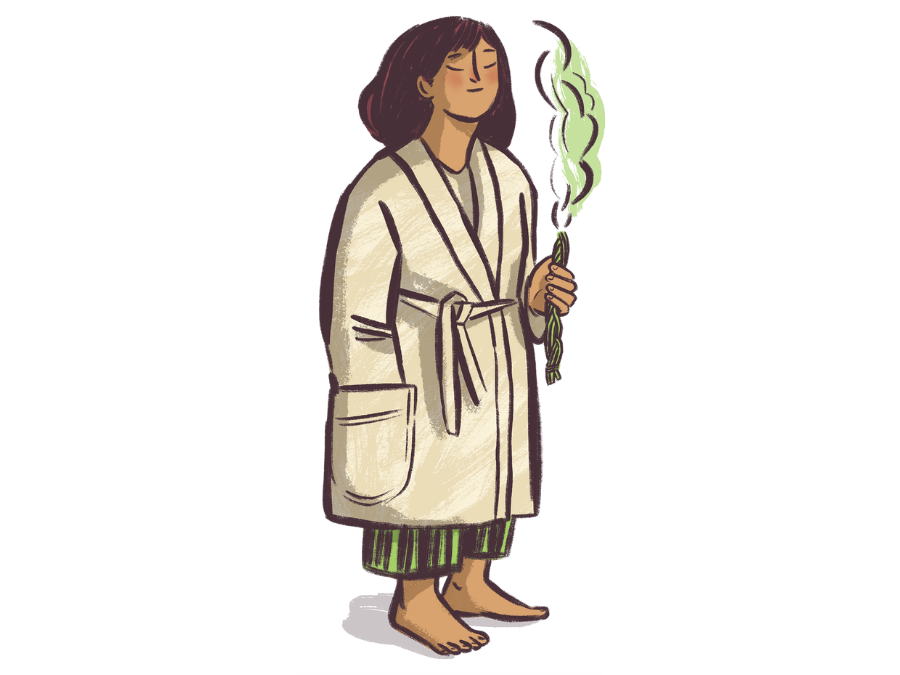
On March 19, Broadview published the digital story, “The everyday ceremony that grounds me during Lent,” written by Rev. Shane Goldie, a Two-Spirit Cree-Métis United Church minister.
Goldie’s story was also featured in the March/April 2026 print issue and reflects on his use of sweetgrass within his Christian practice as an Indigenous person.
You may unsubscribe from any of our newsletters at any time.
While the piece was generally well received, one commenter questioned where Christianity was evident in the article and requested supporting Bible verses.
Goldie responded with this thoughtful biblical reflection on the intersection of his Indigenous culture and Christian faith. Drawing on scripture, he offers a meditation on the many ways people of all cultures and nations live out the Gospel.
From Shane Goldie:
Thank you for your honesty. I want to receive your words with the same care and seriousness that you are asking for. Scripture matters deeply to me. Christ matters deeply to me. This is not a conversation I take lightly.
I am an ordained Christian minister in The United Church of Canada. I hold both a bachelor’s degree in theology and a master of divinity. My life, my call and my ministry are rooted in Jesus Christ, in scripture and in the living presence of God. I also walk with and honour Indigenous spirituality, and I do not see these as competing paths, but as places where the fullness of God’s truth is revealed more deeply.
If the question is whether creation, the land and practices that draw us closer to God through the physical world are biblical, the answer is yes, profoundly so.
Scripture begins with creation. “In the beginning God created the heavens and the earth” (Genesis 1:1). Again and again in Genesis 1, God calls creation “good.” Not separate from God, not disposable, but good, sacred and worthy of care.
Psalm 24:1 reminds us, “The earth is the Lord’s and everything in it.” Psalm 19:1 declares, “The heavens proclaim the glory of God; the skies declare the work of his hands.” Romans 1:20 teaches that God’s invisible qualities are understood through what has been made.
Creation is not outside of God’s revelation. It is one of the primary ways God speaks. When we pray with the land, when we pay attention to the wind, the water, the fire, the soil, we are not leaving scripture behind. We are stepping into it.
Even Jesus teaches this. “Consider the lilies of the field… look at the birds of the air” (Matthew 6:26–30). Jesus consistently points people back to creation as a way of understanding God’s care, provision and presence.
Now regarding the use of physical elements in prayer, this is also deeply biblical.
More on Broadview:
- The everyday ceremony that grounds me
- What fasting is teaching me this Lent
- What if Lent began with a question
In the Old Testament, God commands the use of incense in worship: “Let my prayer be counted as incense before you” (Psalm 141:2). In Exodus 30, incense is prescribed as part of holy worship before God. In the New Testament, this continues. In Revelation 8:4, “the smoke of the incense, with the prayers of the saints, rose before God.” Incense, smoke, scent, physical elements that engage the senses are part of biblical worship. This is not foreign to Christianity. It is embedded in it.
In many Christian traditions, including Anglican and Roman Catholic churches, incense is still used today as a symbol of prayer rising to God. When Indigenous Peoples use sage or other sacred medicines in a prayerful way, it is not outside of this pattern. It is another expression of the same deep truth, that our whole being, body, breath, senses and spirit, are invited into prayer.
God is not limited to one cultural expression. Scripture affirms this clearly. In Acts 17:28, Paul says, “In him we live and move and have our being.” In Acts 10:34–35, Peter declares, “God shows no partiality, but in every nation anyone who fears him and does what is right is acceptable to him.” And in Revelation 7:9, we are given a vision of heaven that includes “every nation, tribe, people and language” worshipping before God. Not erased into sameness, but brought fully as they are. God meets people where they are, within their culture, their language, their land.
As for the name “Creator,” this too is deeply biblical. God is named Creator throughout scripture. Isaiah 40:28 says, “The Lord is the everlasting God, the Creator of the ends of the earth.” Many names are used for God across scripture, each revealing something of God’s nature. Using the name Creator is not abandoning Christianity. It is affirming one of the most foundational truths about who God is.
So when I speak of Creator, when I honour the land, when I engage practices that draw me into prayer through creation, I am not stepping away from Christianity. I am stepping deeper into a biblical understanding that God is present in all things, revealed through all creation and not confined to one cultural form of worship.
I follow Jesus Christ. I preach the Gospel. I believe in the life, death and resurrection of Christ as central to our faith.
And I also believe that the Spirit of God has been moving long before any church structure existed, and continues to move in ways that call us to humility, to listening and to deeper relationship with God, one another and the earth.
This is not about making Christianity optional. It is about recognizing that God is bigger than any one expression of Christianity. If we are going to be biblical, then we must also be honest about this truth: God’s presence cannot be contained, controlled or limited. As scripture says, “Do I not fill heaven and earth?” (Jeremiah 23:24).
There is room in the body of Christ for both deep commitment to Jesus and deep respect for the ways God is revealed through creation and culture.
I share all of this not to argue, but to invite. To invite a broader, deeper, more expansive understanding of the God we both seek to follow.
***
Rev. Shane Goldie is a Two-Spirit Indigenous theologian, writer and spiritual leader. He is the youngest ordained minister in The United Church of Canada and serves at St. Andrew’s United in Spruce Grove, Alta.
His story first appeared in Broadview’s March/April 2026 issue with the title “Offerings of smoke and sweetgrass.”
Thanks for reading
Independent journalism rooted
in faith and justice is under threat
Broadview is the only media organization in Canada offering thoughtful, values-driven journalism from an inclusive, progressive Christian perspective. But our work depends on your support. If you value what you've just read, please act now.
A gift today helps keep this journalism alive tomorrow.
With gratitude,








If this article is referring to my comments, I’m not sure where I stated ‘Show me where the Bible mentions sweetgrass,’.
As I mentioned to another reader, “Christianity is NOT based on animistic or pantheistic theology, to teach Christians otherwise is a sin.”
I was not going to further this, but now it seems an issue. When I make a comment in Broadview, I make them with the intent for others to use the Berean methodology found in Acts 17:10-13. We as Christians are called to prove our faith.
Your credentials are admirable, but totally irrelevant. Pharisees were the lawyers of their day, and we all know what Christ thought of them. Most of the 12 disciples were uneducated, and we all know what Christ thought of them.
The Christian God is a jealous God. (Exodus 20:4-5) God also states “I am the LORD; that is My name! I will not yield My glory to another or My praise to idols.” (Isaiah 42:8)
Paul warns us about the dangers of worshipping nature in Romans 1. He makes this statement ” They exchanged the truth about God for a lie, and worshiped and served created things rather than the Creator—who is forever praised. Amen.”
Yes, ““In the beginning God created the heavens and the earth” (Genesis 1:1). Again and again in Genesis 1, God calls creation “good.”” Yet mankind was created unique from the rest of creation (Genesis 1:26). Not that we should abuse it, or neglect to thank God that He has blessed us by it, but we are not to worship it.
The human race through Adam has defiled what was good. Romans 8 – “For the creation was subjected to frustration, not by its own choice, but by the will of the one who subjected it, in hope that the creation itself will be liberated from its bondage to decay and brought into the freedom and glory of the children of God. We know that the whole creation has been groaning as in the pains of childbirth right up to the present time.” Creation doesn’t pray. It reveals, both God’s Glory and blessings, and sadly reveals the the effect of our fallen nature.
In regards to Exodus 30 and incense you conveniently left out verse 9. The New Testament does not require or demand incense. Matthew 5:17 implies that the burning of incense is no longer required. If we pray in the Spirit, we do not need “aids” to get them to God. If we do, we are into legalism or mysticism. Romans 8: 26 shows us that prayer is through the Spirit,
In regards to cultural expression, I apologize if I sound legalistic, it is not intentional (1 Corinthians 8 addresses that issue). I am concerned about the animistic and/or pantheistic theology that is heavily implied by your article and often used in Indigenous religion. If the cultural expression maintains a different theology than Christianity, that is where the problem lies.
God’s omnipresence is His ability to be present everywhere at all times. Pantheism believes that God is creation rather than separate from creation. Not as you say, “I am stepping deeper into a biblical understanding that God is present in all things”
Your relationship with Christ is between you and Him. I can question your motives, “Preach the word; be prepared in season and out of season; correct, rebuke and encourage—with great patience and careful instruction.” – 2 Timothy 4:2
Thank you for taking the time to reply to my comment.
Christianity has from the beginning always had an element of inculturation – that is it took, and transformed elements of local culture infusing it with Christian meaning and symbolism. I see no reason why sweetgrass is different from any other local herbs, plants and flowers (check out Polish “palms” on Palm Sunday).
Polish palms for luck? I think you should have used a different analogy.