Opponents are describing changes to the Ontario Student Assistance Program (OSAP) for university students as a “debilitating attack on education,” with comments from Ontario Premier Doug Ford adding fuel to their outrage.
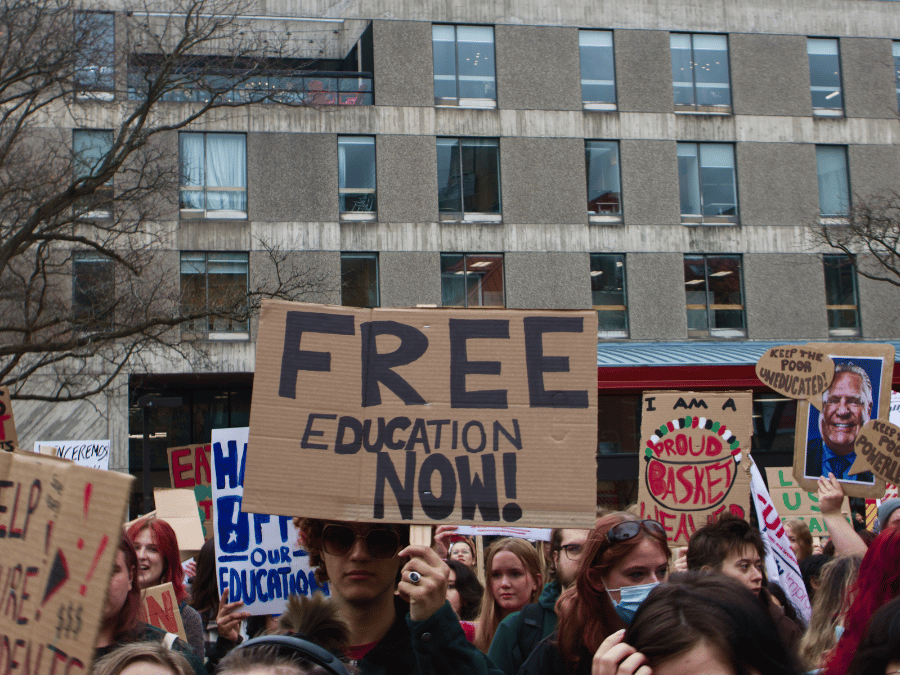
On Nov. 5, an estimated 250 University of Guelph students participated in a province-wide walkout as part of the “Hands Off Our Education!” movement. Students protested the province’s February tweaks to OSAP, which reduce grants and increase students’ reliance on loans.
You may unsubscribe from any of our newsletters at any time.
Previously, students could receive up to 85 percent of OSAP as non-repayable grants. As of Aug. 1, grants are capped at 25 percent, with students owing the remaining 75 percent as loans.
Rebecca Hallett, an undergraduate student at the University of Guelph and spokesperson for Guelph Students Against Austerity, which helped lead the Nov. 5 walkout, says that although education is essential, the OSAP changes treat university as a privilege.
“Education is one of the most critical things,” they told Broadview. “You could argue it’s why Doug Ford is attacking it.”
After the walkouts, Ford labelled protestors “sheep” who blindly follow what “looney tunes” post online. Hallett called him “out of touch.”
“People are struggling to figure out if they’re going to be able to finish their undergraduate degree,” they said. “There’s an incredible amount of uncertainty… his comments are both dismissive and insulting.”
Daniel Corral is an assistant professor of higher education at the University of Toronto and researches how financial support programs influence students’ success.
“[Programs] like OSAP matter immensely in terms of making sure students are able to access higher education,” he said.
“Oftentimes, students are working 15+ hours a week. If you’re adding even more hours on top of that [to make ends meet], at a certain point, there’s going to be negative effects on a student’s academic performance.”
More on Broadview:
- How expensive music programs are stunting students’ education
- Meet the changemaker empowering B.C.’s international students
- Amid anti-trans rhetoric, these faith leaders strive to offer sanctuary
Students may also reconsider their choice of program based on future job prospects. Interest begins to accrue on the Ontario portion of OSAP loans after graduation, though repayments are not required for six months.
After the changes were announced in February, Premier Doug Ford defended them by encouraging students to pursue in-demand jobs.
“I mentioned to the students, you have to invest in your future, into in-demand jobs,” he said.
In a difficult job market with fewer entry-level opportunities, it is hard to predict which fields will be in demand. The Ford government’s funding choices currently portray liberal arts degrees as less employable.
“I think this really devalues all the valuable things we get from English classes, from history classes… there’s less excitement in these programs, less support,” Corral said.
Recently, the provincial government invested $176 million to fund 6,269 additional spots at the University of Guelph, with a goal to “connect more students to good-paying, in-demand careers.” This funding is directed exclusively to STEM and trades programs.
Prospective students may reconsider attending university based on cost or program choice.
“[Accruing loans] forces students to think from the get-go: ‘This is what I want to do, and I’m only going to stick to it because I know it’s going to pay off,’” Corral said.
***
Andreea Burlacu is a Hamilton, Ont.-based journalist passionate about arts, culture, and community.
Thanks for reading
Independent journalism rooted
in faith and justice is under threat
Broadview is the only media organization in Canada offering thoughtful, values-driven journalism from an inclusive, progressive Christian perspective. But our work depends on your support. If you value what you've just read, please act now.
A gift today helps keep this journalism alive tomorrow.
With gratitude,