
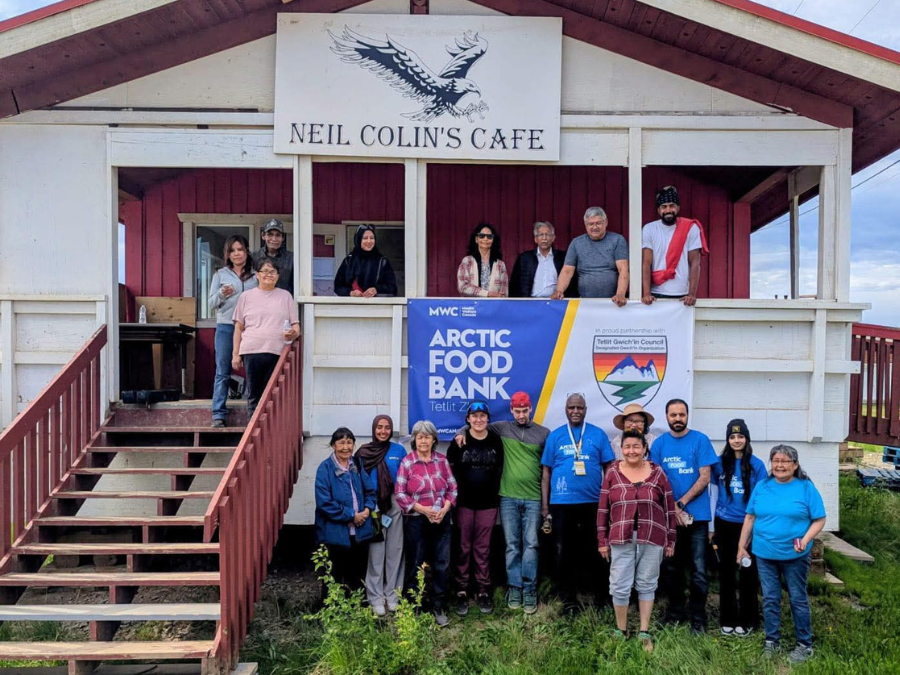
For the first time, residents of Fort McPherson, N.W.T., have a local food bank — a milestone community leaders say has become necessary as soaring grocery prices leave more families struggling to afford food.
Launched by Muslim Welfare Canada and the Tetlit Gwich’in Council, the food bank will distribute groceries twice a month to about 100 registered families in the remote Gwich’in community of roughly 800 people.
You may unsubscribe from any of our newsletters at any time.
“The overwhelming response was just awesome,” Diane Koe, president of the Tetlit Gwich’in Council, told Broadview. “Everybody was so excited and grateful. We had a steady flow between 2-5 p.m. and then I got phone calls from people saying they missed out on the first distribution.”
Situated along the Dempster Highway and 121 kilometres south of the town of Inuvik, Fort McPherson used to serve as the main trading post for the Hudson’s Bay Company in the Mackenzie Delta for over 50 years. Teet’lit Zheh, the Gwich’in name for the hamlet, translates to “place at the head of the waters,” reflecting its location above the east bank of the Peel River and facing the Richardson Mountains.
The food bank idea emerged after Koe learned at a conference in Toronto last December that Fort McPherson was the only Gwich’in community in the Northwest Territories without one. On her trip home, she mentioned it to a Muslim cab driver who had helped establish the food bank in Inuvik. The conversation led to a partnership with Muslim Welfare Canada — the organization that runs the Arctic Food Bank in Inuvik — and the Fort McPherson food bank opened on June 22.
Koe said the service will help ease the burden of high food costs in the remote community, where many families struggle to afford fresh groceries after paying for housing costs, winter clothing, and fuel and wood to heat their homes.
Like the food banks in Inuvik and Iqaluit, the food bank in Fort McPherson is providing perishable and non-perishable items, including halal meat, to residents twice a month. The products are trucked to the community via the Dempster highway from Edmonton, the closest city for bulk purchases at southern prices.
While Inuvik and Iqaluit food banks are often run by mosque volunteers and housed in a common space at the mosque, the food bank in Fort McPherson is run predominantly by members of the community, with support from the food bank manager in Inuvik, and is housed in the building of a former cafe.
More on Broadview:
- The true cost of food: High grocery prices are not the root issue
- How one community leader is fighting for food security in Newfoundland and Labrador
- Our children are risking their lives on the front lines of a burning planet
Data collected by Statistics Canada in the Canada Income Survey shows that 24 per cent of Canadians lived in a food-insecure household in 2025. Nunavut has the highest rate of household food insecurity in the North, affecting 56 per cent of residents (21,600 people). In the Northwest Territories, 16 per cent (7,000 people) live in food-insecure households, compared with 15 per cent (5,500 people) in the Yukon.
Muhammad Iqbal Ali, president of the board at Muslim Welfare Canada, attended the opening in Fort McPherson and said the need for food banks is growing across the country, given that grocery store prices have risen over the last 3-5 years by 22 per cent.
Food banks have also been a meaningful way to build bridges between Indigenous, Muslim and migrant communities on the ground, he adds. “When immigrants first moved [to Inuvik], they were seen as people who had come into the North to take the jobs away from the Indigenous community. Since we have operated a food bank, the relationship between the Muslim immigrant and the local Indigenous community has improved. It’s heartening because we know Indigenous communities have suffered over the last 100 years,” Ali said.
“We firmly believe it is our responsibility to take care of the less fortunate amongst or around us,” Ali added. “They could be in any place or from any ethnicity. Islam requires us to take care of our neighbours.”
***
Meral Jamal is an independent journalist based in Iqaluit, Nunavut.
Thanks for reading
Independent journalism rooted
in faith and justice is under threat
Broadview is the only media organization in Canada offering thoughtful, values-driven journalism from an inclusive, progressive Christian perspective. But our work depends on your support. If you value what you've just read, please act now.
A gift today helps keep this journalism alive tomorrow.
With gratitude,





This was very heart warming!