Last month, Canada’s former environment minister Steven Guilbeault resigned as an MP, accusing the federal government of rolling back environmental protections in favour of economic priorities. His departure reflects a deepening tension at the heart of Canada’s climate strategy, as Ottawa struggles to reconcile its competing climate and industry commitments.
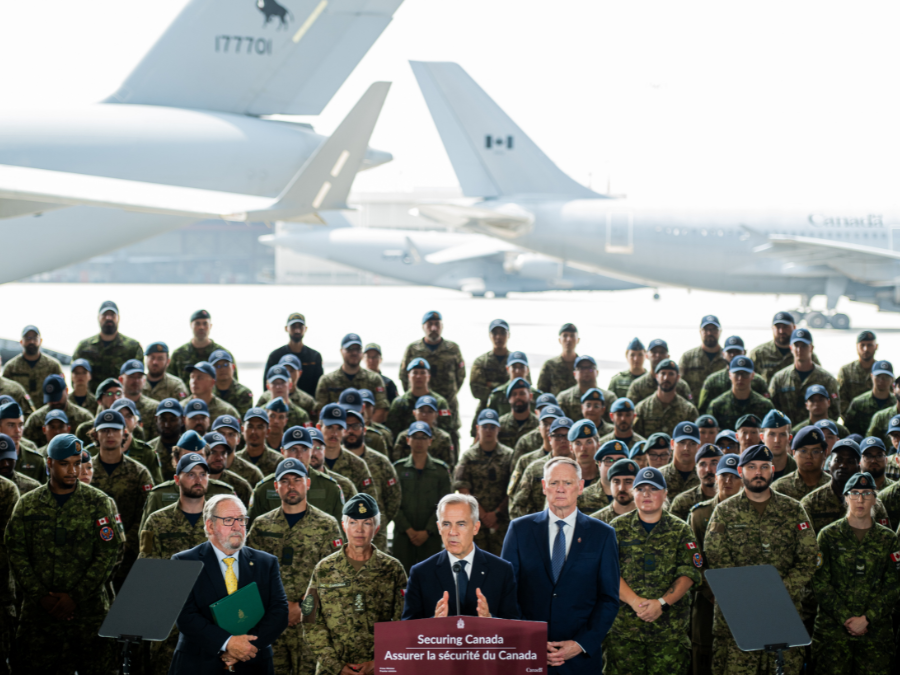
That tension is about to become harder to manage with Canada’s 2030 target to reduce greenhouse gas emissions by 40–45 percent below 2005 levels quickly approaching. Federal policymakers have promised ambitious climate action. But there is still a significant blind spot for Canada’s largest federal emitter: the country’s military. In order to fulfill its climate promises and reliably mitigate emissions, Canada must close this accounting gap by finally measuring and reporting its defence emissions.
You may unsubscribe from any of our newsletters at any time.
Military activity and its vast supply chains represent one of the largest unaccounted sources of greenhouse gas (GHG) emissions in the world and are estimated to account for approximately 5.5 percent of global emissions during peacetime. Yet these emissions remain inconsistently tracked, voluntarily reported and excluded from global climate accounting frameworks.
Canada’s defence sector is emissions-heavy. In 2023-2024, it reported up to 547 kilotonnes of greenhouse gases emitted—the highest of any federal department. The military relies heavily on fossil fuels for its energy supply, spending over $500 million annually on petroleum, with 70 percent allocated for its fleet and 30 percent for real estate.
The Department of National Defence (DND) and Canadian Armed Forces account for about 60 percent of the federal government’s total GHG emissions, according to 2019 data. These emissions are expected to rise considerably with expanded military budgets and operations. While other sectors are decarbonizing, Canada is locking in decades of emissions with its fleet purchases and base expansion.
In June 2025, Canada committed alongside NATO allies to raise defence spending to 5 percent of GDP by 2035 — a budget of $150 billion per year. As Canada’s defence emissions remain exempt from the national carbon reduction targets, there is no public accounting for what this military expansion means for Canada’s climate targets.
- Canada’s military emissions are standing in the way of its climate change commitments
- A Ukrainian soldier on surviving Mariupol and Russian captivity
- United Church General Secretary on the ‘awful’ situation in Cuba
The DND has no public plan to achieve net zero by 2050 and directly states that federal reduction targets will not apply to the National Safety and Security fleet. As the highest emitting department of government, this lack of reporting or reduction plans raises serious questions about the viability of Canada’s net-zero commitments.
Defence spending has been absent from climate accounting for decades. In 1997, military emissions were excluded from the Kyoto Protocol following lobbying by the United States. The 2015 Paris Agreement made reporting military emissions voluntary, with zero countries required to report any data to the United Nations Framework Convention on Climate Change (UNFCCC). To date, Canada only reports fuel consumption from military vehicles, leaving out a vast majority of its emissions from operations, real estate, fuel burning and the impacts of its weapons use abroad.
Canada has acknowledged the need to reduce the climate impact of military activities with plans to host the NATO Climate Change and Security Centre of Excellence in Montreal, a hub for research and training on how climate change impacts military activities. However, without any plans to include DND’s emissions into national targets and require a full scope of reporting, the claims of this centre to promote climate mitigation as a security measure will not be fully supported.
As NATO Secretary General Stoltenberg said at COP26 in 2021: “There is no way to reach net zero without also including emissions from the military.” With COP31 approaching in Turkey this November, Canada has an opportunity to demonstrate climate leadership not only through international pledges, but through domestic accountability. That starts with requiring the DND to measure and report its emissions — as every other federal department does.
***
Randa Ali is a freelance journalist whose work focuses on sustainability and the intersections between climate, culture and social issues.
Thanks for reading
Independent journalism rooted
in faith and justice is under threat
Broadview is the only media organization in Canada offering thoughtful, values-driven journalism from an inclusive, progressive Christian perspective. But our work depends on your support. If you value what you've just read, please act now.
A gift today helps keep this journalism alive tomorrow.
With gratitude,