
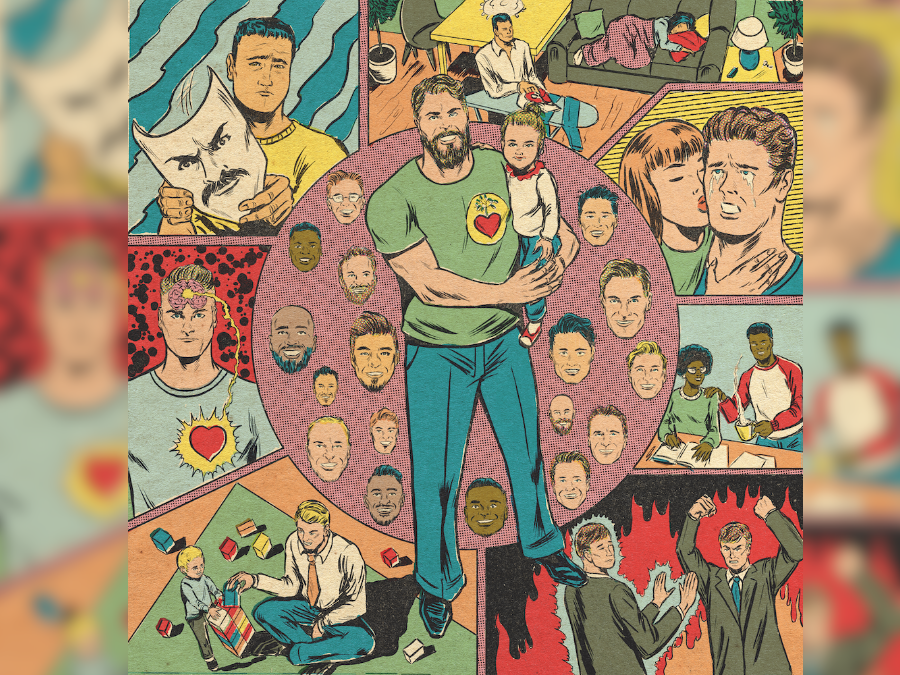
“Are men okay?”
This is less a question than a meme — an observation on the quality of heterosexual men today, who seem to be responding to the erosion of traditional male entitlements with a defensive insecurity that’s hard for the women around them not to notice. Men are debating muscle-building creatine stacks, obsessing over jawlines, reframing inclusion as “reverse exclusion” and helping boost the Turkish economy through its multi-million-dollar limb-lengthening surgical industry.
You may unsubscribe from any of our newsletters at any time.
And that’s before you ask the women dating them, many of whom have been texted a polemic grievance for the mortal crime of declining a second date. More than any media, dating apps have given women unprecedented insight into the very average man — and by most accounts, he is not okay. It’s no wonder that some men can only seem to find true joy in catching a modestly sized fish.
But “not okay” doesn’t quite capture what’s going on. What these encounters are really exposing is a deeper uncertainty — from both men and women — about what it means to be a “good man.” And more broadly, what it means to be a man at all.
The scripts that once defined a good man were relatively clear: hard-working, economically stable, honest and devoted to his family. Some version of that heterosexual ideal has held across cultures, but in retrospect these were merely decent men.
We were not expected to be emotionally fluent, self-interrogating or conscious of our power in the ways demanded of us now. Nor were we expected to take the same share of domestic responsibilities, put in equal parenting hours, speak more than just one love language, show an openness to watching Heated Rivalry but also a willingness to leave the house so our partners can watch it with their girlfriends, have our own friends (real ones, not just “buds”) with whom we can discuss our problems, thus removing some of the emotional labour women are expected to carry for us, plan a vacation, afford a vacation and take some pride in our appearance.
Third-wave feminism has raised the standard for “a good man” — and faster than we can keep up. The result is a kind of conceptual lag: we’ve outgrown the old definition of a good man, but we haven’t agreed on what should replace it.
In some ways, it’s never been a better time to be a man. The traditional model of masculine strength and stoicism comes at a social cost: higher rates of suicide, premature death, substance abuse, criminality. But men are no longer confined to the “man box” — that narrow prison of toughness, self-reliance and emotional repression. Of course, queer communities have long pushed against rigid gender roles and modelled more varied ways of living, loving and belonging, even while carrying their own burdens under masculinity’s rules and often suffering most for challenging them. For many straight men, that broader script is only now becoming legible. It’s a privilege far better than anything offered by traditional patriarchy, and one I’m trying to pass on to my six-year-old son. But truth be told, even at 40 it feels like I’m still trying to convince myself of this, because the data suggests that in reality, men are less okay than ever.
More on Broadview:
- We still exclude and undervalue dads. That hurts moms too.
- Russel Brand, Andrew Tate and the performance of faith
- As we approach the future of feminism, this is the new masculinity
While the expanded definition of womanhood over the past 60 years has improved women’s lives by narrowing income and employment gaps and fully reversing the education gaps, the expanded definition of manhood hasn’t done much in reverse for male well-being. As a demographic, men appear to be falling further behind economically, academically, socially and emotionally.
They are still more than twice as likely to struggle with — or die from — addiction and report significantly higher levels of loneliness. Since 1999, male suicide rates have climbed sharply — first among middle-aged men and more recently among younger men, with deaths rising by roughly 30 percent among those aged 25 to 34.
But perhaps the statistic that best captures men’s shrinking sense of status shows up in dating patterns. Scott Galloway, a New York University professor and author of Notes on Being a Man — one of several recent books attempting to pin down a definition of modern masculinity — points out that only one in three men under 30 reports having a girlfriend, while two in three women under 30 report having a boyfriend. At first glance, it sounds mathematically impossible. But women, on average, are dating older, explains Galloway.
They’re seeking partners who are more economically and emotionally stable, which has left a large cohort of younger men effectively locked out of the most basic form of social belonging. “Men are not attaching to school; they’re not attaching to relationships; they’re not attaching to work,” Galloway said in a Vox Media podcast interview in 2024, pointing to a more fundamental estrangement beneath the insecurity.
This disconnect has opened the door to answers in the form of self-improvement hacks, which, on the extreme end, can involve DIY bone smashing in pursuit of a better jawline. Status has become proof of worth. Meanwhile, the online world of misogyny, dubbed the “manosphere,” is selling young men versions of confidence, discipline and ambition that, stripped of their integrity, are as toxic as they are intoxicating.
What scares me most is not that these men exist, but that they speak to a real vulnerability — one I recognize in myself and suspect my son will feel even more acutely. I want to raise a good man, but when I’m still scrambling for a concept of positive manhood myself, how do I compete with voices that wrongly claim to have figured it out?
This was the dilemma Kiri and Duane Wysynski had faced with their 18-year-old son, Alex. I met them at a mutual friend’s 40th birthday party, where they told me they had spent the last few years trying to understand a change in him that at first seemed admirable. Alex was exercising more, eating better and taking sleep seriously. But when they asked what had prompted it, Alex mentioned a few YouTubers. The one name that raised alarm bells was Andrew Tate, a swaggering online star who speaks to boys in the language of motivation — get fit, get rich, take control of your life — but ties it to something far uglier: the idea that women exist to be managed, used and conquered. (Tate and his brother, Tristan, are currently facing separate criminal charges in Romania and the United Kingdom, including human trafficking, rape and organized exploitation of women.)
A few days later, Alex and I spoke on the phone for an hour and a half. He told me his flirtation with the manosphere started in Grade 8, during the early days of the pandemic. He felt untethered in the way many teenage boys did. He wasn’t especially awkward, unattractive or unpopular. He just felt unbearably average and directionless. “I wasn’t anything extraordinary,” he said.
One day, YouTube served him a video by Hamza Ahmed, a young British self-improvement guru whose tone felt more intimate than the usual algorithmic sludge. The video was called something along the lines of “You Need to Focus.” Ahmed’s pitch was simple and straightforward: modern young men were distracted — and with enough discipline, routine and “stoicism,” they could become something more. It gave Alex the language to describe a feeling he couldn’t yet name.
He started watching Ahmed’s back catalogue and latest drops. When the messages shifted from self-improvement for its own sake to self-improvement as a means of acquiring status in pursuit of women, Alex, a thoughtful young man now taking philosophy classes at the University of Alberta, was wise enough to recognize them as problematic. Still, he kept watching, expanding into other manosphere voices — though he says that brand of stark machismo appealed to him far less.
After pandemic restrictions lifted and he could return to school, Alex began hearing some of the same new terms echoed by his male peers: “gains,” “stoicism,” “beta,” “foids.” It felt as though they had stumbled onto a hidden formula for success — “a secret society,” as Alex told me. He admits their conversations about women could turn derogatory — and for some, that tone hardened into casual contempt. “I’m lucky it didn’t alter me in that way,” Alex told me, “but I know others who it did.”
When his parents caught on, he was defensive at first, but appreciated the way they gently guided him to his own critiques. Instead of confiscating his phone and turning it into a moral panic, they challenged him, kept talking and trusted that he would think his way through it. Looking back now, Alex recognizes that what was missing from his teenage years was structure. Since then, he’s kept up the healthier lifestyle habits, but has shed the victim mentality that came with it. And he has a long-term girlfriend.
When I asked him what makes a good man, Alex paused, thought about it and finally said that it isn’t all that different from being a good person: someone who is ethical and caring, except he should be especially aware of the power and advantages he carries. Notably, he should try to use that responsibly, rather than to dominate.
I heard something similar from a group of teenage boys who meet occasionally in a facilitated peer group run by Next Gen Men, a Canadian organization that supports boys and young men through mentorship and workshops focused on healthy masculinity. They were navigating all the same insecurities, the same toxic content that seems to surface whether they seek it out or not. “A good man is just a good person,” they told me.
Then — and with some trepidation about what this might reveal about me — I put the same question to my son. To my relief, he did not say, “sick gains.” “Being a good man is just being a good person,” he said.
There was something hopeful in the consistency of these answers. Boys who had inherited a more complicated worldview than our elders seemed to arrive at the same humanist ideal — one grounded more in integrity than power. But it was still an abstraction, lacking the kind of practical instruction some are clearly yearning for. If I wanted a definition with more shape, I’d have to look a generation or two up. So I called my dad who, evidently, had been waiting 40 years for this conversation.
After taking five minutes to put together some thoughts and call me back, he told me that a good man, first and foremost, respects himself. He works hard, takes pride in what he does and sees it through to the end. Without that, he can’t be truly successful — another good man trait. He does his job honestly without thinking too much about what he’ll get in return, trusting that happiness will follow. He added that a good man is an optimistic man.
Just when I thought he was done, he called back a minute later. “The last thing,” he said, “you have to have patience. Don’t give up.” It landed with just enough specificity to feel personal. No doubt, my dad was shaped by Lebanon’s macho culture, but the values he listed — self-respect, discipline, patience, honest work — are universal. For the most part, those lessons have served me well. They’ve given me discipline, confidence and a sense of purpose I’m proud to carry.
But that same focus on success has, at times, pulled me away from the people I love. I often struggle to separate ambition from self-worth, and I’ve prioritized it over the emotional needs of my children and partners. This played a role in the fracturing of my marriage three years ago and in the other breakups that followed. As my dating history shows, I also never fully absorbed my father’s lessons in patience.
I know this is not an uncommon struggle among men my age, as we try to evolve positive masculinity to meet new cultural expectations without losing the parts of ourselves that gave us structure, purpose and pride. This reveals how quickly the definition of a good man can shift across generations — from something inherited and clearly prescribed to something far more open and, for better or worse, ambiguous. Jake Stika, the founder of Next Gen Men, prefers to call it an “expanded” definition of masculinity, though he appreciates how unsettling this is for some. Just having a conversation about masculinity is “like a bomb on the table that everyone is scared to touch, lest it blows up.” The old instructions that came in the “man box” — physical strength, stoicism, self-sufficiency, sexual prowess — have no doubt been psychologically damaging to many if not most men, but like an IKEA manual, their simplicity made them easy to follow and endure. But now the box is half-open, the parts spilling out, and no one is entirely sure what to take out or add in. For Stika, though, that’s the opportunity.
That openness creates a kind of moral breathing room. The boys I spoke to weren’t wrong to say that a good man is just a good person.
In its own feminist way, this definition rejects the notion that men should have any special moral category at all. But it’s also an incomplete definition. Because while men may be freer to rewrite manhood, women still hold considerable authority over what constitutes a “good man.”
Across every real-world and online environment, women have borne the brunt of not very good men. The phrase “a good man” has always carried a note of doubt — ever since blues singer Eddie Green, writing from the perspective of an emotionally and physically bruised woman, first penned “A Good Man Is Hard to Find” more than a century ago. In late American author Flannery O’Connor’s 1953 short story of the same title, goodness feels less like a stable trait than something nostalgic. Nearly a century later, women on the apps are still asking, with the same resignation: is a good man actually that hard to find?
Apparently, yes. Research on modern dating shows that men, despite “swiping right” like they’re trying to clear snow off a windshield, often feel frustrated by a lack of replies. The abundance of options, paradoxically, seems to make it harder — not easier — to find a good man. Or maybe it’s raised the standard of a “good man”to a performance level for which most men have received no training.
It has certainly produced an algorithm that pushes concepts like “princess treatment” (a type of curated effort from men) and “sprinkle sprinkle” (a tongue-in-cheek mantra encouraging financial validation of a woman’s worth). Framed as acts of self-respect and self-preservation, these ideas read as correctives to the so-called pink tax.
But they are also convincing women to embrace a return of traditional masculinity — something I didn’t recognize until I started dating into it.
In one recent relationship, emotional vulnerability and fluency was appreciated right up until it collided with older expectations about who should lead, open doors and instinctively know what to do. The breakup arrived as a performance review about “unaligned values.” I admit it left me feeling misled by
years of working on myself to shed my masculine armour. For a while, I wondered whether the softer virtues I’d acquired in return were actually liabilities.
I don’t believe that, but I do think that a technology meant to improve romance has, in fact, made it much worse.
***
In the hands of a straight woman, the apps are a microscope for the male brain, but in the hands of straight men, they’re a kaleidoscope, fracturing women into distorted, confusing patterns. Even those men who advance to an in-person meeting often aren’t equipped with enough questions to earn them a second. It’s the number one complaint I hear on my own dates.
Luckily, I don’t have this problem. A conversationalist by instinct (and by profession), I have a distinct skill for the interview process — one I was eager to use in service of you, the reader.
As tempting as it was to turn my profile into an interview forum, I instead reached out to about half my exes and dates from the past three years. For my own self-preservation, I chose the half that I guessed were least likely to screenshot my request for the internet and bless me with my own “Are men okay?” viral moment. At worst, I figured they might inflict passive damage by forcing me to confront a poorly veiled reflection of my own shortcomings.
So, one by one, I asked: “What does it mean to be a good man today?” Their answers came quickly and with a clarity that felt hard-earned. “There are so many ways to be good,” wrote my ex-wife. “But if I had to specify qualities, a good man genuinely cares about the people in his life….He’s introspective and willing to take accountability. He’ll utilize his power to support those with less.”
The dancer/choreographer (who insisted her liberal perspective be noted) framed it as a type of conscientiousness. “A good man is aware of what he learned about being a man from his father, grandfather and upbringing and has a clear perspective on whether that example is who he wants to be.”
The aesthetician said it meant having basic decency and integrity and being true to your word. She then updated me on her latest dating horror story — getting romantically involved with a covert white supremacist — and added, “so…not being a Nazi?”
The spa manager offered a more practical standard. “A provider: of safety, of radical care and consideration. I think good men are the steady ones.” In other words, “Who am I calling in an emergency?”
The doctor was more clinical in her prescription: “Safe. Trustworthy. Accountable. Open to repair. Humble. Respectful. Vulnerable.”
The Icelandic artist was especially reflective in her voice memo while pushing her infant son through Reykjavík. “Today, being a good man is more about having insight into yourself. Someone who understands that they already have a certain level of privilege.” She saw this moment as especially fraught. Men are facing criticism that is often deserved, she said, but many experience it less as accountability than as an attack. She traces this defensive reaction to an inability to process criticism through their own insecurity. In her view, the problem is structural: the system allows men to sidestep confronting their insecurity and instead forces them to defend it. “I’ll just add one more thing,” she said. “I think men should be allowed to be insecure.”
There were differences in tone, but the throughline was unmistakable. A good man was defined by how well he understands himself and how he treats others. It is, in other words, a relational definition measured in impact. I just had one more followup for them: Are men okay?
“You tell me,” wrote the choreographer.
Right now, I don’t think so. The old script is gone and the new one is still in draft — partly because we, as a society, are so bad at having good-faith conversations about men’s well-being for fear of backlash, and partly because we, as men, rarely had the new masculinity modelled for us. We’re left to piece together a workable balance of old and new. It’s left a lot of men unmoored — some fatally so, falling back on destructive patterns when they can’t meet their own expectations of self.
But I think we will be okay if we recognize that this moment carries more advantages than disadvantages for ourselves than everyone around us. We just have to ride it out knowing that not all of the bruises we incur in the process will be fair.
A good man trusts.
***
Omar Mouallem is an author, filmmaker and multimedia producer in Edmonton.
This article first appeared in the July/August 2026 issue of Broadview with the title “What does it mean to be a good man today?”
Thanks for reading
Independent journalism rooted
in faith and justice is under threat
Broadview is the only media organization in Canada offering thoughtful, values-driven journalism from an inclusive, progressive Christian perspective. But our work depends on your support. If you value what you've just read, please act now.
A gift today helps keep this journalism alive tomorrow.
With gratitude,








I’m a longtime fan of Omar’s writing. My daughter Isabela introduced me to it several years ago, here in Edmonton. She writes, too, and already admired him as a writer and respected him as a person. Together she and I attended an event at the main EPL where we were able to “interview him”. Since then I ‘ve read most everything that he has published in magazines. Nothing has impresseď me more than this article on what makes a good man. So much so that I’ll be delighted to support Broadview from now on. Thank you!