
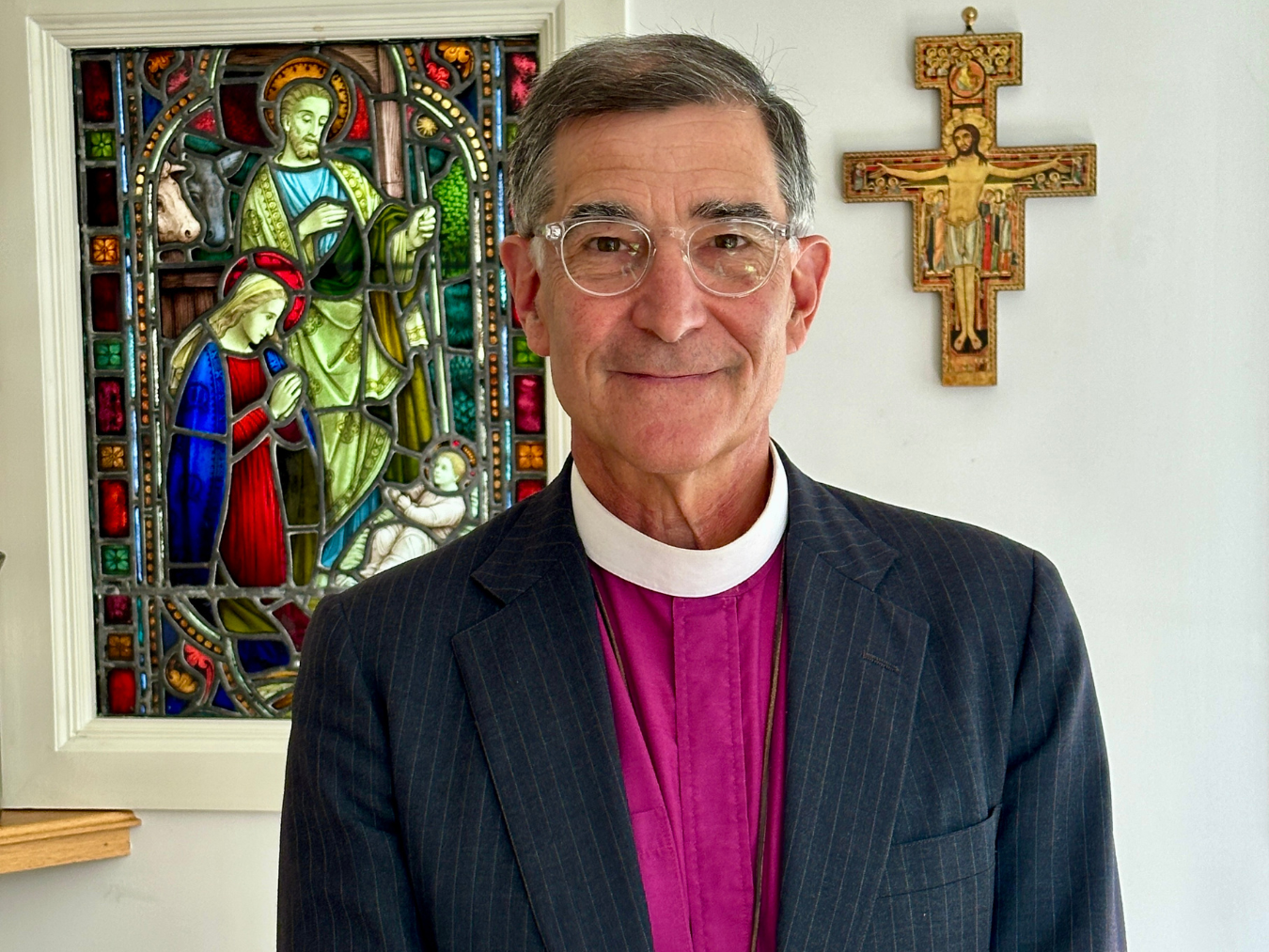
Bishop Robert Hirschfeld is the Episcopal Bishop of New Hampshire. After the fatal shooting in January of Renée Good by an ICE agent in Minneapolis, Hirschfield drew international attention when he called on clergy to ensure their wills are written in case they have to “stand between the powers of this world and the most vulnerable.” He spoke to Broadview’s Rev. Christopher White.
Christopher White: As we are speaking, the U.S.-Israel war with Iran has just started. What are your early thoughts on this?
You may unsubscribe from any of our newsletters at any time.
Robert Hirschfeld: I would say that it is yet another reminder of the human tendency to sin, and that we are living in a fallen world that seems addicted to resolving its differences and its struggles through force. I’m anxious. This is not to condone or justify the Iranian regime and its oppressiveness. But it seemed like we were moving towards some diplomatic resolution to avoid the proliferation of nuclear weapons in that regime [on CBS News a day before Iran was attacked, Oman’s foreign minister stated a peace deal was within reach]. But we just seem to go the way of violence. And we pray and continue to lean on the message of the prince of peace, Jesus.
CW: After Renée Good’s death, you made a statement that was viewed by thousands online. Can you talk to me about how you arrived at those words?
RH: I’ve been occupied with the passage of Scripture, the letter of Paul to the Philippians, chapter two, when Paul says [paraphrase]:
“Let the same mind be in you that was in Christ Jesus, who, though he was in the form of God, did not count equality with God as something to be exploited or grasped, but chose instead to empty Himself and take the form of a human being, and finding himself as a human being, takes the form of a slave and suffers death, even death on the cross.”
God chooses to go weak, to exercise power by being vulnerable and to derive power and authority by even dying. How do you exercise power by weakness, or how do you derive authority through vulnerability? That’s what we are called to do at this time.
CW: The North American context for many Christians has been pretty comfortable, but intervening physically — by showing up to protest or witness to injustice — is a very different thing. Do you think Christians in North America are ready for this?
RH: It’s very curious. I was surprised. I gave that talk that got some attention on a cold, rainy January day, after spending a week in prayer with some other bishops in contemplation and silence. I’m curious what is going on that would have captured the attention of so many people in such a favourable way. There’s been some detractors and some people who have raised some vehement objections to what I said. But I’ve been overwhelmed that this seems to have captured the spiritual imagination, the spiritual attention of people.
More on Broadview:
CW: How have the clergy in your diocese responded to your words?
RH: It generated a huge yawn. I’m in my 14th year as their bishop. I’m going to be retiring a year from now; they’ve heard this message before. I don’t know why they elected me, but it may be because of this.
We’ve seen a rise of Christian nationalism with this identification of God and God language with the military or the police force or just power itself. We’ve seen it in the wedding of the pathological obsession with guns in the United States to faith. The Second Amendment of the Constitution is being held up as though it’s holy scripture. We’re living in a perilous world, and to bear witness to God’s love is not always welcome. We are under the illusion that in North America it would be, but that illusion is being almost systematically and deliberately dismantled weekly.
CW: Why, in your view, have white evangelicals been so supportive of U.S. President Donald Trump?
RH: Underneath the social cleavages and the tearing of the social fabric is a theological problem, which is a discussion about the nature of God. Because what we want to believe in is a God of force, one who intervenes in a particular way, with bolts of thunder or with control and force and manipulation. And it looks like we have, in our president, a person who is not shy to say, “God is proud of me.” That’s a direct quote. And he seems to have plenty of people surrounding him who say this. There’s a kind of divine right to do something like bombing Iran. And that is not the God of the New Testament. Our God has chosen to do something else. That’s what the cross means.
CW: The U.S. Episcopal Church really seems to be rising to the moment. Why do you think that is?
RH: It used to be that a certain percentage of the nation’s population were Episcopalian. There was a sense of this collusion, or this identification of our denomination with worldly influence and power and prestige. We’ve been stripped of that identity. We’ve been coming to stand for racial justice, environmental justice, for peace, for non-violence, against gun violence. And I think we’ve got nothing to lose now, except the cross of Jesus. I simply want to stand in front of those who are vulnerable, because I think that’s what Jesus would do.
CW: What do you see as the future of the church?
RH: Bishop Dorsey McConnell of Pittsburgh once said to me that we “find ourselves at the foot of the cross. We’re no longer in a place of power or prestige or popularity. We’re Christians, and being at the foot of the cross is a beautiful place to be.” And I thought, wow. I never thought of the cross as being a thing of beauty, but there is some mysterious power and grace about being at the foot of the cross. I want to believe that God has us in these places for a reason. And it’s very freeing. You can get up and say things like, “We need to be prepared for a martyrdom.” You can say things like, “the powers of this world, the powers and principalities of this world are not of God.” You can say things that just sound like utter foolishness.
This past weekend, I confirmed a teenage girl in a small town in New Hampshire. She knows that this is not a denomination where all the fun is, but she recognizes that there’s something there. And I’m hoping that, as we find ourselves claiming the cross as the means of life, of solidarity with humankind, that we can find new purpose and joy in the church.
***
This interview has been edited and condensed for length and clarity.
Rev. Christopher White is a United Church minister in Hamilton.
Thanks for reading
Independent journalism rooted
in faith and justice is under threat
Broadview is the only media organization in Canada offering thoughtful, values-driven journalism from an inclusive, progressive Christian perspective. But our work depends on your support. If you value what you've just read, please act now.
A gift today helps keep this journalism alive tomorrow.
With gratitude,







Ironically, Hirschfeld states “pray and continue to lean on the message of the prince of peace, Jesus.” and yet he says, “I’m anxious”. He contradicts John 14:27. “Peace I leave with you, My peace I give to you; not as the world gives do I give to you. Let not your heart be troubled, neither let it be afraid.” (NKJV) The peace Christ gives as the “Prince of Peace” is “Shalom” which the Hebrew defines “to restore completely in regards to one’s mind, body and Spirit”. It has little to do with the Western definition of “no wars”. (I say “little” because of one’s Theological beliefs and interpretation – Christ is to reign 1000 years in peace) If Christ meant “worldly peace” why are we to expect tribulation (John 16:33 and James 1:2)?
Secondly, God NEVER goes weak. He restrains His power, but He never chooses to go weak. Christ never gave up His Deity, He walked on water, walked through a crowd of people wishing to stone Him, stilled a storm and waves together with the word “Stop!”, and raised the dead, not just once. Christ laid aside the benefits of being God, by becoming a man. Hirschfeld misinterprets verse 8 when quoting Philippians 2:5-8. Christ humbled Himself by being obedient. Christ was never vulnerable, Matthew 26:53 “Or do you think that I cannot now pray to My Father, and He will provide Me with more than twelve legions of angels?” NKJV With all power at His disposal, Jesus was in total command. He was not the victim of circumstance, but He managed circumstances for the fulfillment of prophecy. Christ WAS NOT weak, nor was He a martyr.
Third, “Why do you think ‘white evangelicals’ (may want to add males – get all the stereotypes) have been so supportive of U.S. President Donald Trump?” Could it be that liberalism has gone too far, too fast? I doubt most on the “right” truly like a narcissistic tyrant, it’s a knee jerk reaction from the Biden administration, and America’s fascination with populism and celebrity worship. (I mean in 2016 who heard of Ted Cruz?) But regardless of who the President is, God is the one who puts them there, either for blessings or for correction.)