
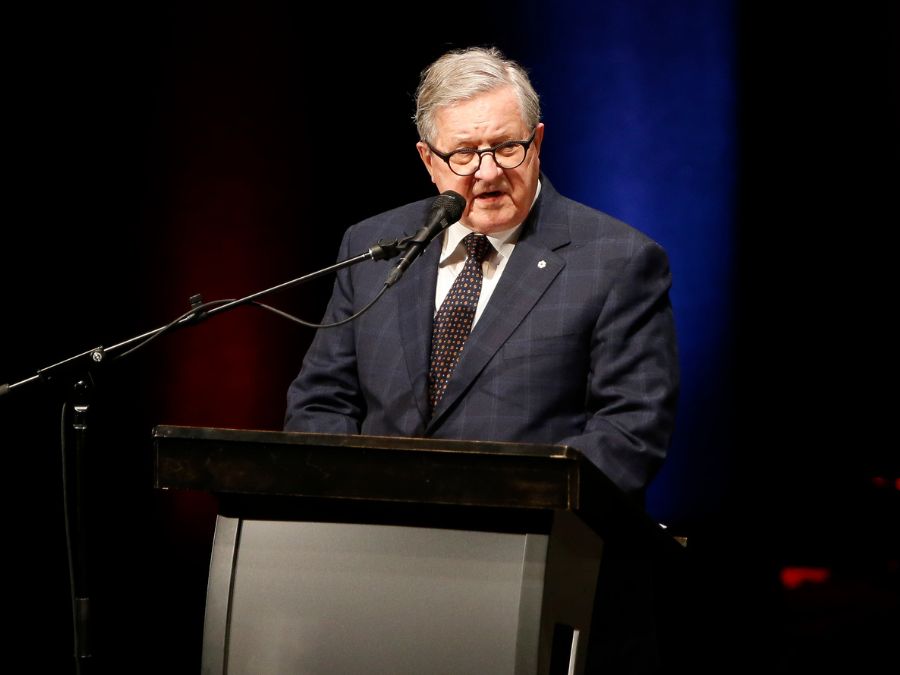
Lloyd Axworthy has served Canada over multiple decades through both politics and public service. He was in elected office provincially in Manitoba and federally for the Liberal Party for 27 years. From 1996 to 2000, he was Canada’s foreign affairs minister, where he championed the Ottawa Treaty banning landmines and was nominated for the Nobel Peace Prize.
He served as president of the University of Winnipeg, focusing on inclusive education for marginalized youth. He passionately believes in global institutions for solving global problems, and continues advocating for refugees and human rights.
You may unsubscribe from any of our newsletters at any time.
Axworthy spoke with Christopher White about the new U.S. doctrine of dominance in the Western Hemisphere — which it executed on Saturday when it entered Venezuela and captured President Nicolás Maduro and his wife — and what this current geopolitical moment requires from Canada.
Christopher White: The post-Second World War order that has held us together since 1945 is being shredded, and we are seeing the reintroduction of great power spheres of influence. How has the post-war order served Canada?
Lloyd Axworthy: I think it has probably been one of the most important pillars of our own stability, our own security, our own ability to become a prosperous nation. Canada took a very significant role in the drafting of the UN Charter. Our foreign minister around that time, Mike [future prime minister Lester B.] Pearson, established the rule that you have to hold people accountable for their actions. Canada was a very much an architect in putting together those international treaties, agreements, institutions. But we also had the security of knowing that we were working in company with a government in the United States who broadly shared that commitment.
The coming to the world of Donald Trump has made a big difference, because he and the people around him don’t believe in that liberal international order. In the meantime, his own institutions in the United States are collapsing or becoming weakened.
And we’re beginning to see similar things happening in our own country. Our own democracy is weakening: we’re centralizing power in the prime minister’s office; Parliament doesn’t count for much anymore. Important decisions are being made behind closed doors. I was in elected office for 27 years, both provincially and federally, and I watched as the power centres became highly exclusive and centralized.
CW: Trump is claiming he can do what he wants in the Western Hemisphere. There has not been much support from our European allies when our sovereignty has been threatened. What should we be doing?
LA: Clearly, Mr. Carney’s government has made a choice that they will do nothing to ruffle the emperor’s clothes or make him mad while we’re trying to negotiate some kind of a trade deal. They’re prepared, as a result, to abandon any direct commitment to the issue of our own independence, of the risk that we have coming in the hemisphere of an uncontrollable hegemon deciding when and if and how he will take what he wants. Following what’s happening in Venezuela, Trump and his minions are talking about Greenland as the next step. That means our Arctic presence and sovereignty goes with them. They will exploit the minerals under the oceans and increasingly Canada will be put in a straitjacket.
More on Broadview:
- Alex Neve on why Canada still falls short on human rights
- Why fascism fuels misogyny and how we can fight it
- Leah Gazan on why Canada should outlaw residential school denialism
CW: What should we be doing instead?
LA: Well, I think we should be doing what we used to do very well, which was to use our diplomatic capacity to start putting together some new coalition. I wrote a piece a couple of weeks ago for Policy Magazine. In it, I said we need a new bargain in the Arctic. Canada was very much involved in setting up the Arctic Council back in 1997, and the whole idea between the council was that all the circumpolar countries, through the Arctic Council, guaranteed the neutrality of the Arctic. It wasn’t going to be a sandbox to play in by the big powers. And it worked for a long time, until the Russian invasion of Ukraine, and all of a sudden, the consensus sort of began to dissolve. So in the article, I said we have to put that back together.
I should say that one of the unique elements of that Arctic Council was the full participation of Indigenous people from the Arctic area. I had to strike a bargain with Strobe Talbott, then the U.S. undersecretary of state. And I’m saying we have to do the same thing now on security, and that means working with the six of the other circumpolar countries to make sure there is a combined co-ordinated voice to say to the Russians and the Chinese and the Americans, “This is not your playground.” But we’re not using our diplomacy to do that.
CW: So is NATO, as we’ve known it, dead?
LA: It’s on life support and then you have this little nasty piece of goods called Stephen Miller, who advises Trump, already saying that Greenland is “ours,” because the USA has the “right of possession.” I don’t think we’re helping ourselves by conceding to the United States. The temperament of a bully is if you surrender, it just strengthens their own resolve.
CW: Last year, I interviewed Thomas Homer-Dixon on the potential of the Americans using force against us. How worried about are you about Canada’s independence as a sovereign state, and the potential to be in armed conflict with the United States?
LA: I think I would start where Homer-Dixon does in simply saying, I think they can do an awful lot to us without sending the Marines across the border. What happens if the Arizona farmers who grow cotton in the desert need more water because their aquifer has collapsed? Will Trump say, “Well, we’re just going to go up there and take it?” Will he announce that the United States will take control of the Columbia River and say, “What are you going to do about it?” We should have been lining up with the president of Mexico and the president of Brazil to say these are not things that we’re prepared to tolerate.
Inside the Ottawa beltway, there is still this view that somehow, we can negotiate a special deal between the United States and Canada. The Business Council here, who represents all the big corporations, is saying that you should do anything to get a deal, whatever the Americans demand, give it to them so we can continue CUSMA [Canada-United States Mexico Agreement].
I was in a meeting where someone from that group made this argument. I said, “Wait a minute, does that mean that we have to give up our Charter of Rights? Do we give up our ability to make decisions for ourselves about our health-care systems, or are we turning the keys of the kingdom over to the Americans? Is that what you mean?”
Yes, that’s what they mean.
This interview has been condensed and edited for clarity.
***
Rev. Christopher White is a United Church minister who lives in Hamilton.
Thanks for reading
Independent journalism rooted
in faith and justice is under threat
Broadview is the only media organization in Canada offering thoughtful, values-driven journalism from an inclusive, progressive Christian perspective. But our work depends on your support. If you value what you've just read, please act now.
A gift today helps keep this journalism alive tomorrow.
With gratitude,






Thanks. I welcome Mr. Axworthy’s views. I hope you will also cover the pleas for condemnation of the U.S. attack on Venezuela and support for international law that have come from the World Council of Churches, The United Church of Canada, KAIROS, and the coalitions of trade unions and development organizations that make up Common Frontiers and Americas Policy Group.
I saw Mr. Axworthy on CBCNC saying essentially the same thing as in this article. Also, Bob Rae, former UN ambassador, took a strong anti-Trump stand on TV recently. It’s interesting that these career Liberals, now retired, are criticizing our current Liberal government. It’s high time.
Excellent questions and answers. There are a number of gramatical errors in the piece that need corrected.
Hi Susan,
What are these grammatical errors? We welcome your feedback.
Best,
Emma