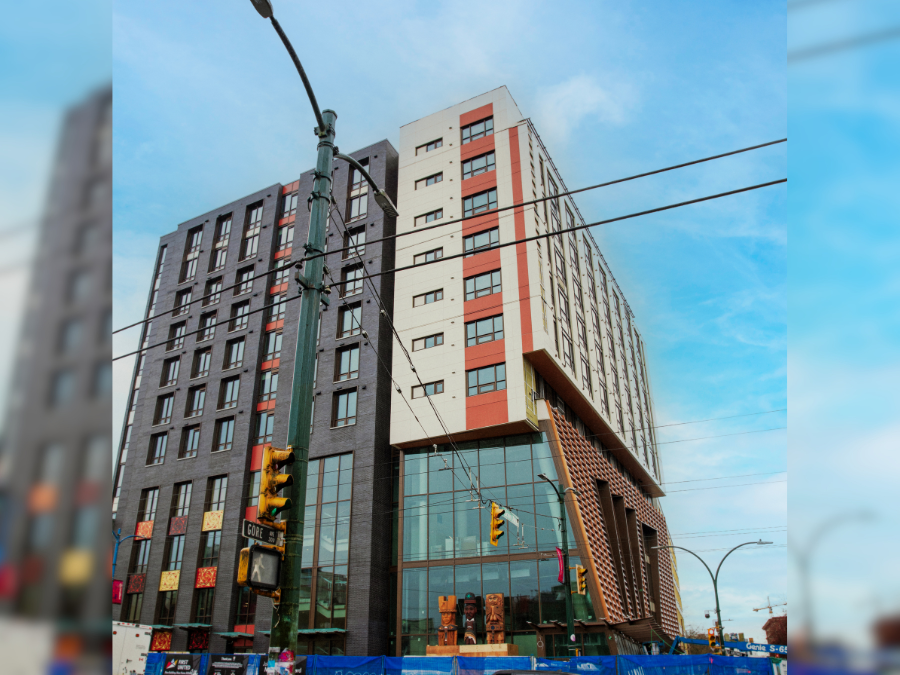
A new community centre in Vancouver’s Downtown Eastside, built by First United Church Community Ministry Society in collaboration with Lu’ma Native Housing Society, will bring much needed social and housing support to the low-income neighbourhood.
Located at 320 East Hastings St., the redeveloped 11-storey building includes four floors (approximately 40,000 square feet) of community space and seven floors of Indigenous social and supportive housing. The community space provides essential services such as meal programs, washroom and shower facilities, legal services, phone and mail services, and tax support. It also includes a library, a cafe, an outdoor centre and a sacred space. The building can also serve as a warming and cooling centre, and an emergency evacuation site.
You may unsubscribe from any of our newsletters at any time.
“There’s not a lot of places to come in with dignity, where you’re not shooed away. And a drop-in that is actually climate-controlled? That’s huge,” says First United executive director Amanda Burrows.
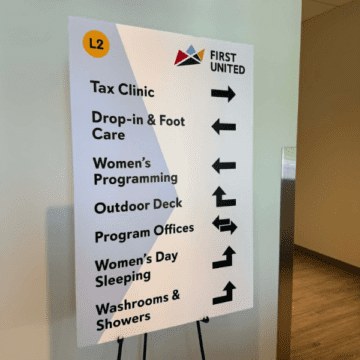
Frequently referred to as “The Church of Open Doors,” First United has been serving the Downtown Eastside community from the corner of Hastings and Gore, providing ministry and essential services to those in need, since 1892.
First United’s decision to partner with Lu’ma was driven in large part by both the community’s need for Indigenous housing and the church’s desire to work towards reconciliation.
The United Church operated 15 residential schools across Canada until 1969, as part of the federal government’s effort to assimilate Indigenous children into Euro-Canadian culture and Christian ideology. In today’s Downtown Eastside, about 31 per cent of the population is Indigenous. Burrows says this reflects the racialized poverty in the community.
“Although we have apologized, continue to apologize, we are so committed at the United Church to reconciliation,” says Burrows. “It’s a way to respond in a meaningful way to a great need; it’s a way to respond in a meaningful way to reconciliation and action as an organization and as the United Church.”
Barbara Lawson, CEO of Lu’ma, says, “We really appreciated and could hear that First United has an approach that isn’t ignoring the history, but is facing the history front on and doing what they can to be in service to those that need us the most in the Downtown Eastside, where the population of the Indigenous is greatest.”
More on Broadview:
- An aging congregation bets its future on the next generation
- Indigenous groups urge Canadians to rethink their relationship with water
- Why this tree planter is organizing from the ground up
The building’s 103 affordable housing units, operated by Lu’ma, include 35 supportive units with on-site staff that are open to all but Indigenous-focused by way of services and support, says Lawson. The other 68 units are Indigenous-specific, funded through the Indigenous Housing Fund of BC Housing. Of these, 14 units are deeply subsidized with rents under $500 per month, while the remaining units are rent-geared-to-income, with tenants paying about 30 per cent of their income toward rent.
“The impact we are hoping for is to hear the voice of need and answer with improved housing, trauma-informed and culturally appropriate essential services, and to advocate for policies that address systemic inequalities,” says Lawson.
The community centre itself, operated by First United, is also addressing an existing gap in gender-specific supports by offering women’s day sleeping and women-only programming for self-identifying women.
“Women’s groups have been calling on all-gender nonprofits in the Downtown Eastside to do more for women,” says Burrows. “We heard that call.”
With the help of over 1,800 community members and corporations, First United raised over $39 million to help fund this facility. Tripling the service capacity of their old centre (built in 1965), Burrows says they are projecting about 1,000 visits per day.
“We want to protect this community. We don’t want to protect poverty, but we want to be able to support the people living in poverty to be able to access the resources that they need to get better, or just to be,” says Burrows.
***
Charlotte MacDonald is an intern at Broadview.
Thanks for reading
Will you help support United Church reporting?
Broadview is the only media organization dedicated to telling the stories of The United Church of Canada — its big decisions, perspectives and the faithful people and communities at its core. But this essential work depends on you.Make a tax-deductible gift today — 100% of your donation goes directly to supporting United Church coverage.

With gratitude,