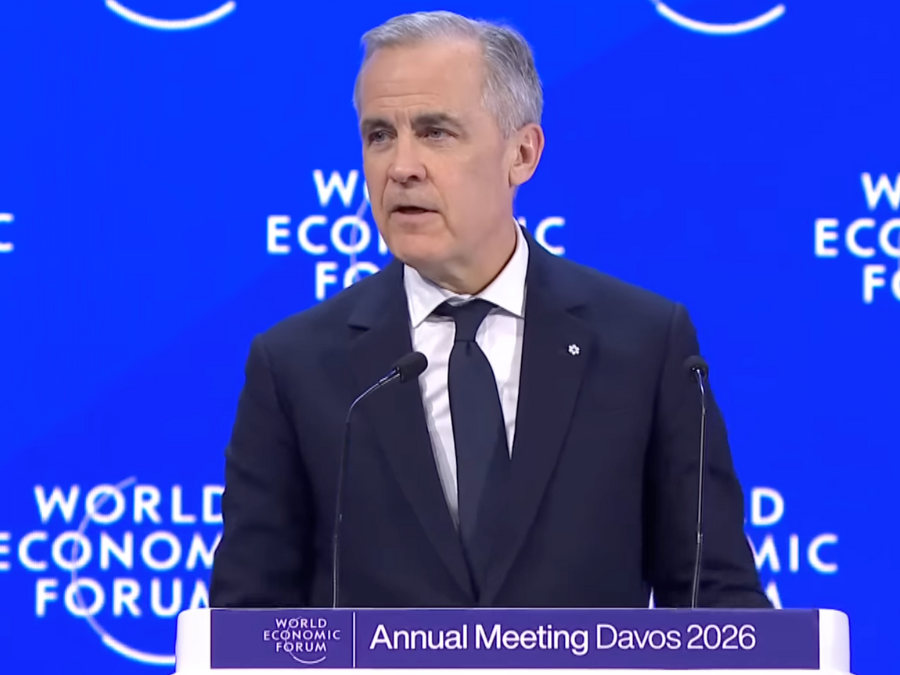
Last week at the World Economic Forum in Davos, Prime Minister Mark Carney delivered a speech that drew global attention. In response, we invited our Broadview’s Best of the Week newsletter subscribers to share their reactions and reflections. Here is a glimpse of what you had to say. These opinions are those of our readers and not necessarily shared by Broadview. The responses have also been lightly edited for clarity.
“I believe that every Canadian who watched Prime Minister Carney’s speech in Davos are so very proud, to shout from the rooftops that we are Canadian and always will be.
You may unsubscribe from any of our newsletters at any time.
It was, and is, so great to see our country put on the map politically in such an astounding way. To witness history and hear such words of hope brought a sense of joy — that finally, finally, someone spoke out intelligently and sensibly about what is happening in our world and countries. Bullying from anyone is not good, especially from world leaders who have no sense of decency. We are Canadian and we live through no other nation. That is what makes us Canadian.”
— Bob and Lloyd Peacock, Vancouver, B.C.
“As I have been even more aware since Donald Trump’s second presidency began a year ago, a lot of social media is focused on building fear and division.
Prime Minister Carney’s speech on the 20th counters that. He clearly stated what is currently going on and provided hopeful leadership and a way forward — not just for us, but for others around the world as well. He did all this without sugar coating the issues and without spewing out negativity. No matter where you stand on the political spectrum, no government has all the answers. There will be missteps no matter who is leading. What we do need is to come together, engage in dialogue and through collaboration move toward greater justice — locally, nationally and internationally.”
— Diane Dick, Wiarton, Ont.
“Perhaps, like many proud and thoughtful Canadians, I was very impressed with Mr. Carney using the world stage to deliver a well-prepared message that the world needed to hear. As others have noted, including Lloyd Axworthy in his Broadview interview, it was time for Mr. Carney, as our prime minister, to step up and be bold in pushing back against the belligerent, egotistical, narcissistic U.S. president. Yes, he is a bully, and world leaders have long allowed him to behave this way, but it was time to change the discourse. Mr. Carney did just that.
Now, other middle-power countries must not only give a standing ovation, as they did for Mr. Carney, but — quoting Mr. Carney’s Vaclav Havel reference—‘take the sign out of the window.’ They need to state their beliefs clearly and refuse to cower to a bully. In saying this, I also want to be clear that I am certain many Americans share our perspective. While some may be in a difficult position, they too need to take the sign out of the window. As we’ve seen in Minneapolis and elsewhere, some already are. May that boldness spread across their country.”
— Jim Kells, Saskatoon
“As a Canadian, I am so proud of Prime Minister Carney. On a personal level, he reaffirmed his reputation as a leading intellect and a trusted statesperson — not only with his European friends and national leaders, but with countries and leaders around the world. He has placed Canada back on the global stage as a country known for balance and calm diplomacy. We are now among the ‘middle powers’ working together through the difficult times ahead. Canada is back, regaining the reputation we once held as international peacekeepers in the 1960s and ’70s.
I suspect Carney knew he had to deliver this kind of speech. It was an implicit expectation, based on his understanding of how he is regarded in Europe and beyond. He likely knew that only he could pull it off.
Carney is also a devout Catholic, and I believe his spiritual values informed both his words and his decision to speak. Just as Bishop Budde spoke truth to power from the pulpit of the National Cathedral in Washington a year ago, Carney spoke truth from the pulpit of the Davos World Economic Forum. This was not a mere political performance — this was a Christian truly in action.”
— Norm Biram, Saskatoon
“Insightful, well-thought-out, beautifully written, powerful and understandable. I wanted to jump up and sing Oh, Canada right in my living room. He has pushed Canada up a notch on the world’s respect scale.”
— Sharon Roy, Nepean, Ont.
“I think it is a mistake to dismiss the prime minister’s speech. He articulated a vision that can help Canada play a stronger role on the world stage in promoting global prosperity, peace, and justice. His recent trip to China also acknowledged the new world order, with China and the countries of the Global South playing an increasingly important role.”
— Ed Lehman, Regina, Sask.
“His speech was impressive in standing up to countries that act like bullies. But his policies suggest he has little interest in confronting the bullies causing us the most harm: corporations and billionaires. To me, an austerity budget should mean that corporations and wealthy individuals face restraint, not the sick, the poor and workers. A five percent surcharge on corporate income over $1 million and individual taxable income over $100,000 could have provided the resources needed to support corporations hurt by tariffs and individuals struggling with living costs. Yet governments remain afraid of corporations and the wealthy.”
— Jim Kenney, East Hawkesbury, Ont.
More on Broadview:
- Charlie Angus sounds the alarm on fascism
- Why fascism fuels misogyny and how we can fight it
- Wab Kinew is just getting started
“There’s no doubt Carney’s speech was iconic. What worries me is that his eloquence and intelligence — especially in contrast to some other public figures — could put rose-colored glasses over potential critics. Nostalgia is clearly not a winning strategy, yet beneath the rhetoric, Carney’s proposal feels like 20th-century Liberalism redux.
The core of his speech is that Canada is a great place to invest in resource exploitation, run by savvy financial actors, zealously pursuing freer trade and spending tens of billions to arm up.
Conspicuously absent were mentions of the values that should guide us into the next quarter century — perhaps things like decolonization and climate action.
Time will tell how Carney’s strategy plays out and I truly hope it benefits everyone — especially the least of these (Matthew 24:40). But as we set off down this new path, we must do so with careful, critical attention.”
— Christopher Sanford Beck, Halifax, N.S.
“I was very heartened to hear our prime minister state the obvious — and to be applauded by those of like mind. Until now, he had displayed the traditional Canadian approach: polite and respectful, but, in my view, too hesitant.
This week, I heard someone comment that he sounded like a preacher. That is certainly not a criticism. He is intelligent, articulate and a true Christian — not just someone who professes to be. Canadians must unite to stand up to a narcissistic bully with delusions of grandeur.”
— Daphne Strowbridge, Riversport, N.S.
“I was impressed by the speech—it gave me even more respect for our prime minister. He called out the bullies without hurling specific insults, leaving it to the listener to infer who he meant. It was a mark of a true statesman and very Canadian. I was proud to see him represent our country so well.”
— Mary Riseborough, Leduc, Alta.
Thanks for reading
Independent journalism rooted
in faith and justice is under threat
Broadview is the only media organization in Canada offering thoughtful, values-driven journalism from an inclusive, progressive Christian perspective. But our work depends on your support. If you value what you've just read, please act now.
A gift today helps keep this journalism alive tomorrow.
With gratitude,