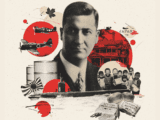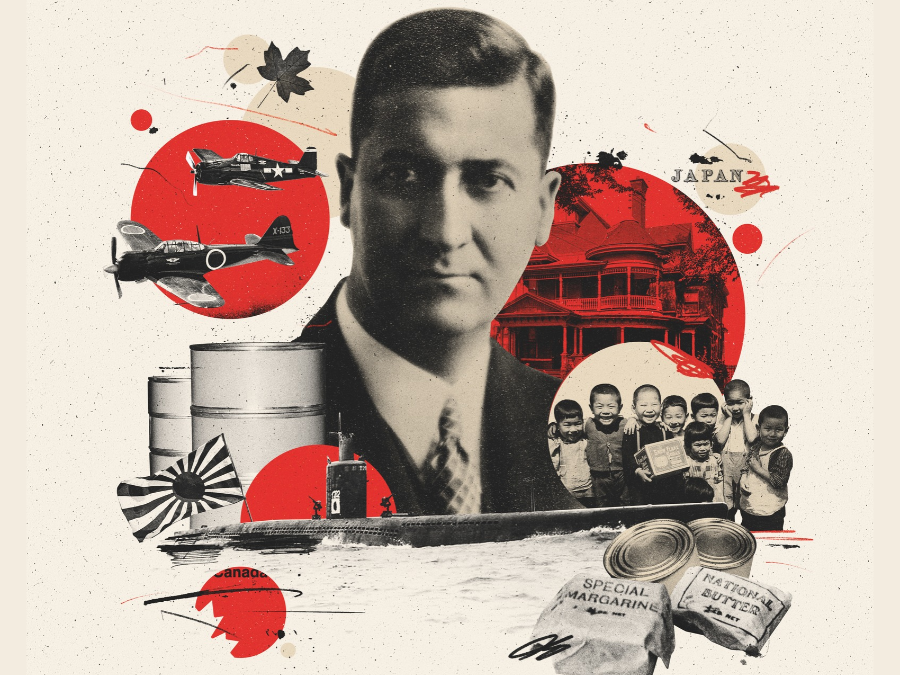
Around eight o’clock on the morning of Dec. 8, 1941, the phone rang in the home of Rev. George Earnest Bott, a United Church of Canada missionary in Tokyo. The caller had chilling news: hours earlier, Imperial Japanese Navy planes had attacked the American naval base at Pearl Harbor, Hawaii. Simultaneous raids had struck other American and British targets in the South Pacific and Southeast Asia.
Still processing the news, Bott left to attend a previously scheduled event. Partway through, he was informed that an imperial decree declaring war on the Allied powers would be broadcast later that morning. He promptly returned home. “Obviously everyone was shocked and somewhat dazed at the tragic turn of events,” he later wrote in a letter, “and no one quite knew what to expect.”
You may unsubscribe from any of our newsletters at any time.
Born in rural Ontario in 1892 and educated at Toronto’s Victoria College, Bott (known as Ernest) and his wife, Edith, had been dispatched to Japan by the Methodist Church in 1921 — the same year he was ordained as a minister. After two years of language study, he was assigned to the Methodist (later United Church) mission in Tokyo. A familiar sight riding his Harley-Davidson motorcycle, Bott became widely admired for his tireless social welfare work in the city’s eastern slums. The high regard Bott enjoyed from government officials was evident as hostilities raged after Pearl Harbor: while most other missionaries were rounded up and interned, he and Edith were told they’d be left alone if they stayed close to home. Nevertheless, Bott later wrote, every knock on the door — even from the postman — was cause for alarm.
While Bott adjusted to de facto house arrest, American and Japanese diplomats, acting through Swiss and Spanish intermediaries, were working on a deal to repatriate civilians caught behind enemy lines. Canada’s Department of External Affairs drew up a short list of Canadians to be included in the first exchange. The Botts were on it. (Their two teenage children were reportedly already back in Toronto.)
In mid-June 1942, the Botts and other evacuees boarded a ship bound for Mozambique, at the time a colony of neutral Portugal. There, they met the Gripsholm — a Swedish ocean liner operating under the banner of the Red Cross carrying hundreds of Japanese repatriates as part of the one-for-one dockside exchange of nationals.
The Gripsholm, with the Botts aboard, arrived in New York in late August. Neither of them could have known that Ernest would soon be summoned to a mansion in Ottawa buzzing with activities so secret that the story of what went on inside remained hidden for decades.
The 2014 Oscar-winning film The Imitation Game shone a light on the super-secret British codebreaking operation at Bletchley Park, north of London, where mathematicians cracked Nazi Germany’s Enigma cipher machines during the Second World War. Everyone who worked there swore an oath of absolute secrecy.
By the mid-1970s, the British government had begun to declassify some of the files. In 2009, it pulled back the veil of secrecy for good, announcing commemorative badges for surviving veterans of Bletchley Park and its outstations, and an honour roll with the names of everyone involved in operations. The list included Ernest Bott.
Bott had been dead six decades by the time the nature of his wartime service came to light. But we now know that the Ottawa mansion where he wound up just months after being repatriated housed a high-level codebreaking operation. It was there that Bott helped spy on the country he’d called home for 20 years, and to whose population he was passionately devoted.
Bott appears among the cast of characters in Canada’s Bletchley Park, a popular history of this country’s wartime codebreaking effort, written by Diana Pepall, a retired senior librarian in Ottawa, and published by the Historical Society of Ottawa in 2017. Evolving out of research into Canadians entitled to receive a Bletchley badge (only two were found surviving), Pepall’s account traces the story of the operation — discreetly known as the Examination Unit, or XU for short — from its inception as a covert arm of the National Research Council located next to Prime Minister Mackenzie King’s residence, to its shuttering near the end of the war.
The XU’s job was to decipher and translate coded enemy messages intercepted by Allied listening posts around the world. Alongside Bott, the XU’s ranks included top academics recruited from Canadian universities, future prime minister Lester B. Pearson and Herbert Norman, the celebrated Canadian historian and diplomat who died by suicide in 1957 amid accusations by U.S. Senator Joseph McCarthy that he was a communist.
Bott was assigned to a section of the XU that Norman set up to decode diplomatic messages sent from Tokyo to Japanese interests abroad. (Separate XU sections handled Japanese military communication and messages from the Nazi puppet government of Vichy France.) A single-copy secret history of the XU, written internally in 1945 and only recently declassified, noted the extreme complexity of deciphering different code systems and translating the material from Japanese to English: “Considerable effort was being made at this time to find new translators capable of handling the material.” Bott, who spoke and read Japanese fluently, fit the bill.
Bott died in 1952, while the story of the XU was still strictly off-limits; the particulars of his recruitment are buried with him. But it’s a safe bet that Herbert Norman, who grew up in Japan as the son of Methodist missionaries, had something to do with it. Norman worked at the Canadian legation in Tokyo and had been repatriated to Canada with the Botts aboard the Gripsholm in 1942.
Once signing on with the XU, Bott would have received a directive, similar to one quoted by Pepall, reminding him that the “Oath of Secrecy taken by all persons joining the staff of the Council” remained in effect even after their employment ended. The oath was so ironclad that staff who contributed to the secret history of the XU in 1945 were not allowed to see what each other had written.
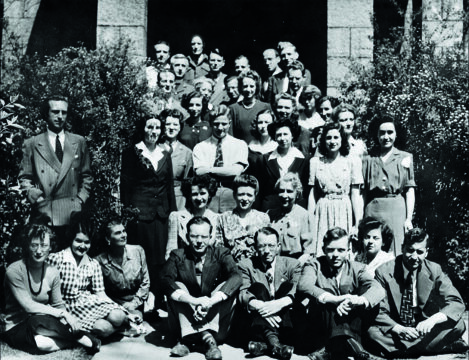
The Japanese diplomatic section of the XU was dealing with a surge in intercepted traffic when Bott arrived in late March 1943. Some of the traffic was housekeeping chatter between scattered Japanese consular posts. But other messages revealed important information about espionage activities, domestic politics and Japan’s economy. The XU would also decode and translate intercepted communication detailing the movement of maritime supply convoys. Those messages would be sent to the U.S. navy, which would pass along the intelligence to submarines. To avoid arousing “suspicion that Japanese codes had been broken before torpedoing an enemy convoy,” Pepall writes, “the Americans would dispatch a reconnaissance plane in order to give the impression that the convoy’s discovery was made by the plane.”
She continues: “How difficult it must have been for [Bott] to think of the Japanese as the enemy when he was so clearly attached to the country and its people. After all, the Examination Unit’s efforts directly resulted in U.S. submarines sinking supply ships on their way to Japan, the loss of which would undoubtedly cause hardship to Japanese civilians.”
Bott embraced a social gospel that preached care for the less fortunate and love for one’s neighbours, regardless of their faith or lack of it. Associates noted his intolerance of “social greed, avarice and injustice,” and his disdain for those who “shut their eyes to poverty, starvation and inequality.”
More on Broadview:
- The Koreas, on the most complicated peninsula in the world, remain at war
- Palestinian Christians seek solidarity amid war and displacement
- Nowruz in a time of war
This raises a thorny question: why did Bott agree to work for an operation that could bring harm to people he deeply cared about? Riding out the war in a United Church pulpit would have been morally less fraught. His rationale for joining the XU was another secret that followed him to the grave. But the decision likely wasn’t easy: war forces good people to make painful choices.
The Imperial Japan that Bott fled in 1942 was a nation gripped by militarism and ultranationalism.
It had been merciless in expanding its empire in East Asia, and had allied itself with Nazi Germany and Mussolini’s Italy in a campaign to fashion a repressive new world order. This, coupled with having witnessed the horrific consequences of rampant militarism and nationalism as a frontline soldier in the First World War, likely persuaded Bott to aid the Allied cause.
His divided loyalties may have leaned toward the Allies, but Bott’s fidelity to Canada was not unqualified. He was a vocal critic of the racist and vindictive expulsion of more than 21,000 Japanese Canadians from their homes on the West Coast to ill-equipped remote internment camps, and the splitting up of families and seizure of property without compensation.
As the war wound down, the federal government made plans to relocate internees east of the Rocky Mountains. Any who refused to move would be deported to Japan. In a 1945 letter to church officials, Bott fumed: “Every Canadian Japanese who goes to Japan after the war will be a living demonstration of the fact that Canada is neither Christian nor democratic and that Canada’s signature on the United Nations Charter guaranteeing justice for minorities is a hollow mockery.”
Deportations began with Japan’s surrender in August 1945. In early 1947, the government of Mackenzie King bowed to public pressure and halted the program, but not before 4,000 Japanese Canadians had been expelled.
The XU was disbanded after the fall of Nazi Germany in spring 1945. In a letter written less than a year later, Bott describes crossing the Pacific toward Japan on an American naval vessel navigating waters still teeming with anti-ship mines. He and an American evangelical missionary had been tapped to lead private relief efforts. Disembarking at Yokohama on Palm Sunday, 1946, Bott and his American counterpart became the first civilians not directly tied to the Allied occupation to step onto Japanese soil since the end of the war.
Immediately after arriving in Tokyo, Bott visited the neighbourhood where he and Edith had lived. Their home was gone, likely destroyed in the March 1945 firebombing of Tokyo that killed an estimated 100,000 civilians and left a million others homeless. All that remained of the dwelling was a chimney; what had once been lawn was now a vegetable garden tended by neighbours struggling against chronic food shortages. He later wrote, “The whole area is completely destroyed. In fact apart from the centre of the city and an occasional oasis where a few buildings are standing the city is a sorry picture of ruin.”
An essay by historian Andrew Hamish Ion of the Royal Military College in Kingston, Ont., recounts Bott’s feverish early efforts to procure relief supplies by cutting deals for military rations deemed unsuitable because of damaged packaging or, on one occasion, buying an entire boatload of surplus canned food from the U.S. navy.
Ion doesn’t shed much light on how Bott vaulted to the vanguard of the civilian relief operation. He notes that Bott had argued that the first returning missionaries should “know and admire the good qualities of the Japanese.” Yet affinity alone was unlikely his ticket back to Japan. The more probable explanation was his association with Herbert Norman, the architect of the XU’s Japanese diplomatic section. Norman held senior intelligence and administrative posts under Gen. Douglas MacArthur, the Supreme Commander of the Allied Powers, who believed that a robust Christian presence in Japan would avert a drift toward communism. Although Bott was not officially part of the occupation, Ion writes that he was housed, fed and “given the use of cars for transportation on exactly the same basis as if the Occupation authorities employed them.”
Bott’s official title was director of the Japanese branch of the Church World Service (CWS), a New York-based ecumenical organization created in 1946 to co-ordinate church-sponsored relief efforts in war-torn areas of Europe and Asia. The United Church of Canada was a partner in the organization, but the CWS paid Bott’s salary and living expenses.
Aid groups couldn’t simply show up on Japan’s shores and start doing good works. Relief programs were strictly controlled through an arm of the Occupation called Licensed Agencies for Relief in Asia (LARA). The CWS was the largest contributor to LARA’s operations. Bott was vice-chair of LARA’s central committee; every major initiative bore his stamp.
The challenge LARA faced was daunting. In addition to the atomic attacks on Hiroshima and Nagasaki, American bombing had levelled major cities, leaving millions homeless and Japan’s economy in ruins. A crippled transportation system combined with poor harvests threatened mass starvation. Bott’s letters painted a desperate picture. One read: “Everyone tells the same story of the difficulty of getting enough to eat. Rations are inadequate and black market prices for food to supplement are extremely high. One wonders how people manage and it is pretty clear many really do not get enough food to maintain their health and vitality.”
LARA operated in Japan until March 1952, distributing close to 15,000 tonnes of supplies valued at US$10 million (around US$126 million today). Japanese descendants in North and South America accounted for about 20 percent of the support. It’s estimated that 14 million people, roughly a sixth of Japan’s population at the time, benefited from LARA relief.
In 1947, Bott and two other officials were received by Japan’s Emperor Hirohito, who had taken an interest in LARA’s relief work. The audience was “indicative of the respect in which Dr. Bott and his associates are held at this time,” The United Church Observer wrote a few months later.
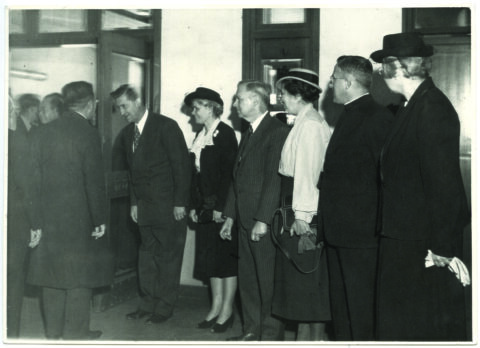
Bott frequently expressed concern that the Japanese population was “physically and mentally and emotionally exhausted at a time when more than ordinary vitality is needed to cope with the extremely complicated and difficult problems with which they are confronted.” As events would show, he could have been describing himself. Bott suffered a stroke in 1951. The following year, as LARA’s relief operation was winding down, he had a heart attack and died on March 5. He was 59. The consensus among friends and colleagues was that he had worked himself to death.
Upwards of 1,000 people attended his funeral at the Tokyo Girls College, which featured a floral tribute from Japan’s prime minister and homages from government and city officers. Ten days later, United Church officials, colleagues and friends gathered for a memorial service at Howard Park United Church in Toronto. The eulogy read: “Men and women of the stature of Dr. Ernest Bott do more for the peace of the world and the brotherhood of mankind than all our atomic bombs, jet planes, armies, navies or statesmen combined.” It made no mention of his work in wartime espionage — nor did other tributes. Apart from an occasional reference to him being “connected with the Department of External Affairs” or serving “in a special capacity for the Canadian government,” the two years he spent in the XU were edited out of his story.
Three-quarters of a century after his death, Bott’s name is rarely, if ever, mentioned in United Church circles alongside storied missionaries like Robert McClure, James Endicott and Katharine Hockin. The United Church of Canada contributed liberally to LARA during the postwar relief effort. Yet in 2016, a Church World Service program officer from Japan reported that a veteran United Church global mission staffperson was unaware of Bott’s role in the operation.
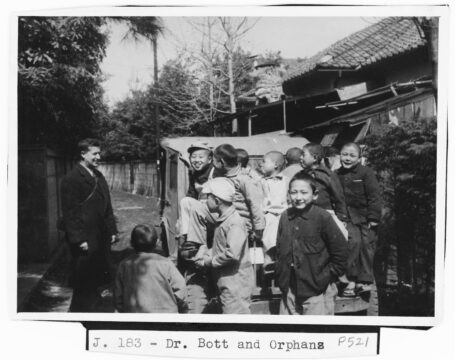
Bott’s profile in Japan contrasts sharply. In 1956, a Christian social welfare agency in Tokyo fulfilled a longstanding wish of Bott’s and established an orphanage, naming it the Dr. Bott Memorial Home. Seventy years and several upgrades later, it remains in operation, housing about 40 children. Bott also endures as a legendary figure in the Church World Service. A 2016 video commemorating the 70th anniversary of LARA was mostly an homage to him and his Christian credo: “It is more blessed to give than receive.”
The video did not cite Bott’s wartime activity. Nor does a plaque honouring him at the now-vacant Pine-dale United Church, near the Sunderland, Ont., farm where Bott was born and raised. His final resting place is an adjacent cemetery, alongside Edith, who died in 1996 at the age of 101.
A Decoration Day event at the cemetery three years ago celebrated Bott’s missionary service but was silent on his war years; locals say they were completely in the dark about his turn in the codebreaking business. The headstone on the grave bears witness to a life lived in and out of the shadows — just names and dates, not even a “Rev.” to indicate he was a minister. It’s notable for its ordinariness, for the stories it doesn’t tell.
***
David Wilson is a writer and editor in Toronto.
This article first appeared in the November/December 2026 issue of Broadview with the title, “Rev. Secret Agent.”
Thanks for reading
Independent journalism rooted
in faith and justice is under threat
Broadview is the only media organization in Canada offering thoughtful, values-driven journalism from an inclusive, progressive Christian perspective. But our work depends on your support. If you value what you've just read, please act now.
A gift today helps keep this journalism alive tomorrow.
With gratitude,