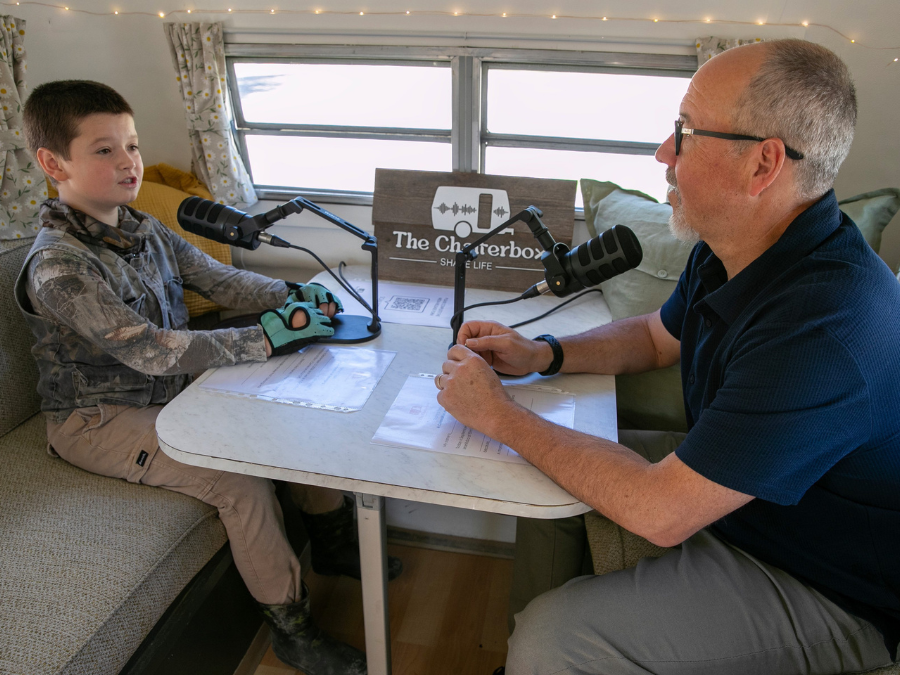
GRUNTHAL — Last Sunday, David Balzer parked his vintage 1978 Triple E Surfside camper trailer on a church lot in town and, like an itinerant priest with a mobile confessional, prepared to hear people’s stories.
It was a crisp sunny morning. Inside the trailer were a pair of yellow mugs that matched the trailer’s egg yolk trim. On a table were two microphones.
You may unsubscribe from any of our newsletters at any time.
Outside the trailer stood a sandwich board with an invitation: “Step in.”
Balzer doesn’t actually hear confessions, but he does perform what some might consider a priestly duty: helping people share their stories.
“I help people find the thing inside of them which they wouldn’t naturally find,” he says.
Balzer teaches communications and media at Canadian Mennonite University in Winnipeg. He’s produced podcasts and radio shows; for 12 years he hosted a call-in radio show called GodTalk. A few years ago, he had an idea. He wanted to buy a camper trailer, outfit it with recording equipment, take it to festivals and community events, and invite people to step inside and tell a story about someone who’d changed their life. Then he would edit the stories and give them to the people they were about.
He found a trailer for sale and drove out to Saskatchewan to pick it up. His wife, Kathryn Balzer, helped paint the interior and reupholster the cushions, preserving the 1970s vibe. Balzer then installed a pair of microphones and a soundboard. He called it the Chatterbox.
Balzer thinks a lot about social media and artificial intelligence and the ways these technologies can contribute to social atomization — loneliness and isolation created by the breakdown of interpersonal bonds. He wanted to use the Chatterbox to explore how technology could be used to build human connection.
“Does the use of this technology enhance embodied relationships?” he likes to ask.
That term refers to a connection between individuals that is deeply rooted in the physical and emotional presence of each person.

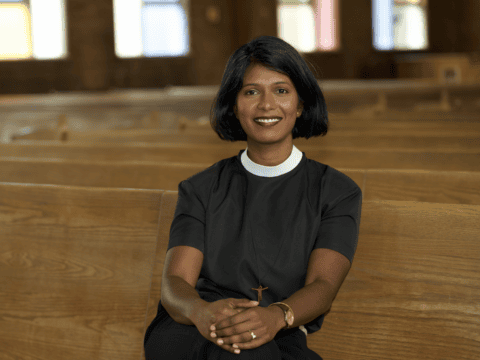
Lizzie Wipf, pastor of Grunthal’s Elim Mennonite Church, had been asking some of the same questions. Her parishioners talked to her about cellphone addiction and the ways AI was infiltrating their lives. So she called Balzer and asked him if he’d speak to her congregation.
Balzer was happy to talk about how technology could be used to enhance human relationships. “But we could just do it,” he added. He told Wipf about the Chatterbox.
The two of them settled on a question to prompt people’s stories: “Who made you feel like you belonged?”
No one knew quite what would happen when Balzer parked the Chatterbox on the church lot. Each time he does this, Balzer says, he worries no one will step forward with a story to tell. But when he saw the lineup outside his trailer, he realized he might have the opposite problem.
Belonging, it turned out, was a topic people at Elim Mennonite Church wanted to talk about.
Because not everyone in Grunthal believes their church belongs.
The Grunthal district has a population of between 1,000 and 2,000 people, and at least seven different churches. Recently, an association of local pastors decided Elim Mennonite Church was no longer welcome in their group.
More on Broadview:
- The small church that went big online
- ‘By any metrics you choose,’ this northern B.C. congregation is thriving
- Celebrating a 195-year legacy
“We had different theological interpretations,” explains Colleen Edmonds, who used to chair Elim’s church council. “We allow women in leadership, for example. We take the Bible as a guide, and not literally. If Jonah really got swallowed by a whale, I don’t know, but it doesn’t bother me that I don’t know.”
Wipf knows of only two other female pastors in southern Manitoba east of the Red River. Since she’s not welcome in the local boys’ club, she goes for lunch once a month with the two of them.
The ostracism was painful for the congregation, Edmonds says. But her church decided to lean into their new identity as outcasts. “We call ourselves the church of second chances. We want to be here for people who need us.”
One person who needed a second chance was Maria Reimer. She grew up in a conservative Mennonite community in Bolivia and came to Canada in 2018 with her husband, who was abusing her.
She told her story standing in the sunny parking lot while her three children took turns climbing up her hip and loading their hotdogs with slices of New Bothwell cheddar.
Reimer and her family started attending a conservative Mennonite church in the area. When Reimer tried to talk to church leaders about the abuse, they told her she needed to submit to her husband.
“When you’ve been raised in a Mennonite household where you’ve been told marriage is for life, you’re actually betting your soul on stepping out,” she says.
In 2020, Reimer’s husband hurt her so badly she ended up in the hospital. The doctor who examined Reimer told her he needed to call the police. Two officers showed up at her bedside. Reimer quoted a Bible verse and said it was her duty as a Christian wife to submit to her husband. But the police officers, who, it turned out, had read the Bible as well, countered with words from the Apostle Paul, who said husbands should not abuse their wives and, if someone claimed to be a believer but acted otherwise, you should not even eat with them.
“We had this beautiful debate back and forth,” Reimer says.
In the end, she agreed to make a statement. Her husband was arrested and convicted. He served time behind bars before fleeing the country.
Reimer began rebuilding her life and her sense of self-worth while caring for her children. Her church wouldn’t let her volunteer because she was divorced.
One day she slipped on a patch of ice and hurt her back. She went for a massage and while she was on the table the therapist warned her about a local church.
“He told me there was a very unholy church that was trying to pretend they were godly people but they’d been kicked out (of the ministerial group) because they let divorced people come into their church. And gay people were allowed to come! And I thought: ‘Oh, that’s my kind of church!’”
When Reimer got back to her car she started to laugh. “I said to God: ‘You really have the most warped sense of humour!’”
The first time she showed up at Elim Mennonite Church, a woman invited Reimer and her children over for pizza.
“And now, here I am,” Reimer says, her face breaking into a smile. “When you find out that (you are) loved and strong … it builds something up in you and you don’t feel as vulnerable and helpless anymore and you don’t see the world as quite as threatening.”
Reimer’s 11-year-old son Christoph was one of the first in line to tell his story at the Chatterbox. He wanted to talk about his friend Aaron.
“Aaron, he’s my very best friend,” Christoph says. “He’s the one that made me feel at home. He’s a really good listener and he’s a really good talker. When I’m feeling sad, he comes into my room and we talk. And when he’s feeling sad, I come into his room and talk. Knowing he’s there makes me feel like I’m at home. He has two cats. He’s overall a perfect guy.”
***
Josiah Neufeld is a writer in Winnipeg and the author of “The Temple at the End of the Universe.”
This story was produced in conjunction with Winnipeg Free Press, as part of a joint Religion in the News partnership covering issues of faith in Manitoba and nationally.
Thanks for reading
Independent journalism rooted
in faith and justice is under threat
Broadview is the only media organization in Canada offering thoughtful, values-driven journalism from an inclusive, progressive Christian perspective. But our work depends on your support. If you value what you've just read, please act now.
A gift today helps keep this journalism alive tomorrow.
With gratitude,