
On a warm July evening, inside the Comox United Church hall on Vancouver Island, 70 seats were arranged around long tables for guests from the Comox Valley and other parts of B.C. The event began with a land acknowledgment of the unceded and stolen territory of the K’ómoks First Nation, where they were gathered. Then Judy Goldschmidt, one of the organizers, drew an unexpected parallel between the K’ómoks people’s sacred bond to the surrounding waters, mountains, and forests and the Palestinian people’s multi-generational bond to their ancestral olive groves, hills, and valleys.
“Both K’ómoks and Palestinian identities are inseparable from the lands they have protected against systematic displacement, erasure and fragmentation,” said Goldschmidt. “Whether in the Comox Valley or the Levant, the theft of land is an attack on culture, history and life itself.”
You may unsubscribe from any of our newsletters at any time.
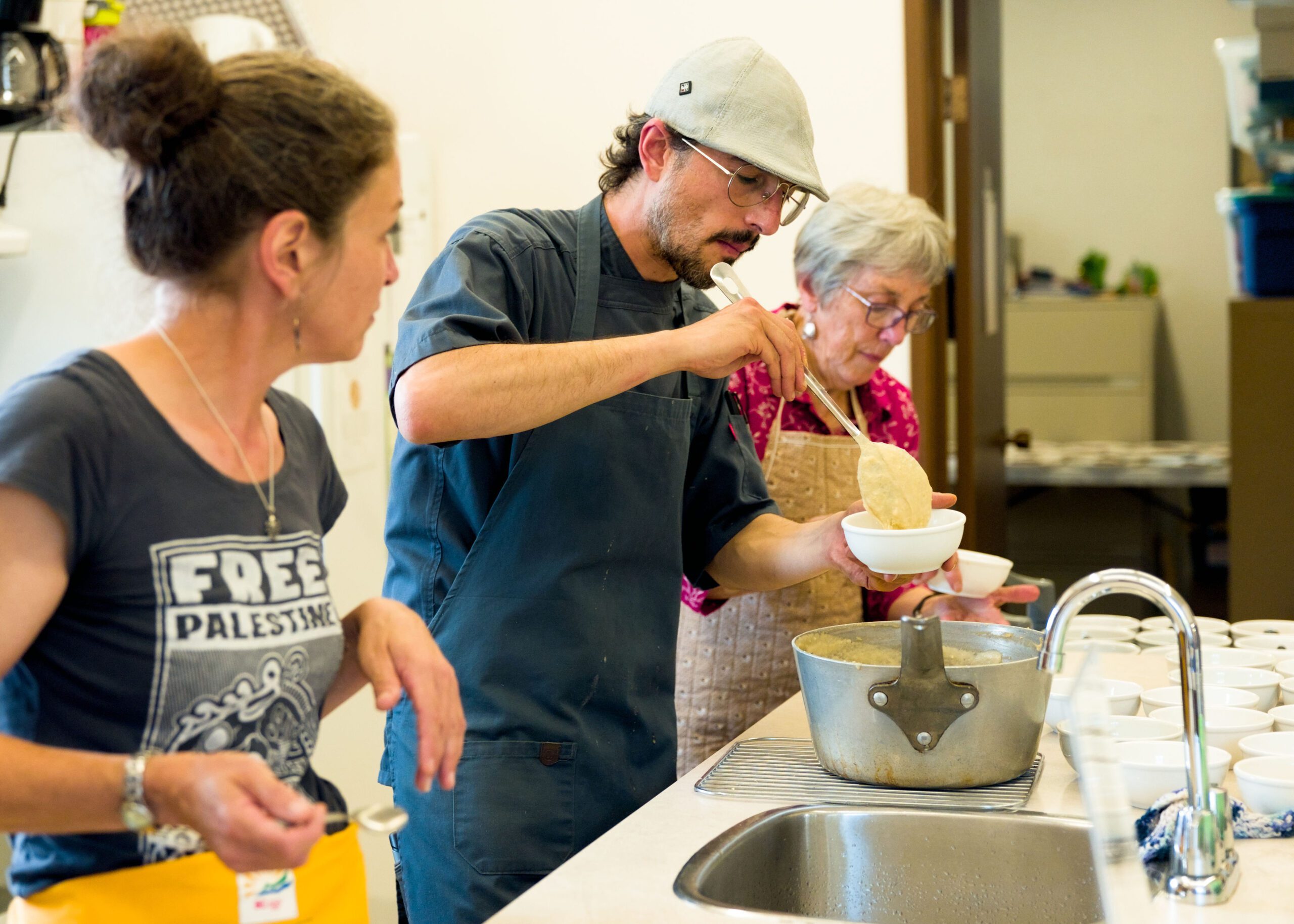
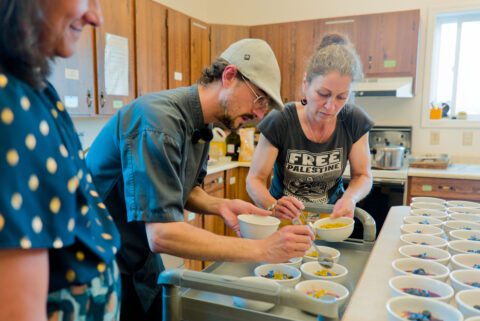
In the kitchen, directing the volunteers plating the first of a three-course meal, was Izzeldin Bukhari, founder of a food storytelling initiative in the Old City of Jerusalem called Sacred Cuisine. For the last decade he’s been hosting pop-ups, cooking classes and fundraiser dinners in 25 cities across 10 countries, pairing traditional dishes with their fascinating lore. Bukhari specializes in Somi food, a Palestinian tradition of vegan and vegetarian cooking associated with spiritual fasting.
More on Broadview:
“I’ve been really touched by the number of people who are aware and are wanting to hear the narratives and the stories, especially in these smaller communities,” said Bukhari. It’s at the community level that the most important things happen, said Rt. Rev. Kimberly Heath, moderator of The United Church of Canada. She not only supported the tour, but also was instrumental in Bukhari securing a visitor visa to Canada.
“Even with the supposed ceasefire, we know that in a lot of ways, very little has changed on the
ground for the people of Gaza and the people in the West Bank,” said Heath. “To me, this was clearly one way to lift up the continued struggle of Palestinians.”
When Bukhari serves dinner, stories accompany the courses. The first course at Comox United was rummaniyeh — a stew of lentils, eggplants and pomegranate molasses. Everyone assumes it’s Gazan, he told the room, but it actually originated in the coastal towns of Jaffa, Ramla and Lydds, which were once ringed with orange and pomegranate orchards that shipped fruit
worldwide.
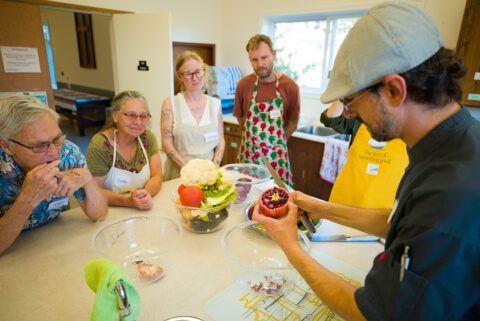
In the 1940s, Bukhari’s maternal great-grandfather had 200 acres of fruit trees near Ramla. When his well ran dry, he visited the neighbour’s farm to ask if he had water. His neighbour admitted to having installed a new water pump that drew more water quickly and easily, and casually offered to sell water to Bukhari’s great-grandfather if he needed it.
That neighbour, Bukhari revealed, was Chaim Weizmann, who would become the first president of the new state of Israel in 1948 — after which nearly 750,000 Palestinians were displaced from their homes and villages during a time referred to as the Nakba, or “catastrophe.” Many people from Jaffa, Lydd and Ramla, including Bukhari’s mother’s family, fled to the nearest coastal city: Gaza. They brought their recipes, such as the one for rummaniyeh, with them.
Bukhari’s stories captivated the audience at Comox United, who were soon tying the food and stories to their own experiences. For Lisa Caswell, whose mother’s family was from Damascus in Syria, the cucumber-yogurt salad tasted like her childhood. For Jean Sarrazin, who loves to cook, it was the cultural component that made the event stand out. “I really think food is fundamental to our identity and how we move about in the world,” he said. “[It’s] is a wonderful insight into a people and their culture — you understand what’s important to them when you have some of their food.”
This is why Bukhari spends weeks on the road cooking for strangers — over 1,600 of them so far by his estimate.
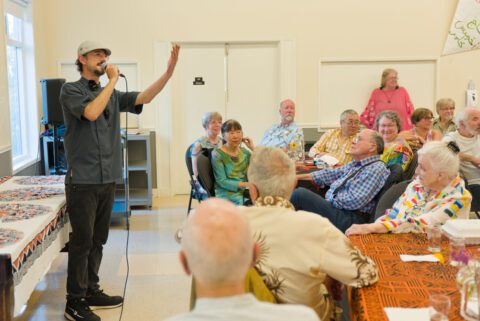
“As a Palestinian, I am very aware that my culture is under continuous threat from Israel trying to delete our narrative history, confiscate the land and kick people out of their homes,” he said. “So from looking at the history of the Palestinian people, and also my grandma and many others who were driven from their land, it’s just been a continuous loss that we face.”
***
Thanks for reading
Will you help support United Church reporting?
Broadview is the only media organization dedicated to telling the stories of The United Church of Canada — its big decisions, perspectives and the faithful people and communities at its core. But this essential work depends on you.Make a tax-deductible gift today — 100% of your donation goes directly to supporting United Church coverage.

With gratitude,





Thanks so much for sharing this story about Izzeldin. We are actually having dinner with him tonight, just before he flies east to Ottawa.
It was such a privilege to have Izzeldin in B.C. Rev. Marianna Harris
Food and story…how many of us have memories of sharing meals around our tables with others? Not only memories created but understanding as well. As I read this story I was thinking that this is another version of the communion table that many of us gather round in our communities of faith. Thx for sharing Izzedin’s story.