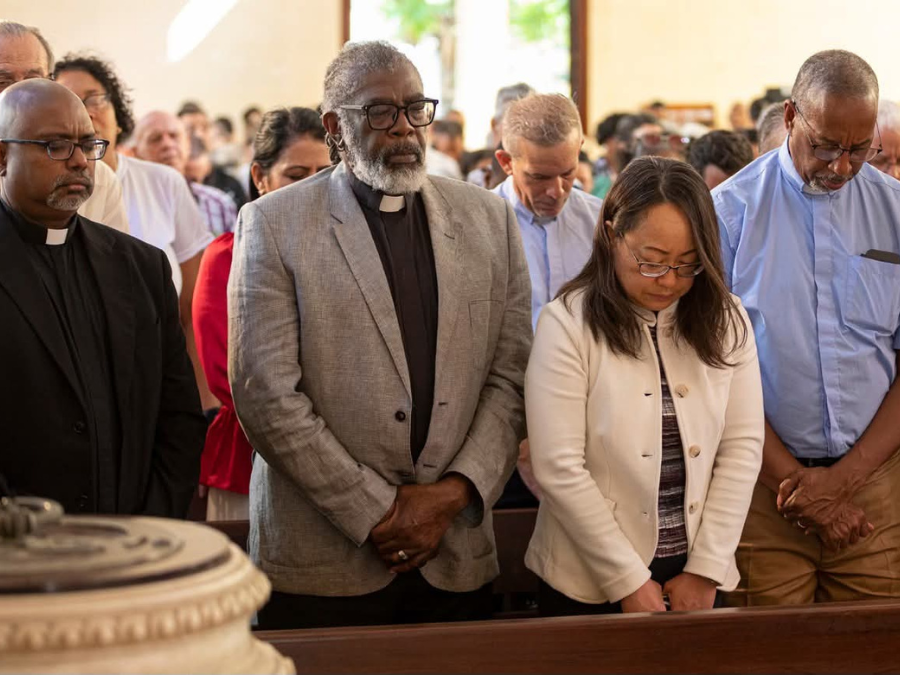
Travelling in Cuba this spring, Rev. Michael Blair, general secretary of The United Church of Canada, was surprised by what he saw.
“If you have ever been to Cuba, you know they have these iconic older model cars, and you hardly saw any of them on the road,” he says.
You may unsubscribe from any of our newsletters at any time.
As Broadview reported in April, Cuba has been facing an energy crisis since U.S. President Donald Trump signed an executive order in January threatening tariffs on countries trading oil with the long-isolated island nation. By the time Blair visited in late March, electricity blackouts were common, and public and private transportation had been severely restricted due to fuel shortages.
The delegation Blair travelled with also included prominent members of the World Council of Reformed Churches, World Council of Churches, the Presbyterian Church (USA), the Anglican Communion and the World Methodist Council. They were there to witness the struggles firsthand and offer support to Cuban churches and communities.
For Blair, the experience was revelatory.
“I think what struck me was just the way in which… foreign policies that are made outside of countries impact the real lives of people. The impact [the oil embargo has] had on children, on families,” he says.
One example that stayed with him was Cuba’s medical system, which he says is at risk of collapsing under the strain of power outages and very limited supplies.
“They couldn’t get medication for the kids who were being treated for cancer. There were folks who couldn’t get radiation therapy that was needed for cancer care,” he says, recalling his visit to a pediatric oncology hospital. “We heard one story that in the middle of a surgical procedure, the power went out and so the nurses and doctors were using their cell phones’ flashlight to be able to complete the surgery.”
Another eye-opener was the difficulty faced by funeral homes operating without electricity. “You never think about that kind of stuff, but it is so obvious. Bodies need to be frozen, and the impact of unfrozen bodies is awful.”
More on Broadview:
- Two of North America’s largest denominations take a giant step for faith
- Learning to sign ‘Amen’
- The objects and rituals that shape faith at home
The delegation’s visit coincided with Holy Week, and members participated in Easter services. Rev. Jerry Pillay, general secretary of the World Council of Churches, addressed worshippers in a prerecorded Easter Sunday message that was broadcast nationally. He described daily life in Cuba as “shaped by economic hardship, shortages of essential goods, limited opportunities and uncertainty about the future. Yet the church lives not in abundance, but in faith; not in security, but in trust. The hope of the resurrection emerges not from favourable circumstances, but from encounter with the living Christ.” It was this hope and faith that Cubans carry even under extreme stress that Pillay said resonated with him.
Since Blair’s return to Canada, concerns have grown about escalating tensions between the U.S. and Cuba. He worries that any military action would have devastating consequences. “You may know [Donald Trump] is continuing to talk about some kind of military action in Cuba. My suspicion is that if he does that, it’s not going to be the cakewalk he probably thinks it is.”
He adds, “I think the Canadian government needs to ensure that at every level it’s pushing against U.S. policy that would lead to war in Cuba.”
As part of its ongoing advocacy, the United Church has partnered with Common Frontiers Canada (a national multi-sector coalition of like-minded social justice groups) to promote a petition urging Canadian elected officials to increase humanitarian assistance, oppose the U.S. oil blockade and uphold Canada’s commitment to Cuba’s self-determination.
Church representatives also met with the Cuban ambassador to Canada about “whether or not we may be able to connect with [Cuban expats] and support their initiative to send supplies and emergency relief to Cuba,” Blair adds.
Whatever way the United Church supports Cuba, whether it be in practical or spiritual ways, the message being delivered to Cubans is the same: You are not alone.
***
James Adair is an intern at Broadview.
Thanks for reading
Will you help support United Church reporting?
Broadview is the only media organization dedicated to telling the stories of The United Church of Canada — its big decisions, perspectives and the faithful people and communities at its core. But this essential work depends on you.Make a tax-deductible gift today — 100% of your donation goes directly to supporting United Church coverage.

With gratitude,