
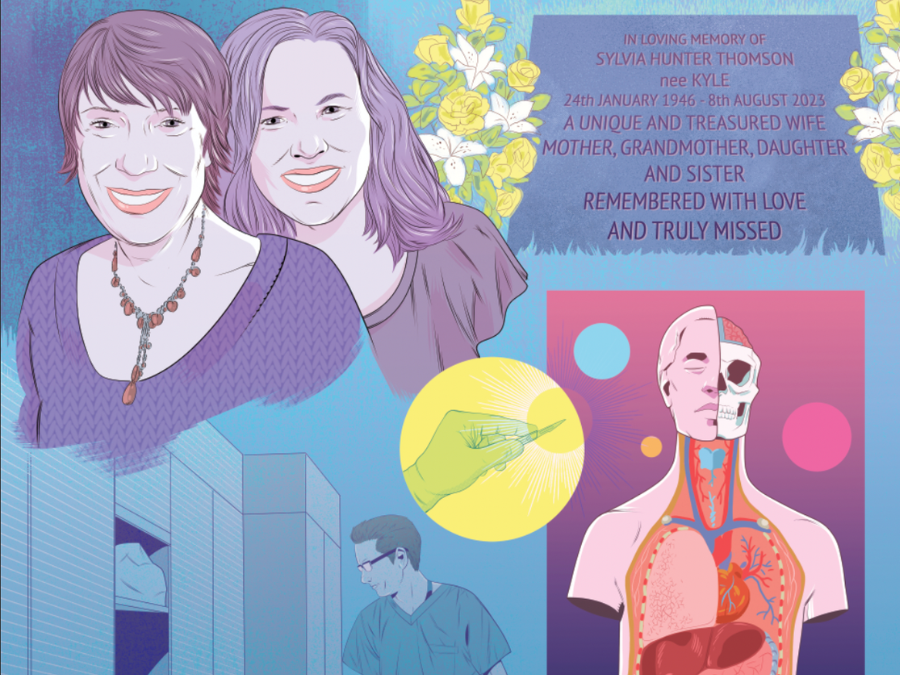
In February 2025, I received an invitation to a group funeral for my mother and 72 deceased strangers. As I scanned the details, my head felt light. I’d pushed to the back of my mind the idea that Mum was still out there having a final earthly experience, away from those of us who knew and loved her. For the past 18 months, as I learned how to live in a world without my mother, she’d been teaching students at the University of Dundee — many of whom had never seen a dead body before cutting into hers. My mother, Sylvia Thomson, registered to be a body donor in 2014, when she was 68 years old. She was living in Scotland, where I grew up, and broke the news to me in Canada by email — the week before I turned 40:
You may unsubscribe from any of our newsletters at any time.
DATE: July 6, 2014
SUBJECT: unfortunate combination!
Hi Valerie!
Just to say I sent off your birthday card on Saturday. Did I mention that I’d also be sending details
of body donation? Anyway, sorry they’re both in the same envelope. Don’t think of it as an extra birthday present!
I’ll speak to you on Sunday.
Lots of love
Mum xxxx
This was very Mum: generous, unconventional, pragmatic.
Why waste a body you don’t need anymore? Why separate major life and death milestones? Why not save a stamp? My three siblings, who still lived in the United Kingdom, also received copies of the Declaration of Bequest along with instructions for what to do on D-day — although, lucky for them, not on their birthdays. We all acknowledged how brave Mum’s decision was, but it was too unsettling to think — let alone talk — about the prospect of her body on a dissection table. Besides, our mother swam laps, ate her greens and chased her grandkids around the park. Everyone assumed she’d live to at least 100.
Less than a decade after that birthday, in June 2023, a tentacled beast of a tumour invaded the brilliant brain that made Mum both a whiz at mental arithmetic and the family Scrabble champion. Her illness began with hallucinations: seeing my six-year-old niece under her bed; a dead uncle in the garden.
Within weeks, she was losing physical and cognitive functions. A neurologist did a biopsy, and we learned my mother had glioblastoma the same day singer Sinéad O’Connor died, in late July. Afterwards, I sat on the back doorstep and sobbed into my tea. “Nothing Compares to U” played on the radio all day. A few days later, the neurologist met with Mum to tell her the tumour was untreatable and deliver her prognosis: “Three to six months,” he said.
By early August, my Mum, who’d won prizes for her short stories and poems, could neither read nor write. The last text I remember sending her was an uncaptioned photo of my kitten peering over my overalls — the universal love language of cat pics. She replied with scrambled letters, punctuation marks and emojis. It read like a message from a malfunctioning robot. I decoded it as “I love you too.”
At her final cognitive assessment, Mum couldn’t recall the day of the week or where she was, yet in the days leading up to her death, she could still articulate what mattered. When the hospital chaplain asked if she was afraid, she answered calmly: “No.” Once my mother was back home, my sister, Juliet, asked if she still wanted to donate her body to medical science. “Yes,” Mum said, pointing across her living room. “The paperwork’s in that filing cabinet.” I wish we’d asked more questions at that point about what inspired her to donate her body — but even then, we still thought we had time.
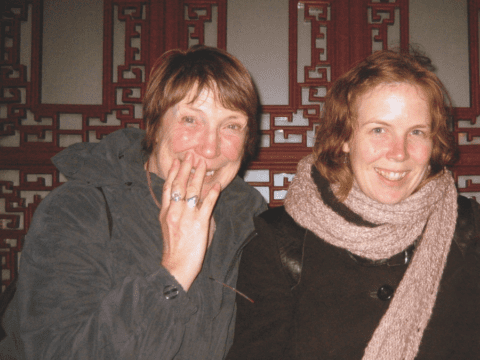
On Aug. 8, 2023, scarcely a week after Mum got her prognosis, my elder brother, Richard, phoned. She was already gone.
After the paramedics called time of death, my family rang the University of Dundee’s bequeathal administrator. A few hours later, my mother was transported from the cozy living room of her cottage to the unknown of the mortuary at the Centre for Anatomy and Human Identification. We were so shocked by Mum’s quick demise that it was hard for us to think about what was going to happen next.
***
Few sciences are as rooted in shame, infamy and bad PR as human anatomy,” Mary Roach writes in her 2003 bestseller Stiff: The Curious Lives of Human Cadavers. The discipline’s origin story is grim: Herophilus (c. 335–280 BCE), hailed as the Father of Anatomy and reviled as the Butcher of Alexandria, is rumoured to have dissected living criminals to learn more about the inner workings of the body.
Around two millennia later, when Scotland entered a golden age of intellectual and scientific enlightenment, anatomy became a burgeoning field of inquiry. Chronic cadaver shortages followed, and medical students had the option of paying their tuition in cash or corpses. Prior to the introduction of the Anatomy Act in 1832, the only cadavers that could be legally used in classrooms across the United Kingdom were those of convicted murderers or prisoners, as well as bodies that went unclaimed 48 hours after death. Others were supplied by resurrectionists (a.k.a. body snatchers), who went to graveyards under the cover of night and dug up the newly dead. The most infamous resurrectionists, William Burke and William Hare, went the extra mile and committed murders to satisfy the market.
The reality of the University of Dundee’s body donation program today couldn’t be more different. The anatomy department’s records date back to 1888, when most of the earliest bodies were unclaimed corpses from the poorhouse. But since the passing of the Human Tissue (Scotland) Act in 2006, bodies must be donated voluntarily and can be used only with the donor’s explicit consent. Emily Thomson, the bequeathal administrator for the program, tells me they have no need for marketing or recruitment.
“We’re very lucky,” she says. “The program is so popular in Scotland.” She remembers one man who, after registering, would periodically drop by her office to announce cheerfully, “I’m still alive! I’m still here!” while waiting his turn.
Before I worked up the courage to research how cadavers were used — and treated — in an educational setting, my main point of reference was Grey’s Anatomy. On the TV show, corpses are props for pranks and shock-value plots with no reprisals. Interns eat sandwiches while practising procedures on unclaimed bodies stolen from the morgue. Department chiefs stab a fresh-tissue body donor with a kitchen knife and douse him in fake blood before ordering interns to save his life for the chance to win a turn in surgery. “Happy Halloween,” says the head surgeon. None of this was reassuring.
The day Mum’s body left for the mortuary, the logistics of how it would be handled played on my mind. I thought back to a conversation I had in the 1990s with my then boyfriend — a medical student at another Scottish university. He’d told me about the body donors being sawn into parts, stashed in the freezer and defrosted on demand as the students worked on different body parts. He recalled one classmate tapping another on the shoulder with a cadaver’s hand as a prank. Mum had a dark sense of humour, so I tried to make peace with the potential for mild shenanigans. But I didn’t like the idea of her being frozen stiff.
It was only after the donor program had finished with Mum’s body that I dared find out what really happened to her there. I felt dizzy at first as I clicked through their website and pored over images of bodies under blue protective covers and of students gathered around their table in anatomy class. Once my initial unease settled, I arranged to speak with people who were part of this closed-doors chapter of my mother’s existence. Immersing myself in their world brought both comfort and wonder.
More on Broadview:
- Grizzly bears are back in B.C. Is coexistence possible?
- My hands shake. I’m not nervous; it’s essential tremor
- How restorative justice can heal communities
I learned that the University of Dundee was the first educational institution in the United Kingdom to adopt Thiel embalming. Most medical schools embalm cadavers arterially with formalin, or formaldehyde, a known carcinogen. The process takes only a few hours, but it leaves bodies rigid, brittle and washed in a greyish pallor. Thiel embalming, however, is much less toxic and produces cadavers that remain supple, with realistic colour and easily distinguished veins, tissue and organs.
“The cadaver looks and behaves much more like you and I,” explains Dr. Craig Cunningham, the university’s principal anatomist, on a video call. “You can pick up an arm and flex it at the joints; you can open the mouth — things that you wouldn’t be able to do with the traditional type of embalming.”
When a body arrives at the mortuary, anatomy technical manager Tyler Halliwell injects the veins and arteries with a solution of salts, boric acid and propylene glycol mixed with low levels of formaldehyde — just enough to ward off bacteria and fungus. The next step is immersion: six months in a tank filled with the same salty brine, a bit like curing a ham. (Anatomist Walter Thiel pioneered the method in the 1960s after a eureka moment at a butcher’s shop.) This scene feels less confronting to me than the freezer scenario I’d imagined. Now, I can picture Mum taking a leisurely float before the bustle of the school year began.
***
While my mother was meticulous in sharing plans for her body, she left nothing in writing about how she wanted us to honour her life and spirit. In Scotland, mourning rituals typically involve human remains; funeral directors handle the details. But without a corpse, we had to figure things out for ourselves. In the months that followed Mum’s death, it felt like her soul was everywhere and nowhere. We longed for a place to anchor our grief.
Mum had mentioned once she might like to be memorialized at the church where she was baptized. We called the minister, but he couldn’t wrap his head around a funeral without a body. By the time he came around, we had second thoughts. Our mother hadn’t been a regular at church since Sunday school. By her own definition, she was “spiritual, not religious.” How fitting a goodbye would this be?
Next, we turned to the crematorium in hopes of putting a plaque in their garden. But the rules were strict: no ashes, no dice. A wildflower-and-birdsong-filled natural burial ground in northern Scotland offered benches and trees of remembrance — no corpse required — but it was hours away. We wanted somewhere local so the family could easily drop in on Mum.
Eventually, my elder brother found a workaround: we could have our mother’s name carved onto a small stone and added to our grandparents’ plot in the village cemetery. Six and a half months after Mum died, on what would have been her 78th birthday, we were finally ready to hold a celebration of life. We wore colourful clothes, read a poem Mum wrote and laid yellow roses on her grave. In the car park, we shared a box of fudge doughnuts from her favourite bakery before heading to lunch to swap stories about her blasting Beethoven in the garden while hanging her washing and tending to her rescue chickens, which she affectionately named Tikka and Korma. Toward the end of the day, my elder brother turned to me and said, “I really needed this. I don’t think I knew how much I needed this.”
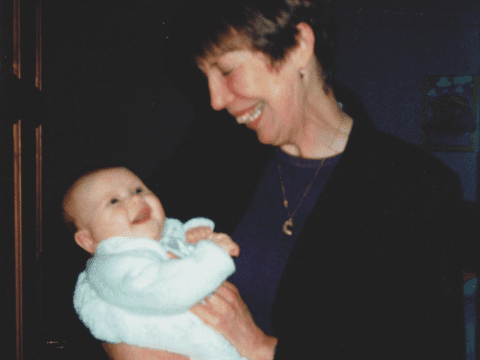
That night, as I lay in bed, I let my thoughts drift briefly to her body at the school. I wondered if the students were curious about her life. Did they know her name was Sylvia? When they studied her arms, did they imagine them once pushing her kids on swings or cradling her grandbabies? I wanted them to know how much my mother loved marzipan chocolates. I hoped they knew how lucky they were to spend time with her.
***
“I’m so grateful to have this experience, and it’s something I will take with me into every patient interaction I’ll have in my entire career,” says Freya Williams, a third-year student who began studying medicine the same year Mum began her stint as a body donor.
Before even setting foot in the anatomy classroom, students attend a lecture on the laws governing human cadavers and the school’s code of respect. “We get them to think, ‘How would you feel if this was your mother, your father, your granny, your grandfather?’” says Cunningham, who instructs the class.
With that preparation complete, the students then enter the lab for “meet-your-donor day,” where they find 30 bodies lying on numbered tables. “They’re often the students’ first encounter with death, and for those who are working in the clinical professions — medicine in particular — that’s going to be something they’re having to deal with day in, day out, in their practice, so this is a really important first encounter,” says Cunningham.
On day one, there’s no need for sharp instruments. Students simply view their assigned body donors and may touch their cold skin, if they wish, to cross that psychological threshold. Cunningham says some students feel “macabre excitement,” some faint and some are overcome with emotion, particularly if they’ve recently lost a loved one.
Just five months before Williams started medical school, her own mother died. When the then first-year medic stepped into the classroom on meet-your-donor day, she immediately felt her stomach drop. “I went in, and I could just see my mum. That was all I could think about.”
She spent most of that year working next door in the anatomy museum, learning from diagrams and models until she was ready to return to the lab for individual sessions — at her own pace, with a compassionate professor. She rejoined her classmates in her second year and by her third, felt at ease.
“I saw the beauty in this style of learning, how valuable it truly is. I began to notice the quiet stories that are written into the bodies of our donors — tattoos, scars from surgeries, joint replacements and all the other signs of illnesses once endured,” she later wrote in a reflective essay.
Unlike most other schools, which teach anatomy using textbooks, plastic models and augmented-reality computer programs, the University of Dundee places medicine, dentistry, anatomical sciences, biomedical engineering and forensic anthropology students in groups and assigns them a single body donor for the duration of the year. They work on the same body at different times and at the end of each class, carefully suture their work so the body remains intact for the next group. The only personal details shared are the donor’s sex, age and cause of death. A cloth usually covers the donor’s face, unless they’re working on the head or neck. Body donors provide incomparable insights: “Just as we all look different on the outside, we’re also different on the inside,” says Cunningham.
That understanding of anatomical variance can be critical in real-world operating rooms. Since Thiel cadavers retain lifelike tissue, flexibility and durability, students can go beyond basic dissection and practise their clinical skills. Before dissecting the lungs, they may first learn how to ventilate a patient by placing a breathing tube into the trachea and attaching it to a hand-held bag-valve device. As the bag is squeezed, air is pushed into the lungs, and they visibly rise and fall. “I would say 99 percent of the students gasp in amazement,” says Cunningham. While Williams has learned to compartmentalize her grief, she still tends to hold her body donor’s hand when the others in her group are practising a procedure. “Patients always find that really comforting, so I just sort of thought the donor would too,” she says.
It’s not only students who learn from donors like my mother. High-level surgeons — notably from Middle Eastern and African regions, where cadaveric study is limited — also fly to Dundee to train on the Thiel cadavers at advanced workshops. They hone their skills in everything from complex facial reconstructions for victims of accidents, wars and disasters, to transcranial focused ultrasound, an emerging treatment for Alzheimer’s and Parkinson’s diseases. (In Canada, about one in four medical programs offers cadaveric instruction.)
By injecting fluid into the donors, Halliwell and his team can simulate blood flow and recreate real-life conditions, allowing surgeons to practise delicate procedures such as thrombectomies, where every second counts to prevent brain damage or death from a stroke. Otherwise, they’d have to practise on animals or 3D-printed silicone models before working on patients whose lives are in the balance. In November 2025, University of Dundee professor Iris Grunwald performed the world’s first known remote robotic thrombectomy on a human, with a donor body as her test patient. Hours later, a neurosurgeon in Florida repeated the procedure, operating on a body in Dundee from 6,400 kilometres away. Once the realm of science fiction, this medical advance could save lives in remote regions. “It felt as if we were witnessing the first glimpse of the future,” Grunwald later told the BBC.
***
The funeral service for body donors at the University of Dundee took place in May 2025. I was back home in Canada by then, so couldn’t attend, but my siblings caught me up through phone calls and a flurry of photos and messages in our group chat. A chaplain read all 73 body donors’ names aloud from the Book of Remembrance, and there was a violin solo that made my siblings think of Mum, who was first violin in an orchestra and practised with gusto in our only bathroom, insisting it had the best acoustics in the house.
They also felt a kinship with the other families in the room, who’d experienced that same strange limbo of body donation. “Even without talking to them, you had some sort of shared feeling,” my elder brother said.
Attendance at the service was optional for students, yet hundreds filed into the chapel to pay last respects to their “silent teachers.” Hearing them speak about what the program meant to them, my siblings began to grasp the magnitude of Mum’s gift.
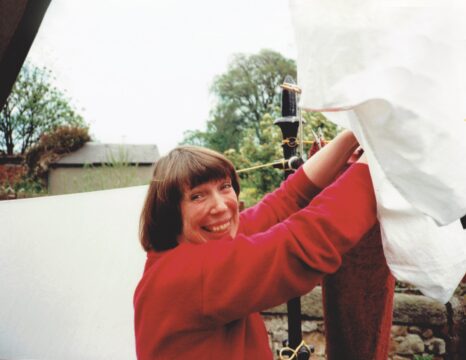
My mother’s final act of generosity was a continuation of the energy she once invested into teaching. At her celebration of life, we shared a letter from one of her former Grade 3 pupils, Jamie: “I have never seen a teacher as such careing, gentle, very consideret towards the children here. I hope you can provide such cind, consideret feelings and thoughts to everyone you mett in your travels,” he wrote, with a p.s. — “I don’t say this to every teacher, you know.”
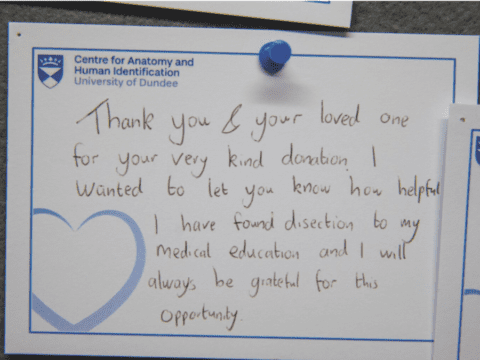
Even in retirement, Mum volunteered as a medical actor at her local hospital, helping student doctors practise their diagnostic skills and bedside manner by taking on the role of patient. Though given a script, she delighted in hamming up her symptoms and improvising lines.
But what defined Mum more than anything was her belief that dying was not the end; it was only a transition. She lost her own mother to cancer just before turning two — a grief she carried her whole life. Death didn’t scare her because she believed her mother would be waiting for her when the time came. To Mum, the body was a vessel for the spirit; in death, an empty shell. Perhaps donating her body was an expression of her faith in the soul’s journey.
A few weeks after the funeral in Dundee, Mum was cremated. In May, we’ll gather to scatter her ashes in two places: at her grave in the town where she was born, and into the sea at the fishing village where we have our happiest memories of summer holidays.
Body donation made grieving Mum more complicated, but it also gave us three ways to say goodbye: a celebration of life to honour her free spirit, a funeral to pay tribute to her generous heart and a scattering of ashes to return her to the places she loved most.
Even though we have Mum’s ashes now, small parts of her remain at the University of Dundee — something she consented to while she was alive. Her temporal bone is teaching surgeons how to restore hearing while her left clavicle is helping a forensic anthropologist study clues that a single bone can reveal about a person’s identity. I find solace in that: fragments of her still teaching, still in careful hands.
***
Valerie Howes is a writer, editor and photographer living in Prince Edward County, Ont. She inherited her love of words, photos and stray cats from her mother.
This article first appeared in Broadview’s May/June 2026 issue with the title “Anatomy of a Goodbye.”
Thanks for reading
Independent journalism rooted
in faith and justice is under threat
Broadview is the only media organization in Canada offering thoughtful, values-driven journalism from an inclusive, progressive Christian perspective. But our work depends on your support. If you value what you've just read, please act now.
A gift today helps keep this journalism alive tomorrow.
With gratitude,



An intriguing and inspiring read. Thank you, Valerie.