
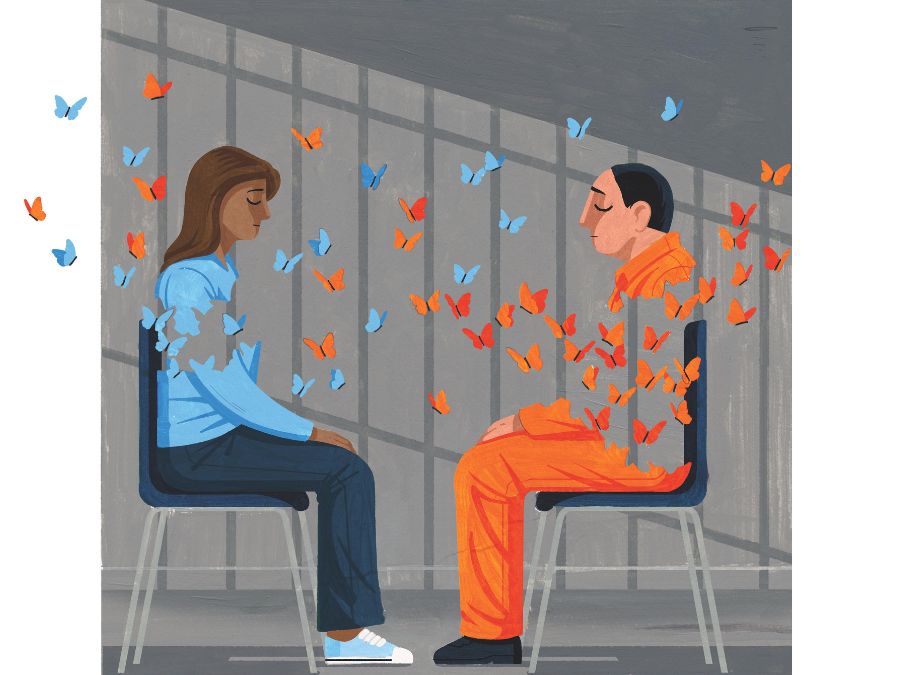
In 2012, Adam Campbell was out at an Ottawa nightclub when a very intoxicated Justin Williams approached his younger sister (names and some details have been changed to protect their identities). Campbell was taking a break from the dance floor and let Williams know his sister was not interested in talking to him.
“We’re cool,” Campbell recalled Williams saying when he recounted the night to Amber Montgomery, a restorative justice facilitator in Ottawa. The two men, both in their early 20s, shook hands. Campbell did not remember any signs that the situation would turn violent, but moments later Williams smashed the beer bottle he was holding repeatedly across Campbell’s face. A witness told police, “He kept hitting him without stopping, multiple times, until he was bleeding excessively.” Campbell’s sister watched in horror as her brother was beaten unconscious.
You may unsubscribe from any of our newsletters at any time.
Campbell spent the next four days in the hospital. A deep cut ran down the length of his face, crossing his nose and coming dangerously close to his eye. He received 31 stitches in his face and 21 more on his elbow.
Williams, on the other hand, woke up the next day in a police cell with no recollection of the night’s events. He only learned what he had done a day later when the details of the attack were read out during his first court appearance, where he faced an assault charge.
While police statistics show overall crime has dropped recently across Canada, violent crime has been rising steadily since 2014. After a brief drop during the first years of COVID-19, Statistics Canada’s Crime Severity Index shows that in just three years, violent crime rose 13 percent. At the same time, confidence in the criminal justice system is low. A 2025 National Justice Survey found that nearly half of Canadians had little or no confidence in the fairness of the justice system, and 39 percent were not confident it was accessible to everyone.
Much of the recent public debate around crime has centred on arguments for increasing jail time and stricter parole conditions, but research-based evidence points to an alternative pathway for reform: restorative justice.
Victims often feel anxious and isolated after a crime; they wonder why they were targeted and worry that it will happen again. But restorative justice programs use facilitated dialogues to bring together victims, offenders and, in some cases, community members to discuss the impact of the crime and jointly agree on actions that will address its harms. Offender accountability and healing for victims are priorities, with many finding that meeting the offender can help them both make sense of what happened and regain their sense of safety. Restorative justice practices have been implemented in more than 80 countries around the world. These programs look different from place to place, but they tend to have similar outcomes: offenders are less likely to reoffend, and victims often feel satisfied with how things are resolved.
Restorative justice programs are already operating across Canada, but sustained support beyond youth programs is limited. Organizations scramble for funding, many projects end after the pilot stage and investments in training, outreach and promotion are lacking.
At the same time, Canada’s criminal justice system is facing unprecedented strain. Costs for policing, courts and correctional services are ballooning, and delays are plaguing the system.
But systemic strain can also open the door to systemic change. As Kamil Ahmed, restorative justice practitioner at Community Justice Initiatives in Kitchener-Waterloo, Ont., recounts, his organization’s 50-year history began when a crown prosecutor and a judge asked themselves a simple but powerful question: “What else is possible here?”
***
In 2015, Jody Wilson-Raybould, then federal justice minister and Canada’s attorney general, was tasked with reviewing changes to the criminal justice system over the previous decade and exploring sentencing alternatives and bail reform. She convened roundtable discussions across the country with prosecutors, defence lawyers, academics, victims, advocates, restorative justice proponents and front-line service providers in health, mental health and housing. Many participants stressed the same concern: most people who encounter the criminal justice system are vulnerable or marginalized individuals struggling with mental health and addiction issues, poverty, homelessness and prior victimization. An over-reliance on incarceration, they argued, was making things worse.
Eric Granger, a criminal defence lawyer and board member for the Collaborative Justice Program (CJP) in Ottawa, has seen how restorative justice can make a difference in cases where offenders have mental health issues or are suffering from harms themselves. Launched in 1998, CJP has spent almost three decades showing how a restorative justice approach can be used to improve outcomes for victims, offenders and the greater community.
According to a 2021 Mental Health Commission of Canada report, close to 80 percent of inmates in federal correctional facilities suffer from mental health problems and illnesses, including substance use disorder. Yet Canadian prisons still lack proper mental health and addiction supports — particularly for those awaiting trial.
Since CJP’s inception, the Ottawa courthouse has been sending cases to the program, with judges making referrals when offenders plead guilty. Over months of facilitated dialogue leading up to the offender’s sentencing hearing, victims and offenders are able to gain a deeper understanding of each other’s circumstances. Granger has repeatedly observed victims becoming advocates for offenders, helping them access services — from counselling and stable housing — that support their mental well-being and lower the likelihood of future criminal behaviour.
Wilson-Raybould’s 2016 roundtables ultimately recommended reducing reliance on incarceration and expanding alternative approaches. This advice reflected not only a concern for outcomes, but also the mounting costs of an overburdened system. Today, more than 75 percent of people in provincial and territorial jails are awaiting trial or sentencing. At an average cost of $428 per day for each inmate, Canadians are paying over $6 million every day to hold people awaiting their court appearance. Investing in restorative justice programs can lower these costs while also reducing recidivism, or the rate at which people reoffend.
More on Broadview:
- Grizzly bears are back in B.C. Is coexistence possible?
- My hands shake. I’m not nervous; it’s essential tremor
- The last words of an ancient world
In 2024, the Centre for Public Safety and Criminal Justice Research at the University of the Fraser Valley released a comprehensive study of restorative justice programs across British Columbia. The research team interviewed senior police officers and managers of restorative justice programs to assess, in part, their potential to address power-based crimes like partner violence and sexual assault. They also analyzed over 3,000 police records to compare the recidivism rates between people referred to restorative justice programs and those who weren’t, but who committed similar offences. Although the two groups differed in age, gender and criminal history, the results were striking: only 12 percent of the restorative justice group reoffended compared to 75 percent in the control group. And even when restorative justice participants did reoffend, it was after a significantly longer amount of time.
While most restorative justice models have been geared toward minor offences and young first-time offenders, the study also showed that when restorative justice was used in serious violent crime cases, the recidivism rate was still lower. In Canada’s federal prisons, the Restorative Opportunities (RO) program, which has been brokering communication between victims and convicted offenders in serious crime cases since 1991, has seen similar results.
RO mentor and retired United Church minister Rev. James Scott, who has spent years working as a mediator, has seen how meeting face to face with victims can spark a deeper sense of accountability in offenders. “There’s a motivation that prison won’t give you,” he says.
***
When Adam Campbell was first offered an opportunity to participate in a restorative justice process, he was reluctant. He hated seeing his disfigured face staring back at him in the mirror each morning and didn’t think the facilitated dialogue offered by Ottawa’s Collaborative Justice Program — founded by Scott — would help him. But he had questions about why the attack happened that he wanted answered. Since Williams pled guilty, the next court proceeding would be a sentencing hearing and would be unlikely to reveal any new details. Although concerned that his participation might favour Williams’s case during the sentencing, Campbell agreed to the restorative justice process. It started with separate one-on-one meetings with Montgomery, the CJP mediator assigned to the case (and now CJP’s executive director). Williams was a first-time offender but could still face significant jail time for his assault.
The Williams-Campbell case was typical for CJP. Many of the cases referred to CJP involve males ages 18 to 29. By comparison, many other restorative justice programs in Canada work at the pre-charge stage, taking police referrals for young or first-time offenders to divert their cases from the criminal justice system altogether. Today, CJP works with clients for a wide range of offences. They receive government funding for youth programming but rely on a patchwork of donations and project funding to support adult services.
The Canadian criminal justice system establishes if a law has been broken, determines the facts of guilt or innocence and dispenses punishment and rehabilitation for guilty offenders. In recent years, victims’ rights and support services have improved, but many still feel sidelined by the system.
Scott sees restorative justice’s ability to centre victims’ needs as one of its central strengths. “Healing, to some degree, was dependent on their interaction with the person who had hurt them,” says Scott.
In the RO program, victims are given control over the process. They can initiate meetings and guide the form and pace of communication, which sometimes takes place over years. Program participation is largely motivated by victims — or, in the instance of murder cases, their family members — who are seeking answers to questions only the offender can answer. Victims also often want to share their story of the crime’s impact directly with the offender. Everything participants say in a meeting is strictly confidential.
In a case where a young man beat another man to death with a baseball bat while he was sleeping, the offender wrote a letter to the mother expressing remorse early on in his sentence. It took 12 years before the mother decided to participate in a RO meeting. She brought the letter to the meeting but couldn’t bring herself to read it. “She didn’t want to touch anything that had been touched by the man who had killed her son, so she had it in a plastic bag,” Scott recalls.
By the end of the second face-to-face meeting the mother walked over to the offender and took hold of his hands. The offender was unsure of what was going on. Scott remembers explaining, “She’s touching the hands of the man who killed her son.” It was an act of forgiveness and acceptance. But this is not always the outcome, nor does it need to be.
For Campbell and Williams, a breakthrough came from a letter exchange. After several one-on-one meetings with their mediator, Williams wrote a series of apology letters: first, to Campbell, then to his sister, mother and father. Reading them, Campbell could see how Williams put himself in each family member’s shoes, considering how the assault may have affected them. Williams also explained the changes he was making to ensure he’d never repeat the mistakes again: he stopped drinking alcohol and was attending anger management counselling. He also reimbursed Campbell for the ambulance bill and the clothes ruined in the attack. It was a small sum, but it gave Campbell something he may not have received through the courts.
Williams’s depth of responsibility and empathy surprised Campbell. This was the start of his own healing.
Their experience offers a glimpse of what restorative justice can achieve. In recent years, some parts of Canada have started to move in this direction, including Vancouver, which in 2022 committed to becoming North America’s first restorative justice city. Since then, 40 organizations have collaborated on a restorative justice framework that extends beyond the criminal justice system into policing, courts, schools and parks and recreation facilities. That framework was presented to Vancouver City Council in November 2025, but recent budget cuts may affect how and whether it gets implemented.
Nova Scotia has gone even further. The province now operates one of the largest and most comprehensive restorative justice programs in the country. Launched in 1999 as a series of youth pilot programs, the Nova Scotia Restorative Justice Program (NSRJP) expanded across the province within two years through partnerships with community-based restorative justice agencies. By 2011, it began piloting restorative approaches for adults, and by 2016 those programs were integrated across all regions. From the beginning, the NSRJP believed restorative justice could be used for all offenders and all offences.
Dalhousie University law professor Jennifer Llewellyn has helped implement restorative justice programs across Nova Scotia, including school programs and the Nova Scotia Home for Colored Children Restorative Inquiry. The daughter of a United Church minister, Llewellyn started thinking about justice at an early age. “Questions about what justice looks and feels like in the world were central to what it meant to be part of the church community,” she says.
Yet even with Nova Scotia’s success, Llewellyn cautions there is more work ahead. Across Canada, the system remains a fragmented patchwork of pilot programs. And without deeper structural change, the harms restorative justice seeks to address remain. “It can’t continue to grow in terms of people’s expectations and desire for it without a similar growth in terms of the investment and resources that could support and sustain it,” she says.
***
After nearly year of mediated communication, Campbell agreed to a face-to-face meeting with Williams. The meeting, which included their parents and a facilitator, centred on what happened, how they each were affected and what each needed to move forward.
Montgomery recalls a moment when Campbell spoke about the physical scar he bore from the attack. He reached for his cheek to touch the long mark but could not remember what side it was on. “Six months ago, I would not have been able to forget,” she remembers him saying.
By the time Williams’s sentencing hearing took place later that year, Campbell was seated in the court room alongside Williams’s family. The judge turned to Campbell and asked him how much time he thought Williams should serve. The answer surprised her.
“None,” Campbell said. To him, Williams had already made things right.
***
Shauna MacKinnon is a freelance writer from Vancouver. Her writing blends science and data with on-the-ground human stories. Follow her on Substack at Climate Connection.
This article first appeared in Broadview’s May/June 2026 issue with the title “Making Amends”
Thanks for reading
Independent journalism rooted
in faith and justice is under threat
Broadview is the only media organization in Canada offering thoughtful, values-driven journalism from an inclusive, progressive Christian perspective. But our work depends on your support. If you value what you've just read, please act now.
A gift today helps keep this journalism alive tomorrow.
With gratitude,












In Manitoba in !995/96 as MLA for Riel I Chaired a review of the Civil Justice System of Manitoba. Our September 1996 Report and its unanimous recommendations of a trial and appeal court judge and of lay and legal reps after public hearings chose to support ADR and restorative justice as desirable ways to reduce adversarial litigation processes and achieve resolutions of disputes by agreement through mediation and other innovative means. The image on the cover page was a circle of lay diverse people holding hands in a circle. Within the circle was a scales of justice on one side and a small circle on the other. The small circle represented restorative justice. The recommendations were designed to encourage alternate dispute resolution in the public interest. After i returned to private law practice in 2000 i had become a champion for restorative justice, I was motivated by my positive experience as a cabinet minister for Northern and Native Affairs who supported the minister of justice for the province in the formation of community restorative justice committees to facilitate such processes for first time offenders. So, when I returned to private practice in 2000 . I helped elder Art Shofley organize a training program for 11 restorative justice facilitators including myself and my wife and Rev. Murray Still, a First Nations Anglican minister and several RCMP and police constables and other lay people a training program at St. Benedict’s retreat centre. Since then Rev Still and his team have opened Initiatives for Just Communities (ICJ) that Dora’s this work. Lots more needs to be done to realize the benefits of restorative justice. it is needed locally, nationally and globally. This need led me to create a project with Dr. Kawser Ahmed http://www.crric.org called RoLE http://www.rulesoflawonearth.org. Guess what the logo is? Yes, the same logo as the 1996 report . David G Newman K.C. Retired: lawyer, legislator, cabinet minister now 100% Volunteer Rotarian peace builder and founding advisor of CRRIC
Shauna McKinnon’s Broadview article is superb: it is well researched, well supported (especially with folks like one of Canada’s original Restorative Justice pioneers, Rev. Jamie Scott providing comment) and well-written. Kudos.
We out here at Community Justice Initiatives, BC, are honoured to be affiliated with all of you. And, as those among the pioneers, glad to see another fine expression of what we have known since our agency’s conception, as well: that “Restorative Justice Can Heal Communities.”