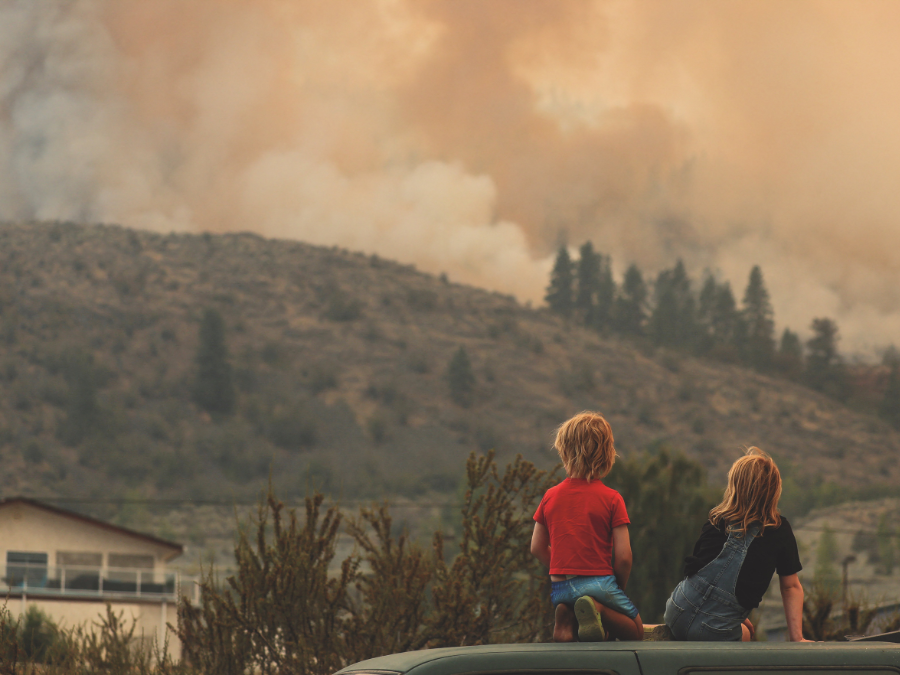
July 11, 2023, was like any other summer day for Amber Vigh. She was getting ready to take her nine-year-old son, Carter, to the summer camp she ran at the local arena in 100 Mile House, B.C. In preparation for an afternoon trip to the water park, she did what had become routine during British Columbia’s wildfire season: she checked the air quality index on her phone.
“It was like a one or a two,” she recalls. “You couldn’t smell smoke at the time we left. It was like any other beautiful summer day.”
You may unsubscribe from any of our newsletters at any time.
Carter had lived with asthma for years. Vigh knew the routine — inhalers packed, activities adjusted on smoky days — but that morning gave her no reason to worry. There were no active wildfires near their home in 100 Mile House, and the closest major blazes were in other parts of British Columbia. Air quality forecasts showed little immediate risk, but the data Vigh relied on came from monitoring stations in Williams Lake, nearly 100 kilometres from her home, or Kamloops, nearly twice that.
That evening, Carter was sitting on the couch when he began to cough. “All of a sudden, it just happened,” Vigh says. “He started coughing, and we did all the things we were supposed to do.” She and her husband gave Carter his puffer, water and a cool bath. When his breathing worsened, Vigh rushed him to the hospital. “I just thought he needed his oxygen [levels] topped up,” she says.
At the hospital, Carter fell in and out of consciousness. Medical staff cycled through the room as doctors from across the province were consulted. After several rounds of CPR, Vigh was told there was nothing more they could do. “I never thought in a million years I was leaving that hospital without him,” she recalls.
A coroner later told the family Carter’s cause of death was asthma exacerbated by wildfire smoke. Microscopic particles had drifted from fires burning across the country, building up in Carter’s lungs. “It went from zero to 100 in the blink of an eye,” Vigh says. “I feel like we used all the information that we had at the time, and it wasn’t enough.”
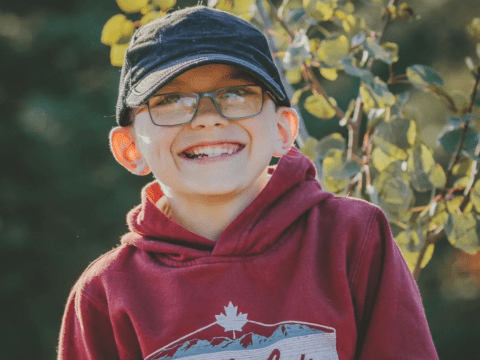
Carter’s death is a heartbreaking symbol of what doctors and researchers across the country are warning: Canada’s children are on the front lines of the climate crisis. As wildfires, extreme heat and air pollution intensify, pediatric hospitalizations are rising, and most cases go unrecognized as climate related. Parents like Vigh, as well as doctors and public health experts, are hoping for clearer policy action and education that moves responsibility of individual families and creates systemic safeguards for children.
“We have become complacent as a society in thinking that this is just the norm,” Vigh says. “There needs to be guidelines set.”
According to Health Canada, rates of heat-related emergency department visits among children aged two to 12 increased between 2005 and 2023, with higher baseline levels and more frequent spikes during years with more extreme heat events. Among adolescents aged 13 to 18, the same pattern emerges more starkly, with emergency visits peaking in 2018, the year of a North American heat wave.
Another study published last year in the Canadian Medical Association Journal found that asthma-related emergency department visits among children increased by roughly 40 percent in the days following heavy wildfire smoke exposure during Ontario’s 2023 fire season.
Natural Resources Canada describes 2023 — the year of Carter’s death — as the most destructive wildfire season ever recorded, with more than 15 million hectares burned nationwide. In a study published in Nature last year, researchers estimated that about 5,400 premature deaths across all ages in Canada and the United States were linked to short-term exposure to wildfire smoke in 2023. Much of that harm was driven by PM₂.₅, the scientific term for fine particulate pollution produced by combustion, including burning forests, vehicles and industrial activities. The name refers to the particles’ size: 2.5 micrometres or smaller, utterly invisible to the human eye. The particles can bypass the body’s natural filtration system, build up in the lungs and enter the bloodstream.
The World Health Organization recommends an annual average exposure to PM₂.₅ of no more than five micrograms per cubic metre. In 2023, Canada’s average reached about 9.2 micrograms, according to the Energy Policy Institute at the University of Chicago’s Air Quality Life Index — levels researchers estimate could shorten average life expectancy by roughly half a year if sustained over a lifetime.
Health Canada identifies children, older adults and pregnant people as among those most vulnerable to wildfire smoke, which disproportionately increases the risk of respiratory related deaths and is also linked to higher rates of PTSD, anxiety and depression. Despite this, children remain among the least protected.
More on Broadview:
- A year after a wildfire destroyed their building, Jasper United is finding new ways to gather
- How Lytton, B.C. is preserving its history after a devastating wildfire
- How Indigenous burning practices can help stop destructive wildfires
Helen Doyle is the chair of the Ontario Public Health Association’s Environmental Health Workgroup. She also collaborates with the Canadian Partnership for Children’s Health and the Environment, or CPCHE (pronounced kip-chee), an affiliation of organizations dedicated to raising awareness of how environmental exposures, air pollution and climate related risks affect children’s health, while advocating for policies and actions that reduce those harms. “Children have unique vulnerabilities because of their developing bodies,” she says. “They breathe more per kilogram of their body weight. They’re more active. Their bodies are developing their respiratory systems.”
These biological vulnerabilities, Doyle adds, are compounded by social and structural inequalities that leave some kids more likely to face exposure and adverse health outcomes than others. Children living in poverty, children from Indigenous and racialized communities, and those with chronic health conditions, such as asthma, are often less able to avoid environmental hazards.
That concern is echoed on the pediatric front lines. In Edmonton, Dr. Anne Hicks is an associate professor in pediatric respiratory medicine at the University of Alberta and works at a World Health Organization Collaborating Centre that provides clinical care and conducts research on children’s environmental health and climate impacts. The clinic was opened in 1997 to address a growing gap in pediatric care, as families and physicians sought expertise on how environmental exposures affect children’s health.
Hicks says extreme heat and wildfire smoke place an overlapping strain on the body. “Heat impacts the body by getting blood flow to go to the surface so that you can cool off,” she says. “Which means that your blood doesn’t flow as well through your veins and into your heart, because it’s busy being on the surface trying to cool your body off, so your blood pressure drops, and your heart has to beat faster, and it has to squeeze harder to get the blood to flow around your body.”
As the heart works harder, Hicks continues, the body’s demand for oxygen increases, forcing the lungs to work harder as well. For people with underlying heart or lung conditions — including children with asthma — that strain escalates quickly. As dehydration sets in, the kidneys are also placed under stress. Add in the inflammatory effects of wildfire smoke and air pollution, she says, and you get a “double hit” that overwhelms the system.
Beyond the immediate dangers, Hicks points to growing evidence linking long-term wildfire smoke exposure to chronic health outcomes, including a faster progression of neurodegenerative diseases such as dementia, Alzheimer’s and Parkinson’s.
You shouldn’t have to dig for the information. It should just be there.
Dr. Bethany Ricker is a family physician in Nanaimo, B.C., and co-chair of the Canadian Association of Physicians for the Environment, a CPCHE affiliated organization. She identifies extreme heat and wildfire smoke as two of the greatest climate-related health risks facing Canadians.
She recalls a pregnant patient who went into premature labour during the 2021 heatwave in British Columbia, ultimately resulting in a NICU stay for the baby. “We’re not connecting the dots that those are climate change-related impacts that we can both mitigate and adapt to,” she says.
The effects ripple outward, she adds, placing pressure not only on patients, but on health-care infrastructure itself. “That’s just one example of the strain on the patient, on the whole maternity and pediatric unit, and on the health-care system at large for the resources that it requires,” she says.
During the 2023 wildfire season, Ontario estimated that smoke-related health impacts cost the system $1.28 billion over just a single week.
Despite the financial stakes, Ricker says she isn’t aware of a national tracking system for climate-related health effects, making it diffcult to measure the correlation between health outcomes and climate change.
Doyle also highlights the importance of data. “What we need is more data linking those health outcomes, whether it’s respiratory conditions, whether its cancer, linking those to what we’re seeing in the environment.”
Even with the limited data, a clear picture is emerging. Canada’s air quality indicators show a rise in the number of “high risk” days under the Air Quality Health Index (AQHI). During the 2023 wildfire season, Canada recorded twice as many poor air quality days as in 2021, and 11 times more than in 2020.
In its 2021 report “The Limits of Livability,” the Global Climate and Health Alliance warned that public health systems are not currently equipped to deal with longer and more severe wildfire seasons, which can force hospital closures and evacuations of patients and staff.
Schools and childcare facilities are also contending with extreme heat and smoke. Doyle points out that classroom temperature can affect learning outcomes and children’s focus. “The kids are coming home, they’re having headaches, they’re not feeling good,” she says.
Health agencies have begun issuing new guidance. Vancouver Coastal Health and Fraser Health authorities, for example, recently published a wildfire smoke guidance document recommending schools install MERV-13 or HEPA filters, maintain indoor temperatures below 26°C and cancel outdoor activities when the AQHI exceeds seven.
But recommendations only go so far. Some experts say federal standards, backed by investment from all levels of government, are also needed. Protecting kids from the health effects of climate change is a multi-sector challenge that calls for “an all-of-society approach,” says Doyle.
Ultimately, says Ricker, we need to shift away from fossil fuels and toward clean energy sources. “Every degree or part of a degree of warming that we are locked into today will impact children born today so much more than it will impact each of us in the future.”
For Amber Vigh, access to clear information is part of prevention. “There’s such a lack of information out there, and it’s heartbreaking,” she says. That’s why she started Carter’s Project in 2024, in collaboration with the BC Lung Foundation. Since its launch, the foundation has distributed more than 200 indoor and 20 outdoor air-quality monitors across the 100 Mile House region, allowing families to access real-time air data online.
“You shouldn’t have to dig for the information. It should just be there,” says Vigh. “There needs to be protocols and guidelines put in place that are going to keep communities safe.”
Last summer, Vigh travelled with the BC Lung Foundation to Gold River, B.C., on Vancouver Island, where Carter’s Project was implemented in two local schools. Students were taught how to build DIY air purifiers, and the completed units were installed in classrooms, where they remain in use. The group also held a public demonstration at a town hall meeting, attended by dozens of community members.
Vigh continues to share Carter’s story while encouraging parents to learn about the risks wildfire smoke poses to children with asthma. She hopes to bring air quality monitors beyond British Columbia to communities across Canada and the United States.
“I just want people to think about how quickly things can change,” she says. “I want people to see his little face and think, that’s Carter Vigh, and he’s changing the world.”
***
Paniz Vedavarz was a 2025 summer intern at Broadview. She is the senior culture and engagement editor at the Western Gazette, Western University’s student newspaper.
This story first appeared in Broadview’s March/April 2026 issue with the title “Children of Smoke.”
Thanks for reading
Independent journalism rooted
in faith and justice is under threat
Broadview is the only media organization in Canada offering thoughtful, values-driven journalism from an inclusive, progressive Christian perspective. But our work depends on your support. If you value what you've just read, please act now.
A gift today helps keep this journalism alive tomorrow.
With gratitude,