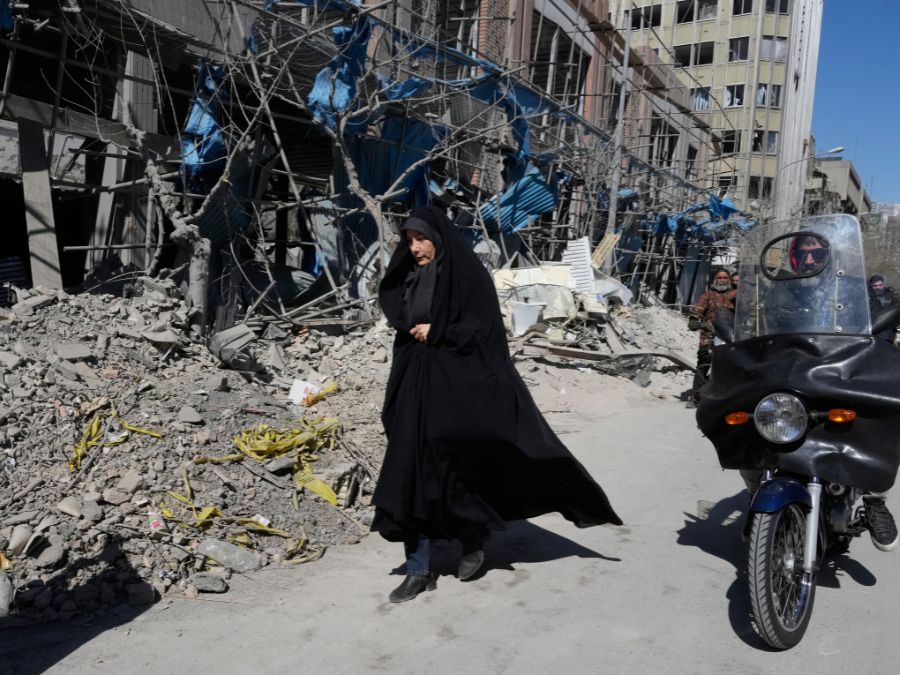
On Feb. 28, the United States and Israel launched a joint strike campaign against Iran. These airstrikes killed Supreme Leader Ayatollah Ali Hosseini Khamenei, along with several other senior regime figures. Shortly after, the country retaliated with its own missile attacks on Israel and other locations in the Persian Gulf, including U.S. military bases. More than 1,200 people have been killed in Iran so far, along with over 100 in Lebanon and more across the region. The U.S.-Israel strikes have also destroyed warships and ballistic missile sites in Iran.
Canadian prime minister Mark Carney and foreign minister Anita Anand put out an initial statement pledging their support for Israel’s right to defend itself and for the U.S.’s actions to prevent Iran from “obtaining a nuclear weapon and to prevent its regime from further threatening international peace and security.” Carney later said that he took this stance “with regret,” and said the intervention appeared “inconsistent with international law.”
You may unsubscribe from any of our newsletters at any time.
Faith groups in Canada and around the world are weighing in on the ongoing conflict and Canada’s role as a peacekeeping nation. Some were concerned by the Canadian government’s endorsement of the U.S.-Israel attack while others say the military action was justified. Here are some of their comments.
The United Church of Canada called for a ceasefire in Iran in its statement on Saturday, insisting that all governments, including Canada, work to prevent further escalation and conflict. The denomination expressed concern over Carney and Anand’s statement that condoned the attack on Iran instead of “upholding international law and condemning military actions in the midst of ongoing diplomatic talks between Iran and the US.” It also said it was in touch with its partners in the region.
The Centre for Israel and Jewish Affairs (CIJA), a major Canadian Jewish advocacy group, expressed concern for those threatened by Iran’s “Islamic Regime” in its statement. They encouraged the Canadian government to continue supporting military action from the U.S. and Israel, saying that “Here in Canada, Iran is designated as a state supporter of terrorism for good reason.”
More on Broadview:
- Nowruz in a time of war
- The everyday ceremony that grounds me during Lent
- Religious OCD took over my childhood. Years later, I learned how to manage it.
The National Council of Canadian Muslims (NCCM) openly condemned the Canadian government for endorsing “an illegal invasion or violation of international law” in its statement. While the NCCM agreed that Khameini ran an authoritarian dictatorship in Iran, the organization said that such military action would only result in more death and chaos across the Middle East.
Pope Leo XIV insisted during an address on March 1 that peace could not be built with weapons, but with a return to dialogue and open communication. He called upon the countries involved to “assume the moral responsibility to stop the spiral of violence before it becomes an irreparable abyss!”
The U.S. Episcopal Church’s statement on the ongoing armed conflict asks for prayers for the safe return of American members currently based in the Middle East and for the people of the Diocese of Iran. The U.S.-based church also predicts that such attacks “will surely mean further hardship for the most vulnerable Iranians and, as retaliation inevitably follows, suffering that will spread across the entire region.”
***
Sarah Grishpul is an intern at Broadview.
Thanks for reading
Independent journalism rooted
in faith and justice is under threat
Broadview is the only media organization in Canada offering thoughtful, values-driven journalism from an inclusive, progressive Christian perspective. But our work depends on your support. If you value what you've just read, please act now.
A gift today helps keep this journalism alive tomorrow.
With gratitude,