
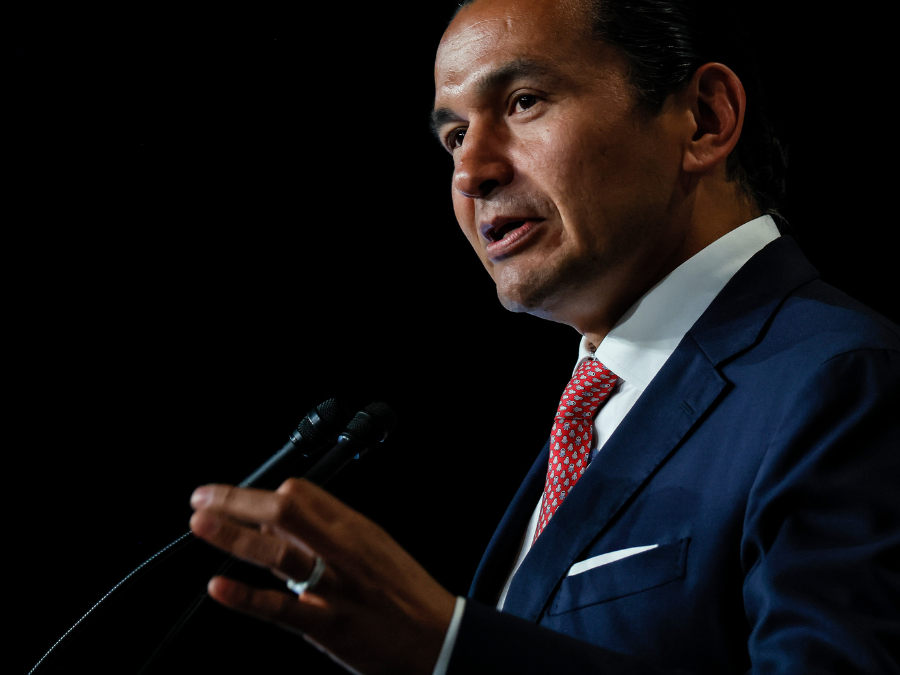
Wab Kinew won’t say no to a righteous fight.
In October, on the first day of the fall session of the Manitoba legislature, the province’s premier stood up during question period to chastise a crowd of protesters who had gathered outside calling on Kinew to fire his minister of families, Nahanni Fontaine, a fierce advocate for missing and murdered Indigenous women and Two-Spirit people. Earlier, Fontaine had shared an Instagram post that called assassinated right-wing provocateur Charlie Kirk a “racist, xenophobic, transphobic, Islamophobic, sexist, white nationalist.” Fontaine apologized, but in the early hours of National Day for Truth and Reconciliation, someone firebombed her constituency office, leaving behind shattered glass, charred walls and melted shelving.
You may unsubscribe from any of our newsletters at any time.
“To the goofballs out front, if you have an issue, you have an issue with me. I am the one who decided to keep this minister at the cabinet table,” Kinew declared. He pointed out that protesters often demonstrate at his constituency office, “but nobody ever thought to light a match.”
Last summer and fall, fires were also set at the office of housing minister Bernadette Smith. Kinew reminded his audience that Smith and Fontaine were the first Indigenous women ever to hold cabinet posts in Manitoba. He called the attacks misogynistic and racist.
Kinew is a fighter. You can see it in his pugilistic posture in question period. You can see it in the house-sized flag he draped over the face of the legislative buildings in response to Donald Trump’s aggressions. You can see it in the cheeky video he released applauding Ontario Premier Doug Ford’s incendiary anti-tariff ad.
“If you throw a rock at a lake and you don’t hear a splash, you’ve probably missed,” Kinew says, grinning from the screen of a 1980s TV set in a parody of the original ad. “And so, to my good friend Doug Ford, keep the ads on TV.”
Two years into his mandate, Kinew remains the most popular premier in Canada. He governs from the political centre, at times progressive, at times populist. He defends trans kids, supports Indigenous self-determination, touts law and order, talks pipelines, and axed Manitoba’s gas tax. Some speculate he’s angling for Canada’s top job.
“Wab is an ambitious, extremely creative, and very, very talented person,” says Anishinaabe writer and educator Niigaan Sinclair. “He brings a lot of himself to the public and brings that in a very authentic way… He understands the political world. He’ll be there for a while.”
More on Broadview:
- Colour the Trails helps racialized Canadians enjoy the outdoors
- U.S. bishop goes viral with comments about ‘new era of martrydom’ to resist state injustice
- The last words of an ancient world
The leader of Manitoba’s NDP since 2017, Kinew ran for election as premier in 2023 on a promise to search a landfill north of Winnipeg for two murdered Indigenous women whose bodies police believed had been dumped there. Winnipeg’s police chief said searching the landfill would be too expensive and too risky. Then-premier Heather Stefanson, playing to her Progressive Conservative base, vowed not to search the landfill.
But Kinew wanted the world to know that Indigenous women were not garbage. He won the election, becoming Canada’s first provincial premier of First Nations descent, and searched the landfill for a 10th of the cost naysayers had estimated. The remains of Marcedes Myran and Morgan Harris were returned to their families with honour and ceremony.
At a press conference in March, after Winnipeg police identified Ashlee Shingoose as the fourth victim of the same serial killer who had murdered Myran and Harris, Shingoose’s father asked Kinew to sing a song. The premier stepped up to the microphone and sang an honour song for her. It was a powerful moment of political and spiritual leadership. In December, Kinew held a pipe ceremony with Shingoose’s parents and sister at the start of a search for her remains at another Winnipeg-area landfill.
But despite his support for missing and murdered Indigenous women and girls, Kinew has also disappointed some progressive voters.
When a community organizer approached him at a recent dinner to ask why he wouldn’t publicly call the destruction of Gaza a genocide, Kinew answered: “If you want me to use activist language, you’ll be disappointed.”
This past summer, as smoke from climate-stoked wildfires choked Manitobans’ lungs and thousands of evacuees tried to sleep on Red Cross cots lined up in Winnipeg gymnasiums, Kinew talked about building a pipeline to Churchill that would carry crude oil or natural gas.
Clayton Thomas-Müller, a Cree climate campaigner who grew up with Kinew and still refers to him as “brother,” says Kinew’s disregard for the climate crisis endangers not just his people’s food, water, ceremonies and ways of life, but all of our ways of life.
Kinew is fond of saying that the “economic horse pulls the social cart,” but Mark Hudson, who teaches climate politics at the University of Manitoba, says extracting and shipping fossil fuels is not good economics. “Anything that locks fossil fuel infrastructure in for the next 50 years is short-term thinking. We either are not going to meet our climate goals or those assets are not going to meet the end of their economic life.”
This fall, Kinew’s government released a climate strategy informed by Indigenous teachings about the wild rice harvest. The 32-page document offers a framework to reach net-zero emissions, but most analysts agree it lacks the timeline and specific next steps necessary to get us there.
One group the premier hasn’t forgotten about in his political ascent is Indigenous youth. He often addresses them in his speeches. Kinew says he’s proud to see Indigenous youth doing well in school, playing sports and getting involved in their communities. He also regularly visits the Manitoba Youth Centre to talk to young people incarcerated there.
“We have this opportunity to try and get them to change their lives around,” he told the Winnipeg Free Press.
Kinew knows this because of his own experiences with the justice system. He grew up with both privilege and hardship. His father, Tobasonakwut Kinew, survived residential schools to become a prominent Indigenous leader, and his mother taught for more than 25 years at the University of Manitoba. But Kinew lost an older brother to an accident and another brother to suicide. In his memoir, Kinew writes about falling into a self-destructive lifestyle and how his decision to follow the spiritual path of a Sundancer saved him.
“[Kinew] is a traditional person and he takes very seriously what he is showing to young people,” says Sinclair. “Growing up in this society [as an Indigenous person] is really hard. Most of us were ashamed our whole lives. He wants young people to be proud of themselves, not to be ashamed. He’s trying very hard to be a good uncle. That’s one of the best compliments I can give to somebody.”
***
Kinew could not be reached for an interview for this story.
Josiah Neufeld is a writer in Winnipeg and the author of The Temple at the End of the Universe.
Thanks for reading
Independent journalism rooted
in faith and justice is under threat
Broadview is the only media organization in Canada offering thoughtful, values-driven journalism from an inclusive, progressive Christian perspective. But our work depends on your support. If you value what you've just read, please act now.
A gift today helps keep this journalism alive tomorrow.
With gratitude,







As someone looking in from the outside, and undoubtedly with a less than full appreciation for the man, I am happy that Wab Kinew is one of Canada’s Premiers. It seems to me that is doing his best to walk the walk that engenders a better place for Canada and Canadians.