

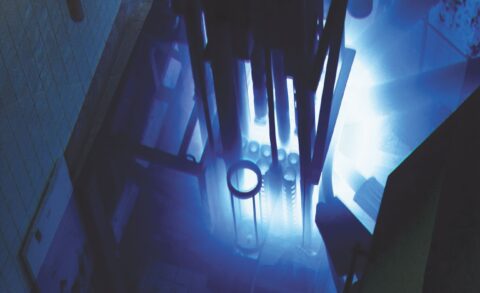
The pool inside McMaster University’s nuclear research building in Hamilton glows an extraordinary translucent blue — like a summer sky nearing sunset. It’s hard to resist the urge to dive in. But this is no ordinary pool. The rounded chamber looks more like a lab from a retro science-fiction film than a place for swimming laps: a crane hangs from the ceiling, and on the floor below there’s a set of mechanical arms to handle glowing radioactive material.
The most striking piece of equipment, though, is the nuclear reactor. Resting at the bottom of the pool, where the water keeps it cool and shields against radiation, the reactor shines bright white — almost like a star. It’s the heart of the facility, driving a chain of reactions that release energy through a process called nuclear fission.
You may unsubscribe from any of our newsletters at any time.
During fission, a neutron collides with the centre of a heavy atom, causing it to split and release energy. The split atom releases more neutrons, which go on to split other atoms, creating a domino effect. To put it into perspective: if all the atoms in a single gram of pure Uranium-235 — the active part of the fuel used to power McMaster’s reactor — were to undergo fission, it would create enough energy to power a 60-watt lightbulb for more than four decades.
Built in the late 1950s, the university’s research pool reactor was one of the first of its kind to become operational outside of the United States. The project came to fruition at a time when people in Canada and beyond believed that nuclear energy would fuel the future. In 1957, the year construction began, an article in the Globe and Mail predicted nuclear power would eventually “raise the living standard of all peoples and maintain it for centuries.”
But soon after the reactor’s launch, public support for the technology began to wane. Mounting evidence about the harmful effects of radiation, coupled with disasters like the 1986 Chernobyl explosion in the former Soviet Union, raised serious safety concerns. By the 1990s, Canadians — whose cultural memory still fused the word “nuclear” with “catastrophe”— remained deeply ambivalent.
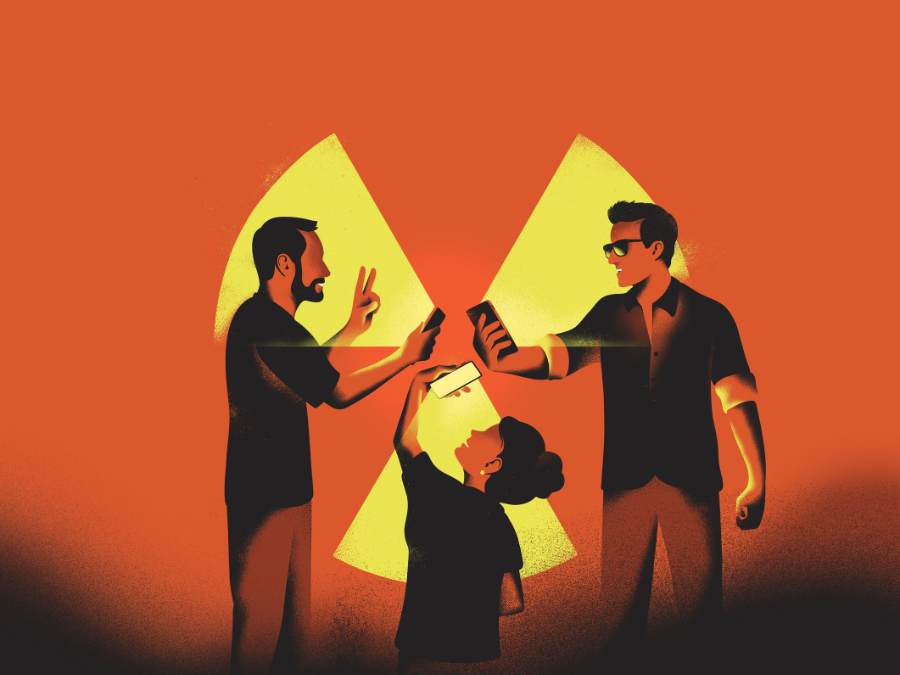
Today, attitudes are shifting. In 2025, an Angus Reid survey found that support for nuclear among Canadians had reached an all-time high of 63 percent. Driving this change in Canada and elsewhere are younger generations — people in their 20s, 30s and early 40s — some of whom call themselves Generation Atomic. As their numbers grow, critics have nicknamed them “nuclear bros” for the high proportion of men in their midst or “nukefluencers” for their persuasive impact on social media.
“The attitude has shifted so dramatically,” says Tristan Tolley, 24, a private swim instructor in Nanaimo, B.C., and a member of Canadians for Nuclear Energy, a non-profit advocacy group. “I would say people were a lot more negative five years ago.”
For Tolley and others of his generation, the priority is ensuring the world remains livable in the face of the climate crisis. Nuclear energy, for all its controversy, is re-emerging as one of the most promising ways to power a warming world with rapidly growing energy needs.
Google’s Generative AI language models alone could eventually use the same amount of energy each year as a country the size of Ireland, according to an estimate from a Dutch researcher in 2023. Demand forecasts from provincial power authorities expect a massive growth in electrical consumption in the decades to come: the B.C. government estimates a 15 percent increase by 2030, while Ontario predicts an increase as high as 75 percent by 2050.
Tolley argues that the task is beyond the capability of renewable energy forms like solar, wind or even hydroelectric, which currently supplies his West Coast province with over 90 percent of its electric power. “I think people are starting to come to that realization that nuclear has to be part of the climate solution,” he says.
***
Canada’s first nuclear research facility was built near Chalk River, Ont., in 1944 as part of a top-secret collaboration between British, Canadian and American scientists to produce uranium and plutonium fuel during the Second World War.
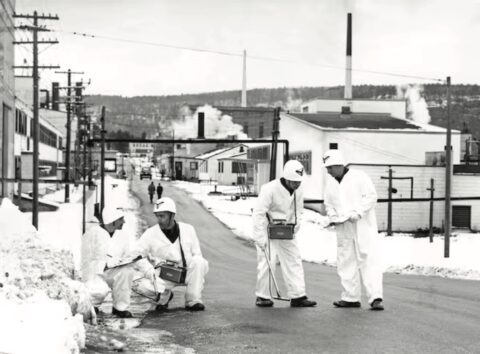
One year later, the facility’s test reactor achieved the first sustained nuclear reaction outside of the United States — a scientific triumph that lingered, despite the string of accidents that followed. The first major incident, in 1950, was an explosion in the facility’s plutonium extraction building that killed one worker and sent four others to hospital. Then, in 1952, came a partial meltdown of the facility’s reactor. It forced the evacuation of workers and their families, and military troops from both sides of the border had to manage the cleanup. Six years later, a damaged fuel rod caught fire in the new reactor, and while no one was immediately injured, at least one person involved in the cleanup later developed unusual cancers.
Proponents downplay these accidents as part of the learning curve of working with nuclear technology, but by the 1960s skepticism intensified. During the Cold War, Canadians found themselves geographically trapped between the United States and the U.S.S.R. and lived in fear of radiation exposure, either from nuclear bomb testing fallout or a bomb itself. The United States’ 1945 bombings of Hiroshima and Nagasaki, Japan, which killed an estimated 210,000 people, had already revealed the devastating potential of nuclear fission.
That fear and skepticism coalesced into a movement: first, to ban nuclear weapons, then to challenge nuclear power generation. At the centre of the Canadian pushback was Ontario Hydro’s ambitious plan to expand its nuclear capacity. In 1976, the provincial utility proposed building nuclear reactors in the townships of Darlington and Augusta, east of Oshawa, along Lake Ontario and the St. Lawrence River. Two other nuclear generating stations were already in operation in Ontario: one in Bruce County northwest of Toronto and another in Pickering, just east of the city.
Anti-plant activists were concerned not only with how accidents might affect surrounding populations, but also with the environmental impact of operations and potential radioactive leaks from storing spent fuel. A government steering such large plants and complex energy-generation processes inspired little confidence in an era of widespread anti-establishment attitudes.
The showdown came in 1977 when Atomic Energy of Canada Limited, the federal Crown corporation responsible for developing nuclear technology, proposed storing nuclear waste in the township of Madoc, near Bancroft, Ont., and building an extraction plant to produce plutonium from the waste.
At a public meeting in March of that year, more than 1,100 residents and protesters — a number just shy of the municipality’s then-population of 1,363 — filed into a local high school auditorium to tell the AECL officials to take their project elsewhere. And the officials listened.
The confrontation proved what many had hoped: “public pressure could work,” writes Neil Forkey, an environmental historian. Subsequent protests prompted inquiries that questioned Ontario Hydro’s demand projections, leading to the cancellation of the eastern Ontario development and delays at Darlington, which finally opened in 1990, a decade after construction began.
Today, most of Canada’s nuclear facilities continue to operate — including the three Ontario plants and one in New Brunswick — with the exception of the Gentilly-2 Nuclear Station near Trois-Rivières, Que. According to CBC, in 2012 the Parti Québécois government quashed plans to refurbish the station after costs ballooned by $2 billion over the original estimate, reaching a total of $4.3 billion. While these four active plants supplied about 13 percent of Canada’s electricity in 2024, rising costs, lack of public support and persistent questions about safety have long cast a shadow over the industry.
But over the last few years, amid an escalating climate emergency, that shadow has started to fade. At the COP28 United Nations Climate Change Conference in 2023, Canada was among 22 countries that pledged to triple the world’s nuclear capacity by 2050, recognizing the technology’s potential to reduce (and possibly eliminate) climate change emissions.
The federal government has since established a fund of nearly $30 million to support the development of small modular reactors and the addition of nuclear power to the country’s Green Bond Framework, which offers government bonds for environmental projects. Last fall, in a show of commitment, the federal and Ontario governments jointly pledged $3 billion to support the development of four small modular reactors at the Darlington plant. In Ontario, Saskatchewan and New Brunswick, provincial governments have also announced expansions of new nuclear projects, while Alberta has begun the process of consulting its residents about adding nuclear energy generation.
With federal and provincial initiatives pushing nuclear forward, curiosity about the technology is spreading beyond policy circles. Just five years ago, Canadian searches on Google for topics like “nuclear power” were statistically so insignificant compared to “solar power” the search engine registers it as a flat line at zero. Now, the volume is equivalent to searches for “wind power” — and modestly increasing.
On social media, posts about nuclear issues regularly go viral. One TikTok video by an account called Antimorphix, which posts on chemistry and biology, featured a class presentation on nuclear power. Soon after it was posted last September, it racked up more than 1.3 million likes and 7,700 comments, showing how discussions about nuclear energy are increasingly entering the public sphere.
One of the most active facilitators of the Canadian nuclear power conversation is Chris Keefer, an emergency room doctor in Toronto. In 2020, Keefer co-founded Canadians for Nuclear Energy, motivated by concerns about how fossil fuel-related climate change and pollution would affect his infant son’s future. The group’s membership currently sits at about 400. (Keefer says it does not receive support from the nuclear industry.)
Previously suspicious of nuclear power, Keefer came to see it as a misunderstood energy source. “It was like this underdog technology,” he says.
Keefer also hosts a podcast called Decouple, which boasts more than 21,000 subscribers on YouTube. He uses it to tackle big questions about nuclear energy in Canada — from the costs of Ontario’s Darlington plant upgrades to concerns about weaponization after the Israeli-U.S. bombing last June of Iran’s nuclear facilities. Decouple’s most popular episode, a tour of Bruce Power posted in 2022, has more than 370,000 views.
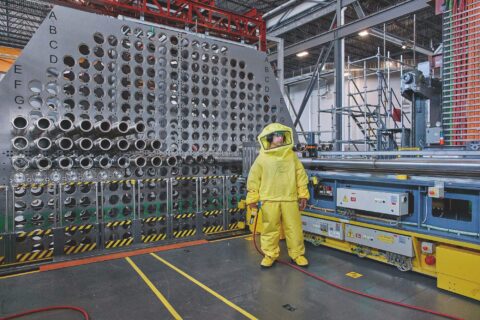
nuclear stations in the world. It has produced 20 percent of Ontario’s electricity since the early 1990s. (Photo by the Globe and Mail)
It’s important to probe widely, he tells me. “To understand the climate question, you really have to understand it’s a fundamental question of energy,” he says. “That’s what got us into this mess.”
The growth Keefer has seen in his own initiatives mirrors the surge in organizational activity happening across the county. According to the website of the industry sponsored North American Young Generation in Nuclear, 37 of the organization’s 150 chapters are located across Canada. In 2024, the Canadian chapters were collectively ranked as among the top performers in the organization’s professional development and networking activities.
Arianna Santos, 21, a fourth-year materials engineering student at McMaster, joined the organization’s local chapter last year. She says the group has about 40 members, many of whom are attracted to the industry because of the opportunity to land well-paying and interesting jobs.
But even as enthusiasm builds among younger generations, longtime critics of nuclear power, who have spent decades warning about its risks, are watching with concern.
Susan O’Donnell is an adjunct research professor in the environment and society program at St. Thomas University in Fredericton who opposes nuclear development. Her research focuses on how rural and remote communities adopt technology, including those related to the nuclear industry. She attributes the growing support of nuclear energy to a concerted industry campaign — much of which is taking place on social media — that plays on people’s anxiety about climate change.
“People really don’t know what to do about the climate crisis,” she says. “If all you hear about nuclear power is that it’s clean, it’s affordable, it’s effective, you know it’s going to do the trick…well, why wouldn’t you be in favour of it?”
O’Donnell is critical of how the technology has been positioned as a problem-free solution to the climate crisis. She acknowledges the sector creates jobs — often in rural areas where finding steady employment can be a challenge — but argues that a decentralized electrical grid could do the same thing while more effectively addressing local power challenges, like those faced by New Brunswick’s northwestern Acadian communities, where storms often disrupt service.
More on Broadview:
- Tzeporah Berman on how the fossil fuel industry hijacks climate discussions
- ‘Radical change’ required to tackle climate crisis after disaster in B.C., say ministers
- Nuns like sister Megan Rice have gone to prison to protect nuclear weapons
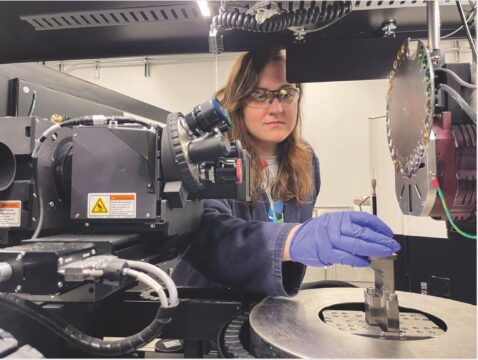
During my tour of the research reactor at McMaster, Markus Piro, an engineering physics professor, emphasized the precautions in place to keep the facility safe. There’s a thick concrete barrier surrounding not only most of the reactor, but also the entire building. Researchers also wear dosimeters hooked to their lab coats to monitor radioactivity, and two larger checkpoints measure radiation. He adds that there are similar precautions in place at other nuclear power generation facilities across the country.
“There were no standards at Chernobyl,” says Piro. “It was an inherently unsafe design. You didn’t have oversight or law enforcement. It was like driving your car with no seatbelt and no airbags after drinking a bottle of wine.”
The partial meltdown of three reactors at Japan’s Fukushima Daiichi plant in 2011, triggered by a major earthquake and tsunami, was a fluke, he says. It became the world’s second-worst nuclear power disaster, despite multiple safety precautions: the facility was designed to withstand earthquakes, was equipped with emergency diesel generators to keep the reactors cool in the event of a power failure and even had barriers to protect it from tsunamis. But a 2024 report from the World Nuclear Association found that the barriers weren’t high enough because they were designed using outdated information, and the backup power systems, located on the facility’s lower level, were flooded.
“The probability of risk is not zero,” says Piro, adding that all things in life involve at least some risk.
Beyond safety concerns, both nuclear energy’s newest proponents and long-term critics share concerns about small modular reactors like the ones currently being built at Ontario Power Generation’s Darlington plant. According to a 2024 report by the international non-partisan organization Institute for Energy Economics and Financial Analysis, these smaller reactors are more expensive to build. The first of the four Darlington reactors and the infrastructure needed to support them is estimated to cost $7.7 billion — more than seven times the amount Saskatchewan recently spent to build a station that uses natural gas to generate roughly the same amount of electricity.
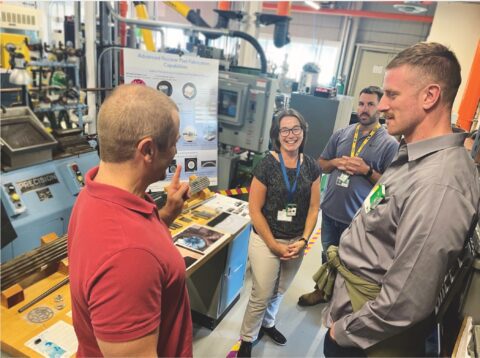
Small modular reactors (SMRs) can generate up to 300 megawatts of electricity — enough to supply the power needs for 300,000 homes. It may sound like a lot, but it’s only about a third of the power of a traditional CANDU (Canada deuterium uranium) reactor.
Keefer describes the promotion of SMR technology as the industry’s attempt to distance itself from past accidents. It’s a “shiny new object that has no [negative] operational record associated with it,” he says. He says he would rather see the larger CANDU reactors built to respond to the escalating demand for energy.
“It’s a massive industrial effort and really requires a different sort of political and economic system than we have in our hollowed-out neoliberal current moment,” he says.
But the time it takes to build such facilities has only grown in recent years. Many of the projects — including individual units, plant expansions and new facilities — currently underway in western countries are taking between 10 and 15 years to finish — more than double their initial timelines, according to a 2020 report by the International Energy Agency and the Nuclear Energy Agency. By contrast, the United Arab Emirates built four reactors over 12 years.
Once the infrastructure is established, a well-maintained plant could last 60 to 80 years, Keefer estimates. “We see really, really deeply decarbonized grids, and you have, ultimately, very cheap power for generations,” he says.
***
Supporters and critics of nuclear power may fight over its role in our energy future, but they recognize a shared challenge: most Canadians simply don’t know enough about how the technology works or what’s at stake.
Advocates of nuclear argue that the technology must be demystified and the public educated about its safety. Few people understand the basics: for instance, that the radioactive component inside an emergency exit sign can’t harm you, or that common medical procedures, like dental X-rays, safely use nuclear technology every day.
Piro, the engineering physics professor, says that as the industry expands in Canada, education is also essential to help train the workers needed to operate nuclear systems.
“They don’t just need engineers; they need people of different backgrounds,” he says, adding that this would include people in business and health sciences. To address the knowledge gap, McMaster University recently introduced an interdisciplinary minor in nuclear studies and society.
Many people I spoke with for this story noted that these conversations should begin in high school and that course curriculum should be standardized. While curricula in provinces like Ontario and New Brunswick does include energy production, including nuclear power, the specifics of how that material is delivered are typically left to individual teachers.
Others, like Andrea Ionel, say some of these conversations are already happening at a community level. In the past, residents of an area slated for nuclear projects were often consulted only after final plans were already underway. But today, with the current wave of expansions and the federal regulatory framework governing nuclear development in Canada — including a protocol introduced in 2012 for sharing public information — these discussions increasingly happen in advance.
Discussing potential issues and impacts ahead of development “is being very proactive,” says Ionel, a 23-year-old McMaster student who studies engineering, physics and society. She adds these early discussions place more pressure on proposals to be thorough and transparent in their supporting research.
For their part, Generation Atomic is filling the gap by bringing discussions of nuclear energy to social media. YouTuber Kyle Hill, a self-described science educator, features tours inside facilities and dissections of nuclear accidents. On X, Jenifer Avellaneda, a.k.a. “Nuclear Hazelnut,” a nuclear engineer who specializes in risk analysis, frequently posts about the safety features used in nuclear power.
Nuclear critics, on the other hand, argue that the conversation needs to be larger than weighing the merits of a single power source. Climate change adaptation is a far greater challenge than a simple shift to nuclear power could ever hope to solve, says M. V. Ramana, the Simons Chair in Disarmament, Global and Human Security at the School of Public Policy and Global Affairs at the University of British Columbia and author of Nuclear Is Not the Solution.
“We need large-scale social and political changes, which are not very feasible at the moment, but that’s ultimately what we need to be thinking about,” Ramana says. “We need to rethink our energy system. We need to evaluate our patterns of consumption and production. We have to ask, ‘What kind of social and political changes are we willing to live with?’”
***
The promise of nuclear power has never been just a matter of science. Nuclear energy depends not only on physics and technical expertise, but also on trust, care and responsibility.
History has shown how these can falter. We’ve seen it when nuclear plants become battle zones, as they have during the conflicts in the Ukraine and the Middle East, or when complacency and carelessness produce missteps and accidents that contaminate regions and disrupt large volumes of lifeways, as they did in Chernobyl and Chalk River.
With the climate crisis accelerating and options narrowing, however, the stakes — and tasks — are changing. It’s no wonder that younger generations are choosing pragmatism, weighing risks rather than seeking their elimination.
For advocates like Keefer, this calculation is straightforward. In a 2022 presentation to the federal standing committee on science and research, he argued, “The need to rapidly scale up our nuclear fleet should not be controversial.”
“When it comes to this proposition of do we need nuclear, do we need to scale it up to fight climate change? For me, it’s an unabashed yes.”
CORRECTION: An earlier version of this piece misquoted Ole Hendrickson. This version has been corrected.
***
Mary Baxter is an award-winning writer and historian in London, Ont., who specializes in environmental and energy issues.
This article first appeared in Broadview’s January/February 2026 issue with the title “The New Age of Nuclear.”
Thanks for reading
Independent journalism rooted
in faith and justice is under threat
Broadview is the only media organization in Canada offering thoughtful, values-driven journalism from an inclusive, progressive Christian perspective. But our work depends on your support. If you value what you've just read, please act now.
A gift today helps keep this journalism alive tomorrow.
With gratitude,










I was surprised that Mary Baxter didn’t mention the Three Mile Island nuclear accident (partial meltdown) in Pennsylvania that cast a chilling effect on nuclear enthusiasm in North America at the end of the 1970s. I seem to recall that the Canadian designed CANDU nuclear reactors were partially blamed for helping some countries develop plutonium for nuclear arms. This is not a great legacy. We still have decades of radioactive waste that needs to be safely stored for thousands of years. I’m not convinced that we’re making the best choices by betting almost exclusively on a nuclear future for energy in Ontario.
Mary Baxter’s blurry-eyed, silver-bullet discussion of nuclear energy and nuclear medicine has omitted key objections to nuclear power generation: safe long-term disposal of used fuel bundles including environmentally and socially responsible extraction of Canadian uranium in vulnerable northern communities. Yes, nuclear energy education needs to be comprehensive, not fulsome praise.