
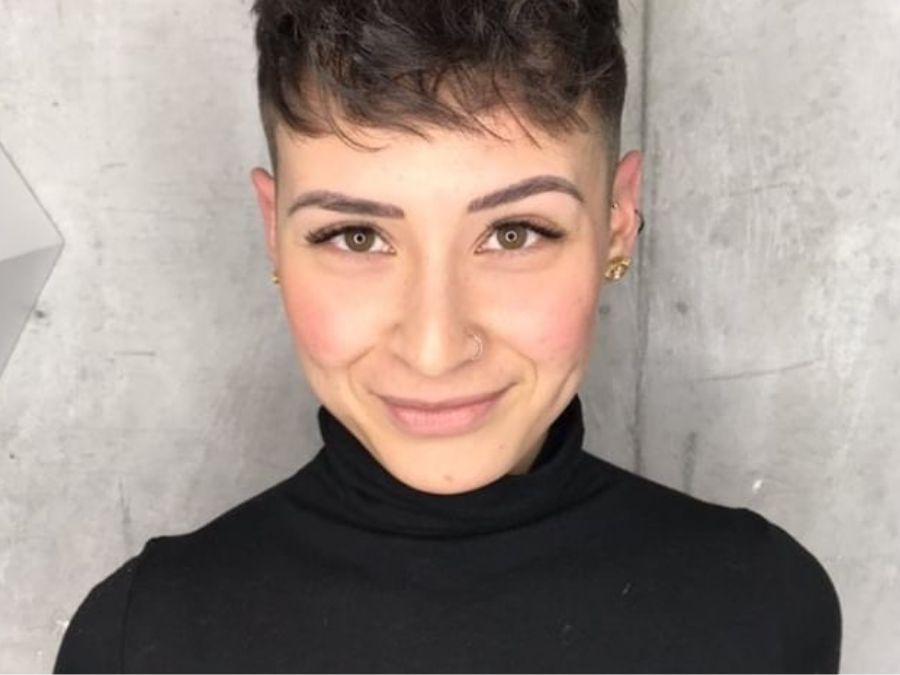
Brianna Wiens is assistant professor of digital media and rhetoric at the University of Waterloo. She teaches graduate students to analyze digital designs, exploring how websites, apps and other media communicate ideas and shape thinking. Her current research looks at images and rhetoric of misogyny, mixed-race representation and misinformation in the context of gender-based violence fuelled by technology. She also runs, with Shana MacDonald, the Feminist Think Tank, “a research-creation collective that advances research on feminist media, art and design.”
She spoke with Christopher White about how the rise in fascist ideology, not just in the United States but across the world, is also causing a spike in misogyny.
You may unsubscribe from any of our newsletters at any time.
Christopher White: It seems to me that COVID was the launching pad for all sorts of conspiracy theories and these have just been amplified by the extreme-right. How much did the pandemic influence what’s happening right now?
Brianna Wiens: I have a paper in review right now that will be published soon that would say that in many ways, the rise of radicalization of young men was triggered by COVID. I think one of the symptoms of fascism that we’re seeing is the radicalization of young men into kind of manosphere spaces. And I think that COVID did push people down those radicalization pipelines. At the same time, podcasters like Andrew Tate, Joe Rogan, Nick Fuentes and Charlie Kirk had more time to create their podcasts and their shows. And so, they ramped up their publication of podcasting materials during the pandemic, which did bring more young men and boys into their spaces, which acted as a pipeline towards being radicalized.
This is really worrisome, and we’re seeing the effects of that with journalist Rachel Gilmore, who received death and rape threats for talking about some of Charlie Kirk’s hateful opinions towards women and trans people. What happens is young men are going to online spaces to find a reason for why this is happening. But they’re actually encountering adults who have bad intentions. There’s a sense of losing your space in society and they have the answer for you. I think that the internet specifically has made misogyny a really powerful recruiting tool.
CW: Why is misogyny such a central part of extreme right-wing and fascist ideology?
BW: I think we have to actually define what fascism is because I always have to remind my students that it is this authoritarian, ultranationalist ideology that wants to create a unified, obedient society. It glorifies hierarchy, discipline and a sort of traditional order, and at the same time rejects diversity, equality and democratic debate. The reason that misogyny plays so well into that is because misogyny is not only a hatred of women. It is a system that polices and then reinforces women’s subordination. While it might reward women who conform to patriarchal expectations, it will punish women who challenge that dominance.
And so misogyny then becomes a structural part of how fascism operates. Fascist movements really rely on restoring this sort of mythic patriarchal past where men can rule the public sphere and women are confined to motherhood and the home — to private life. There’s this sort of nostalgia for traditional values, and that nostalgia is going to give fascism its emotional power and draw people to its cause, because it can promise this return to male dominance and control.
Fascism also sees its community as under threat from outsiders. So that’s what followers might see as immigrants, as minority people, feminists, queer and trans folks. Anyone who challenges that social order is going to be seen as a threat.
CW: You are also concerned about AI as a tool to increase fascism. Why does that worry you?
BW: I’m starting a new project that I’m calling machine learning misogyny, about the ways that machine learning systems — large language models — are making this happen. They’re scraping social media for what’s already there to train the model. So what happens is you get all of these old ideas and tropes about politics, about gender, about sexuality, just repackaged in a new and innovative technological form. I think that the hype around AI is part of this greater political kind of weaponization of technology to further fascism’s goals.
More on Broadview:
- Danté Stewart on fighting the rise of Christian nationalism
- What if Elon Musk becomes a trillionaire?
- Alex Neve on why Canada still falls short on human rights
CW: So how do we resist fascism?
BW: I think we really have to defend education and access to knowledge, which obviously is a biased thing for me as an educator, but knowledge is always the first target of authoritarianism.
A population that can question power is harder to control, and we see that directly with Danielle Smith in Alberta with the book bans and bans in school libraries when they begin removing and reviewing materials related to gender diversity or sexuality or race. That’s a huge problem. We see in Canada that educators and librarians are already pushing back, and that’s really important. But also, we really have to support women and journalists who are under attack, because when they are targeted with this kind of coordinated harassment, the collective response matters.
I think newsrooms that will publicly support their staff and that treat harassment as structural, not just these personal issues that people have with each other — those are really important for preserving space for diverse voices in democratic discourse.
I’m hoping to do workshops with high schools on this issue. We need to get out into young people’s spaces to show an alternative. And academic publications are not the way to do it, because it takes far too long in peer review. We need to write and speak about this through journalism. Because those are the first people that fascism is going to come for — the journalists and the academics.
***
Rev. Christopher White is a United Church minister in Hamilton.
Thanks for reading
Independent journalism rooted
in faith and justice is under threat
Broadview is the only media organization in Canada offering thoughtful, values-driven journalism from an inclusive, progressive Christian perspective. But our work depends on your support. If you value what you've just read, please act now.
A gift today helps keep this journalism alive tomorrow.
With gratitude,











One can make an argument to move an agenda using journalism and the academia. But a little digging we find this quote. “In 1925, at a Nazi Party rally in Chemnitz, Germany, Goebbels praised both Lenin and Hitler, declaring in front of a large crowd, “Lenin was the greatest man, second only to Hitler, and that the difference between communism and the Hitler faith was very slight.”” (Letters of Liberty – The Lockean Project May 3, 2025) The left views the right in the same manner. Wiens suggests – “Fascism also sees its community as under threat from outsiders… Anyone who challenges that social order is going to be seen as a threat.” ” it is this authoritarian, ultranationalist ideology that wants to create a unified, obedient society.” If one doesn’t think this is true to those on the left, disagree with them. Seems it’s a two way street.
“A population that can question power is harder to control, and we see that directly with Danielle Smith in Alberta with the book bans and bans in school libraries when they begin removing and reviewing materials related to gender diversity or sexuality or race.” There is a time and a place for some materials to be presented to youth. [Much to my dismay as a 30 yr old, I was forced (compulsory elective courses – which is an oxymoron) to read three of Margaret Atwood’s material (The Edible Woman, Surfacing, and The Handmaid’s Tale) and I found them ultra-feministic and way beyond reality.] What 12 yr old needs to read that type of material to think it is reality?
Wiens also states: “I think we really have to defend education and access to knowledge, which obviously is a biased thing for me as an educator, but knowledge is always the first target of authoritarianism.” Is this not the same method used by activists? “… debates are not just about who will teach children about sex and sexual morality, but also about who has the right to direct their development. Activist educators are determined to do so, regardless of what parents may wish.” (Ethics and Public Policy Center – March 28, 2022)
Concluding – “… the first people that fascism is going to come for — the journalists and the academics.” Are these not the same people who are pushing the agendas? (Try debating on some hot button topics (agendas) in Broadview comments)