
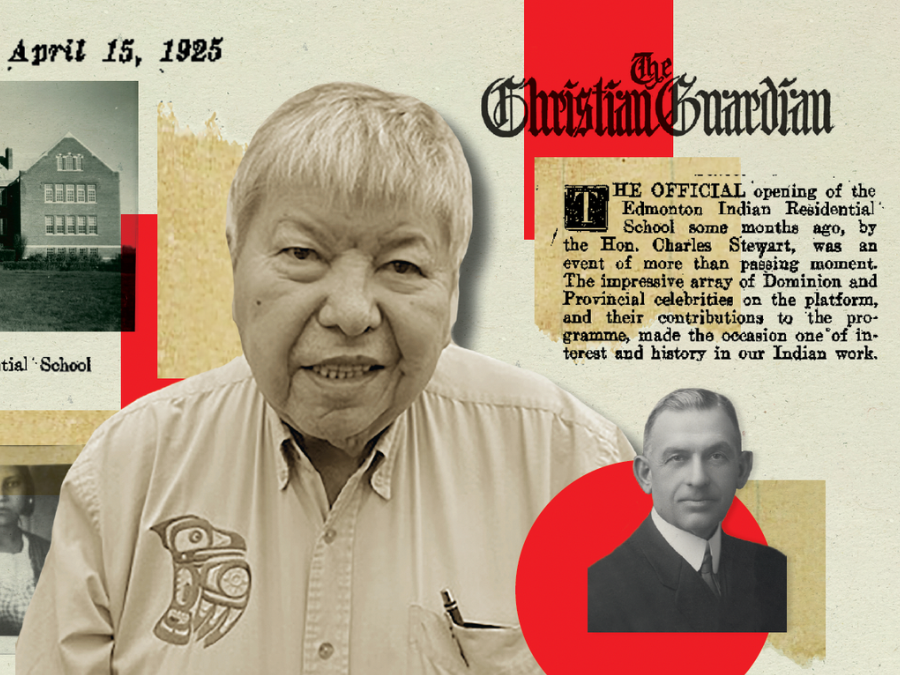
“OF THE BEST,” “large, airy and spacious,” “last word in modern equipment,” “completes the requirements,” “expert” medical attention, “choice land,” “gives every satisfaction.” The Christian Guardian, a predecessor publication to Broadview, did not hold back its praise when describing the newly opened Edmonton Indian Residential School in 1925. “How munificently our dominion government has provided,” it gushed.
Ask a survivor about the Edmonton IRS, however, and a very different picture emerges: “mean,” “very harsh,” “always told a
good Indian was a dead Indian,” “lost my Christianity,” “lonely,” “frightening,” “scarce food.” How to explain the disconnect?
You may unsubscribe from any of our newsletters at any time.
This article is the fourth in a series that examines the nature of Broadview’s historical relationship with Indigenous Peoples, from 1829 when The Christian Guardian launched its first issue, through to Confederation and the turn of the century. This story explores the Guardian’s coverage in 1925, the last year of its publication before it merged with the Presbyterian and Congregationalist church magazines to become The New Outlook, covering the newly minted United Church of Canada.
Entitled simply “Edmonton Indian Residential School” in a section dedicated to “Northern Alberta News,” the April 15, 1925, story describes the opening of the last residential school the Methodist Church in Canada would build — and the newest of the 12 schools that the United Church inherited.
The United Church would not build any more schools, though in 1926 it converted the Morley, Alta., residence for Indigenous students into a residential school. As such, the April 1925 article represents the beginning of the end of the church’s involvement with residential schools, which it continued to operate directly until 1969. It was also, in essence, The Christian Guardian’s last word on what it then called “Indian work” — a term common in church circles that carried an implicit note of cultural condescension.
The new Edmonton IRS was, in fact, not entirely new. It was a reiteration of a school that the Methodist Church had operated near Red Deer, Alta. The Red Deer Industrial Institute, founded in 1893, was built to take in about 50 Cree and Saulteaux children. Students cleared around 120 hectares of land to grow food, raise animals and provide for their own needs.
Soon after its opening, new buildings were added to allow the student population to rise to 90. But there were big problems. The Department of Indian Affairs complained that the Red Deer Institute paid its staff too much. It also declared that hiring teachers who were true experts in the trades was not worth it. Health conditions were horrible. Six students at the Red Deer Industrial Institute died in the 1906-07 year. That same year, Dr. P.H. Bryce delivered a scathing report to the Canadian government on the health of students in residential schools; the Red Deer Institute’s reported death rate was the highest of any school that year.
In 1910, Arthur Barner became the school’s new principal and soon visited the different Indigenous communities to better understand their needs. New policies were implemented to improve conditions for students and to allow them to spend more time with family. Enrolment picked up, and the school reached capacity in 1912. But when Barner left
in 1913, attendance dropped off precipitously. In 1919, the school was closed and relocated to Edmonton. At the time, the federal government was looking to modernize residential schools; closing the Red Deer Institute and opening the Edmonton school five years later was part of this effort.
One thing that changed when the Red Deer Institute moved to Edmonton was the school’s catchment area. Originally, students were drawn from Treaty 6 territory in the vicinity of Edmonton. Treaty 6 covers the northern halves of Saskatchewan and Alberta, one of the “numbered treaties” hurriedly signed in the wake of Confederation. Soon after the move to Edmonton, however, the school began to enrol Gitxsan children from northern British Columbia as well.
Among the Gitxsan children who attended the Edmonton IRS in the 1950s was Ray Jones, also known as niisnoolh, now a Gitxsan chief. Asked about his experience, Chief Jones, who is also a leading member of Gitsegukla United Church in British Columbia, began by explaining that before his time in residential school his father was a lay church minister, and none of his father’s generation had experienced the residential school system.
Young Ray was 11 in 1956 when he and his nine-year-old brother, Tom, took the train on their own to Edmonton. The principal, he remembered, “was a mean bugger. Very harsh. He’d always tell us a good Indian was a dead Indian. After three weeks, I lost my Christianity. I didn’t get it back till almost 50 years later.”
More on Broadview:
- How one Cree grandmother is reshaping the future of law in Canada
- Broadview went searching through its past. The findings were uncomfortable.
- How restorative justice can heal communities
Jones said three feelings defined his Edmonton IRS experience. “Number one is hunger,” he told me. “We were always hungry. Number two is fear, fear of your supervisors, fear of the other boys and gangs. And number three, loneliness.”
The late J.R. Miller, a historian, author and University of Saskatchewan professor, devoted his career to researching residential schools and interviewing many survivors. Last July, two months before his death, Miller spoke to me and summed up the experiences of those he had interviewed as “never easy, never good.” He said that everyone reported hunger.
“You can only maintain this system if you ignore and don’t care,” Miller said. “By the turn of the 20th century, the Canadian public doesn’t care — out of sight, out of mind.”
Jones recalled that there were some good teachers and kind staff at the Edmonton IRS. One was a supervisor who allowed him to comfort his brother, who was deeply homesick and weeping at night. “So this supervisor, this lady, she was very gentle and kind, would come up to my dorm after lights went out. She had numbers tattooed on the side of her arm. I guess it was a World War camp … She was most likely Jewish.”
Jones knew of teachers with reputations for sexual abuse. He also related a story of a riot that consumed the school — a reaction against the harsh conditions.
In our conversation, Miller noted that a survivor’s residential school experience “will vary according to the period. It will vary from school to school, and it can vary based on the leadership in those schools.”
The approach of the government at a specific time was an important factor as well. Principal Barner, for example, arrived at the Red Deer Institute near the end of Sir Wilfrid Laurier’s government (1896-1911). Late in its term, the Laurier government finally listened to complaints and agreed to some reforms to the schools’ funding and management structure. But by the 1920s, attempts to fix the residential schools faced stiff headwinds nationwide, as problems baked into the system were compounded by an economic downturn.
“The Edmonton school falls into the latter part of the period when governments and churches are trying to improve things but then become disillusioned,” said Miller. “When you hit [the] Depression, government has to reduce expenditures.” The Guardian article makes clear the church planned to cover only the principal’s salary, relying on children’s farm labour to help sustain the school. Even then, it was apparent that the Edmonton IRS would not live up to the hype.
So why does The Christian Guardian try so hard to put a positive spin on the opening of the Edmonton IRS? The article suggests that the Guardian is still proud of residential schools and believes them to be a good and worthy project. Maybe the flowery descriptions of the new building were an inferred acknowledgment of the terrible conditions at the Red Deer school and a hope that this school would be different.
Tellingly, the article gives much credit to the government for the new institution, perhaps an attempt to sidestep the church’s own financial and moral responsibility. Also noteworthy, right below this story is another about Alberta’s oldest Indian mission, which states: “Enough has been said in our missionary literature about the discouraging features of our Indian work — and they are all true.”
What’s clear is the degree to which The Christian Guardian had lost touch with Indigenous communities and their stories, how it served as a mouthpiece for the settler vision of the church and not the Indigenous one. It’s hard to believe the Guardian’s editors wouldn’t have known about the hardships students faced at residential schools. What’s painfully obvious is that they did not address them. This is a legacy that Broadview must grapple with as it seeks to provide truthful coverage of current Indigenous issues in the church.
In Jones’s community of Gitsegukla, from where many were sent to the Edmonton IRS, regular meetings and other activities are supporting the healing process.
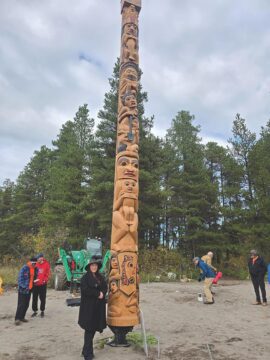
For example, Jones noted that last year The United Church of Canada’s Bringing the Children Home initiative contributed $224,000 to the Gyets Gitxsan IRS totem project. On a beautiful day last September, Jones and 300 others gathered to see the newly carved totem pole — a symbol of pain and trauma as well as resilience and strength — erected next to the community’s new high school, followed by a feast.
The community has also organized two trips for survivors who want to return to Edmonton. “There were people that never wanted to talk about their experiences,” he said. But after the trips, “They started talking about their experiences. They took back their spirits.”
***
Rev. David Kim-Cragg is a historian, author and minister at St. Matthew’s United in Richmond Hill, Ont.
Vanessa Kennedy, who served as a sensitivity reader for this article, is an Indigenous consultant in Hillsdale, Ont.
This article first appeared in Broadview’s May/June 2026 issue with the title, “‘How Munificently Our Dominion Government Has Provided’“
Thanks for reading
Will you help support United Church reporting?
Broadview is the only media organization dedicated to telling the stories of The United Church of Canada — its big decisions, perspectives and the faithful people and communities at its core. But this essential work depends on you.Make a tax-deductible gift today — 100% of your donation goes directly to supporting United Church coverage.

With gratitude,







The horrific story of the Edmonton Residential School was never ending. The fight between two United Church ministers, Clarence Ludford and Earl Stotesbury, in 1960, over accusations of child sexual abuse and subsequent suppression, should be known more widely in the United Church. Donna Wilson’s D.Min. thesis tells the story. https://ualberta.scholaris.ca/server/api/core/bitstreams/b96d8002-6075-4583-bdd8-e4b2af4876a8/content