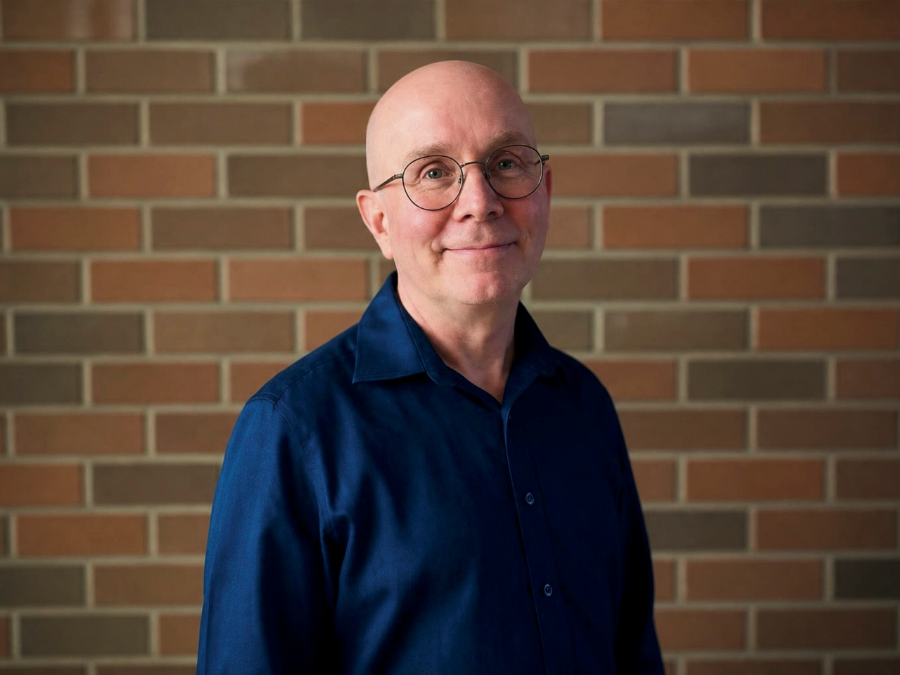
He doesn’t take office until January 1, but Rev. Éric Hébert-Daly is busy getting up to speed on his new role as general secretary of the United Church of Canada. He was confirmed at a General Council Executive meeting in September, following a seven-month search to replace the retiring Rev. Michael Blair. Broadview editor Janice Young caught up with Hébert-Daly over Zoom while he was at a Montreal train station between meetings.
Janice Young: Why did you want this job?
You may unsubscribe from any of our newsletters at any time.
Rev. Éric Hébert-Daly: I’m really enthusiastic about the different ways we can break out of our well-worn paths. I started to imagine what that could look like on a national scale and how I could hopefully bring a little bit of optimism and enthusiasm to the church over the next little while. For me, it comes from that natural place of where I think God is calling us.
JY: What is your vision for the church?
EHD: I see around me, and polls consistently show, that there is a deep spiritual hunger and an appetite for connecting to something bigger than ourselves. And here we are, in a place that talks about deep stuff and is all about community, yet we’re not meeting that need somehow. I’d love to see a church that’s maybe a little smaller, but is known nationally — even by those who don’t come to church — as the place you go for deep spiritual experience, deeper conversation and community. Wouldn’t it be great if that were our reputation?
JY: Before becoming a minister, you worked in political and nonprofit leadership. What lessons and skills from that career might help you lead the church as general secretary?
EHD: When I was working in politics, I was the national director of the NDP under Jack Layton, and when Jack was first elected, everyone had ruled out the NDP as a spent force. Jack sort of said, “Let’s not get hung up on what used to be or what was. Let’s start to imagine where we go from here.” Because he was an avid runner, he would always say, “When you’re in a race, you don’t look back; you look forward. You look to where you’re going.” Those lessons from politics, which of course led Jack to the biggest breakthrough the NDP ever had, are something I carry with me. When we sometimes feel we’re in a downward spiral, that the decline of the church is a prewritten determination — I’m saying no. I’ve heard people be written off before. I don’t think that we need to be written off now.
JY: As the first francophone general secretary, could your election help francophone communities of faith feel more connected to the larger church?
EHD: I don’t think that one person does that alone. In Canada, the majority of the francophone population has historically been Roman Catholic, so it’s not surprising that it’s taken us a little while to better integrate francophones into our church.
JY: What can the church do to help francophone, Indigenous, migrant and diasporic communities feel more connected to the whole?
EHD: I think it comes back to the idea of ministry as meeting people’s needs, rather than trying to meet our own. One of the key things we need to understand, especially with intercultural communities — even in an English-French sense — is that the encounter has to be transformational. I think this is true with the Indigenous church as well. We’ve talked a lot about the two canoes that need to be independent, and we have to stop approaching it with a colonial mindset, absolutely. But we also occasionally need to tie our boats together, have lunch, and then continue, because those encounters and relationships will be transformative for both of us. We need to find ways where the church is being transformed as a whole, not “you stay over there, and I stay over here and we’ll do our thing.”
More on Broadview:
- Michael Blair announces fall retirement as United Church general secretary
- Janet Anstead wants a new vision for Canadian Christianity
- Michael Blair on where the United Church should go from here
JY: What are the greatest challenges facing the general secretary’s office right now ?
EHD: The relationship with the Indigenous church is one that is evolving, and the National Indigenous Spiritual Gathering that happened this past summer was, I think, a really important turning point. That’s going to be one of the areas that isn’t necessarily a burdensome challenge, but an opportunity for us to be mutually helpful in figuring out a way forward for the church. Also this issue of how our congregations see themselves and see their ministry. Sometimes I worry that our services feel a little bit like meetings: we have an agenda — order of service — and we get through all the parts. But where are we leaving space for the Spirit?
JY: Growth and engaging communities must also be challenges that you’ll be facing?
EHD: I would say the “e” word is one of the key challenges for us. Evangelism is a word that the United Church has been uncomfortable with — and given how evangelism has played out over the past several years and generations, I can understand why. But at the same time, if we are in a relationship with God and we’ve had an impact through our communities of faith or through prayer or through our connection with the divine, it’s unfortunate that we’re not sharing that. It’s unfortunate that we’re not screaming that from the rooftops. I think there is a way of doing evangelism in a uniquely United Church way, and I really want to get us going in that direction.
JY: What opportunities are you looking forward to developing in this role?
EHD: The work we’re doing around understanding the ministry of the whole people of God is a place to start talking about the role of lay leadership in our denomination, and how we value and support it. [We also must] make sure that our ministry personnel are feeling well supported and inspired and resilient because it is a tough time to be a minister in this denomination and in the Christian church, largely, in Canada. I think there is a lot we can do by supporting each other and by celebrating the “failing forward” that we might do — trying things that fail, then learning from them and trying again. I saw even in the four years that I was a regional executive minister, this cultural shift from congregations saying “stay out, leave us alone,” to this openness [to work together]. I think the fact that we are now at that pivotal turning point gives us the opportunity to do a whole lot of things we’ve never done before.
JY: Did your experience as a regional executive minister, where you got to know many smaller communities of faith, shape how you’ll lead?
EHD: They inspire me every day now. They’re what keeps me going. In some respects, the rural church has this beautiful ability to have a very porous building. Between the community outside the church and the community inside it, there isn’t as hard a distinction as there is in urban or even suburban communities. There’s this real sense of broader community and I really love that. You don’t have to be a rocking megachurch to be an inspiration.
JY: What else do you want people to know about you?
EHD: Something that I think isn’t terribly well known about me is that I’m not a United Church-from-the-cradle guy. I was born into a francophone family that was Roman Catholic. My parents, being children of the Quiet Revolution, wanted nothing to do with church and actively discouraged me from participating. But my grandparents took me to church and kept me connected to my faith. At some point, I found myself struggling with too many things about Catholic policy, including the role of women, how divorced people are treated and the queer community. The United Church was this beautiful place where I could be fully who I was, while still sitting in pews next to people who might disagree with me. We’re in a world where people don’t listen to each other anymore, and we just yell at each other, and we tell other people they’re wrong. I think the church has the opportunity to be a sacred place of encounter.
JY: Do you think that ability to reach across the aisle will be key to the church’s future?
EHD: Can you imagine if the church was known for being a school for how to love one another? What an amazing legacy for us to have as a church — as a great societally transforming place. That’s the ultimate call of Christ, right? That gives me shivers.
***
Janice Young is Broadview’s United Church in Focus editor, covering a parental leave position.
This conversation has been edited for length and clarity.
Thanks for reading
Independent journalism rooted
in faith and justice is under threat
Broadview is the only media organization in Canada offering thoughtful, values-driven journalism from an inclusive, progressive Christian perspective. But our work depends on your support. If you value what you've just read, please act now.
A gift today helps keep this journalism alive tomorrow.
With gratitude,