In the lead-up to COP30 last year, a collection of bishops representing what they called‘the Catholic Church in the Global South’ issued an unusual call: They argued for an economic model rooted in “planetary boundaries” and degrowth.
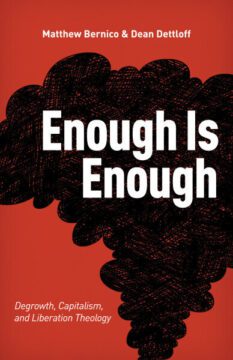
Degrowth has become one of the environmental movement’s most contentious ideas. In their new book Enough is Enough: Degrowth, Capitalism, and Liberation Theology, authors Matt Bernico and Dean Dettloff explore why the concept has gained traction among Christian leaders and what it might mean for churches that have long measured success solely by expansion and growth.
You may unsubscribe from any of our newsletters at any time.
Broadview spoke with Bernico and Dettloff about the relationship between faith and economics and what a “degrowth church” might look like. Matt Bernico is an environmental campaigner for Our Power. Dean Dettloff is a Research and Advocacy Officer at Development and Peace Caritas and teaches at the Institute for Christian Studies in Toronto. Together, they co-host a podcast called The Magnificast.
James Adair: Can you explain what degrowth is for someone who’s not familiar with that term?
Matt Bernico: I think the word degrowth is scary for a lot of people, but it’s about a society that can reduce consumption in a democratically planned way that respects the ecological impact and well-being of individuals.
JA: In your book, you argue that degrowth is necessary to save our planet, but it may also be required to save the Western church. You’re essentially saying: “The same values that are destroying our planet are also the values that are destroying much of the Christian faith.”
Dean Dettloff: There is a Sri Lankan priest named Tissa Balasuriya, who had observed that tying Christianity so closely to capitalism was getting in the way of the gospel for Christians in the Global South.
The obsession with growth is accelerating the deterioration of Christianity into an extremely fascist and evil kind of religion. How do we organize around the gospel of liberation in the face of people organizing the gospel to be a force of oppression?
JA: What would it take for Christian churches to become meaningful places of organized resistance against capitalism?
DD: In many ways, churches are already organized. They’re places where people organize every Sunday to host a really specific event, and they organize all kinds of other activities.
Christians can organize mutual aid networks, show up at a strike, or even create a study group to help Christians understand what issues are going on in their community. There are a myriad of interesting, fun, creative ways for Christians to expand that organizing.
JA: Christians are often conditioned to think of things in terms of individual action. Some might think, for example, “I should do meatless Fridays.” How do you help people make the leap from seeing environmental and social problems as personal moral failings to understanding them as systemic issues?
MB: The first step is recognizing the scale of the ecological crisis. Individual actions, like meatless Mondays, can be positive, but they’re ultimately a small piece of a much larger picture. Climate change isn’t primarily the result of isolated personal decisions; it’s driven by economic and political systems and by major corporate actors.
Responsibility isn’t distributed equally. Oil companies bear far more responsibility for global emissions. Christians need to consider how they can help transform the systems driving the crisis in the first place.
DD: Recognizing that climate change and ecological crisis are systemic problems that require systemic solutions takes the pressure off individual moral perfection, while opening up space for something more constructive: Collective action.
JA: Have you seen any examples of degrowth-oriented churches for people to draw on?
DD: I do think the leadership has come from the Global South, where Christians organize in ways that confront profit and capitalist accumulation all the time in really impressive ways.
In a country like Brazil, for example, you have Christianity really attached to social movements for landless people, for workers’ rights, etc.
When a church in the United States buys up a ton of medical debt and pays that off for people: that’s doing degrowth. Or when a church has something as simple as a community garden that they don’t charge people to use, that’s doing degrowth.
I think what is important to say is degrowth is not a movement where you have to sign a piece of paper or a petition in order to say ‘I’m a degrowth church’.
MB: Churches often sit on land in cities or towns that could be used much more creatively. That could be a real asset for climate-related or community-focused projects. In a context where many parts of the West are increasingly post-Christian, and church attendance is declining, it’s also worth rethinking what these spaces are for. Rather than seeing church property as something to be sold off, there’s a real opportunity to use it for the benefit of the wider community beyond traditional worship.
DD: In Toronto, there are churches exploring how to use their property to become a land trust and ensure that it stays out of the market. That’s a great idea. Do not use your property for growth; instead, actually become an obstacle to growth.
More on Broadview:
- This Montreal church has baptized more than 140 Iranians since 2020
- The United Church has an ambitious plan to grow its membership
- Christianity isn’t just in decline — it’s become obsolete, says sociologist
JA: My favourite chapter is where you talk about the parable of the talents, and the way it’s often read through a capitalist lens. What role do worship, liturgy, Bible stories, and spiritual practices play in resisting growth?
MB: The Christian tradition is full of resources that point toward more communal ways of thinking – prioritizing the wellbeing of the community over individual property rights.
In the early Christian community, after the ascension, one of the first things they did was reorganize their economy around shared life and resources. That idea then reappears across Christian history in different forms.
DD: Another important point is that the Bible was written in non-capitalist societies. Most Christians have lived in societies that weren’t capitalist. Capitalism is extremely recent in human history.
When I go to Mass, the service itself was formed in a different economic world. It creates a kind of “time travel” effect through liturgy, scripture, and ancient song. It reminds us that capitalism is not the only possible way of organizing life. It becomes less natural, less inevitable.
Fasting during Lent, for example, is an anti-growth practice. Degrowth isn’t about denying yourself things for its own sake—but fasting can still train you to resist consumption. Even going to church is part of this. It affirms that life isn’t just about profit. It’s a non-monetized activity.
If we recognize that “growth” is constantly trying to shape our lives, we can see that many Christian practices already run against it. Naming that helps us lean further into those counter-logics.
JA: Where can people buy or find your book in a way that doesn’t contribute to growth?
MB: Writing a niche Christian book isn’t a great way to make money. We want to collectivize access to the ideas as much as possible. Libraries are the best place for that. The goal is shared access, not private accumulation.
***
James Adair is a summer intern at Broadview.
Thanks for reading
Independent journalism rooted
in faith and justice is under threat
Broadview is the only media organization in Canada offering thoughtful, values-driven journalism from an inclusive, progressive Christian perspective. But our work depends on your support. If you value what you've just read, please act now.
A gift today helps keep this journalism alive tomorrow.
With gratitude,