The United Church of Canada joins a coalition of civil society groups pushing back against criticism of a new national museum exhibit on Palestinian displacement.
The Canadian Museum for Human Rights in Winnipeg has faced backlash since the June 27 opening of Palestine Uprooted: Nakba Past and Present. The Nakba — Arabic for “catastrophe” — is how Palestinians refer to Israel’s declaration of independence in 1948, which led to the expulsion of 750,000 Palestinians and the deaths of up to 15,000 more. The exhibit frames the Nakba not as a single historical event in 1948, but as an ongoing process of displacement and dispossession that continues today.
You may unsubscribe from any of our newsletters at any time.
In a joint letter released last Wednesday, the United Church and other signatories say human rights museums have a responsibility to present difficult and contested histories, adding that they are particularly concerned by elected officials commenting on the exhibition’s content and calling for political intervention.
More on Broadview:
- ‘This is where I need to be’: A Canadian doctor reports from a Gaza hospital
- A Canadian medical worker bears witness to life inside Gaza
- Palestinian Christians seek solidarity amid war and displacement
Earlier, Culture Minister Marc Miller said in an interview with Canadian Press there were “regrettable words” in the display. “Not identifying Hamas as a terrorist organization is, I think, a failure. And not clearly stating that, for example, Hamas intended to kill Jews is, I think, an unfortunate error in curation and should be rectified.”
Miller’s concerns echoed those of some Jewish Canadian organizations, which said the exhibit was developed without sufficient consultation and failed to acknowledge the estimated 850,000 Jews who were expelled from Arab countries following the creation of Israel.
“We work regularly on human rights advocacy with several of the signatories to that letter,” Rev. Jennifer Henry, acting general secretary of the United Church of Canada, told Broadview in a statement. “Palestinians in Canada who are part of the advocacy and solidarity networks we’re connected with wanted to support the Canadian Museum of Human Rights, as it was unduly targeted regarding the Nakba exhibit.”
She added, “The museum’s mandate is to enhance public understanding of human rights, promote respect for others, and encourage reflection and dialogue. Criticism and public debate are legitimate, even welcomed, but politicians and lobby groups should not determine which histories Canadians are permitted to encounter. Public museums must be able to present difficult histories without political interference. In the case of the Nakba exhibit, it’s the Palestinian story to tell.”
Rubin Kantorovich, a board member of the United Jewish People’s Order in Winnipeg and another signatory on the letter, says it is essential for the museum to tell the story of Palestinians who were uprooted during the founding of the state of Israel. “I was happy to see the exhibit,” he says. “What it presents is irrefutable.”
Kantorovich, whose parents survived the Nazi genocide against Jews, says there’s nothing antisemitic about the exhibit. “It’s no secret that Israel is engaged in a genocide. Anybody who has a smartphone can capture these things. I think it’s a gasp of desperation to claim that having the Nakba exhibit is antisemitic.”
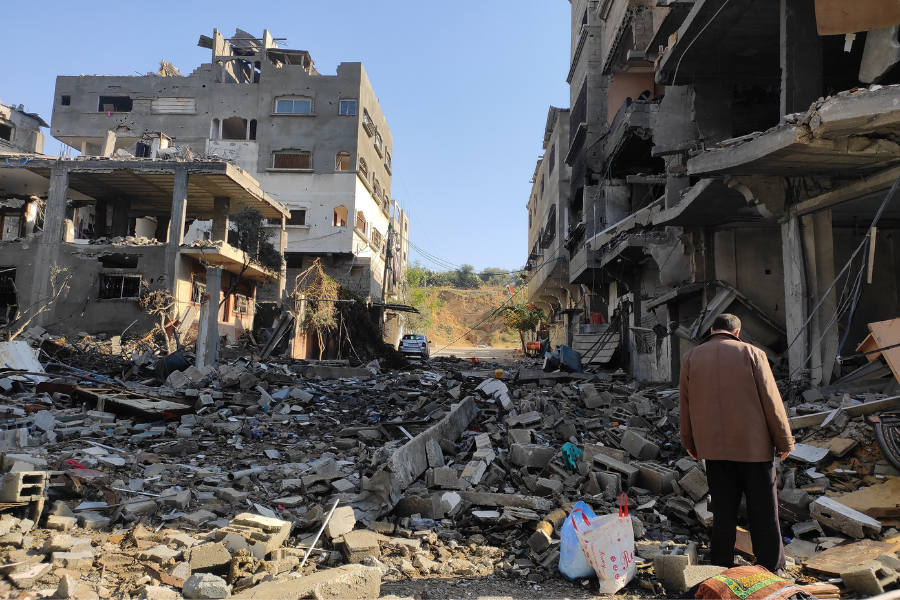
Since October 2023, more than 73,000 Palestinians have been killed in Gaza. Over 174,000 have been wounded and thousands more are believed to remain trapped beneath rubble. More than 90 percent of the Gaza Strip has been destroyed in what many legal scholars, human rights organizations and UN experts have described as a genocide perpetuated by Israel. Meanwhile, about 2,000 Israelis have been killed, including the approximately 1,200 people killed in the Hamas-led attack on Oct. 7, 2023, and subsequent military and civilian deaths.
***
Shenaz Kermalli is Broadview’s digital editor, covering a parental leave position.
Thanks for reading
Will you help support United Church reporting?
Broadview is the only media organization dedicated to telling the stories of The United Church of Canada — its big decisions, perspectives and the faithful people and communities at its core. But this essential work depends on you.Make a tax-deductible gift today — 100% of your donation goes directly to supporting United Church coverage.

With gratitude,