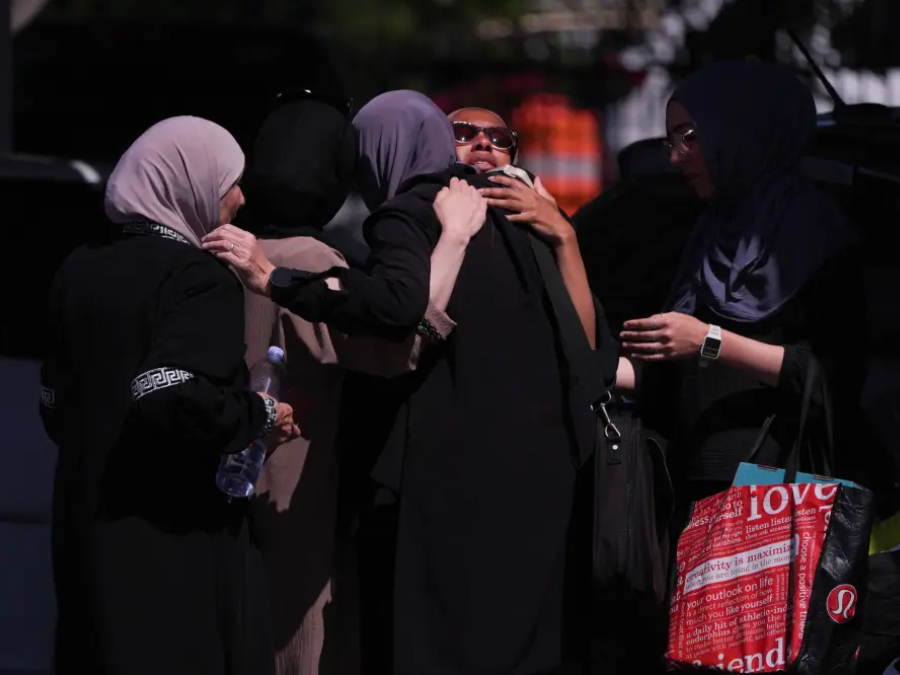
Muslims in Winnipeg are shaken and weighing safety precautions after gunmen opened fire at a U.S. mosque Monday, killing three people.
Two teenage gunmen launched the assault inside a San Diego, Calif., mosque before taking their own lives. A note left behind by the killers contained hate speech, police said.
You may unsubscribe from any of our newsletters at any time.
“A lot of people are worried — fathers and mothers and kids,” said Noris Zeid, a vice-chair of the Manitoba Islamic Association.
Khawja Latif, who regularly attends the Winnipeg Grand Mosque on Waverley Street, worries about the safety of people who come to the place of worship to pray five times a day and for the children who attend school in the building.
He said the safety of the mosque depends largely on the eyes and ears of visitors. The building has security cameras but no full-time security personnel.
In California, one of the victims was Amin Abdullah, a security guard and a father of eight who died protecting the lives of children and staff at a school inside the Islamic Center of San Diego. Officials said the bloodshed could have been worse without his heroic interventions.
Zeid said the Manitoba Islamic Association is working with the provincial and federal governments and the Winnipeg Police Service on a number of measures to improve security at the Winnipeg Grand Mosque and others in the city. The association is also reaching out to other community groups for advice, including the National Council of Canadian Muslims.
Security is increasingly a concern for mosques, Islamic schools, and community centres across the country, said Steven Zhou, spokesperson for the National Council of Canadian Muslims, which helps groups assess what security measures make sense in their context.
“Do we get people to line up? Do we change where people put their shoes so it doesn’t block the exit? Is it a matter of getting cameras or hiring security guards for big gatherings like Eid?”
The biggest obstacle is that most mosques lack the funds to pay for expensive things like cameras or security personnel, said Zhou.
Communities at risk of hate-motivated crimes can apply for funding to secure their place of worship through the federal Canada Community Security Program. But sometimes it takes as long as a year for them to hear back, said Zhou. “It’s quite backed up.” The NCCM has been urging the federal government to switch to a rebate program so groups can pay for security measures up front and then get reimbursed.
More on Broadview:
- High cost of compassion threatens to shutter Christian home for people with HIV in Winnipeg
- What Broadview’s predecessor chose not to see about the Edmonton Residential School
- Winnipeg Anglican church that feeds hundreds each week faces uncertain future
“What it comes down to is alleviating the sense of fear and trying to turn it into something productive,” said Zhou. “Because there is quite a bit of fear going around. It spikes with these events. It’s not every day you see a mosque being invaded in this way.”
David Pankratz, MLA for Waverley, said he’s been in contact with the Manitoba Islamic Association about safety concerns. The provincial government recently launched a $1-million security enhancement fund to help places of worship and improve security and protect against hate-motivated incidents.
“Our thoughts are with the victims, their families and the broader Muslim community,” said Pankratz. “Hate and violence directed at any faith community have no place in Manitoba.”
Idris Knapp, executive director of the Winnipeg Central Mosque, said the facility can’t afford around-the-clock security personnel.
“We’re in danger,” he said, noting members of the community have been stabbed and assaulted. He said the mosque has also been broken into.
Knapp said it’s hard to say how much of the violence is because of Islamophobia and how much is fallout from homelessness, poverty, the drug crisis and unresolved trauma that plagues the neighbourhood.
“Let’s call it what it is,” said Zeid, “this is hatred, racism, terrorism, this has no place in any society.”
Knapp has prayed in the mosque in San Diego where the shootings took place and has friends in the community. “I have been thinking about how I am going to write to this imam in this community because I know how directly affected he is,” he said.
At the end of the day, Zeid counts more on the goodwill of the community than anything else to keep people at the mosque safe.
“Winnipeg’s a safe place and we’re a strong community and our people are strong. I know that there’s more people here that love our community and respect our community, and we love them back.”
***
Josiah Neufeld is a writer in Winnipeg and the author of The Temple at the End of the Universe.
This story was produced in conjunction with the Winnipeg Free Press, as part of a joint Religion in the News partnership covering issues of faith in Manitoba and nationally.
Thanks for reading
Independent journalism rooted
in faith and justice is under threat
Broadview is the only media organization in Canada offering thoughtful, values-driven journalism from an inclusive, progressive Christian perspective. But our work depends on your support. If you value what you've just read, please act now.
A gift today helps keep this journalism alive tomorrow.
With gratitude,