The Marys in Jesus’ entourage have long been a bit of a mystery.
The problems begin when you try to count them. There are anywhere from three to seven women named Mary in the Gospels, slippery creatures who alternately stand out and blend into each other.
You may unsubscribe from any of our newsletters at any time.
There’s the Virgin Mary, of course. She’s a discrete Mary. There’s Mary Magdalene, often portrayed as a sex worker and foil to the purity of Jesus’ mother. Then we have Mary the sister of Martha from the Gospel of Luke and Mary of Bethany from the Gospel of John, who are almost certainly the same person (and who some Christian traditions conflate with Mary Magdalene). Finally, there are Mary of Clopas, Mary the mother of James and Joseph, and “the other Mary,” all of whom appear in crucifixion narratives; they are also, possibly, the same person.
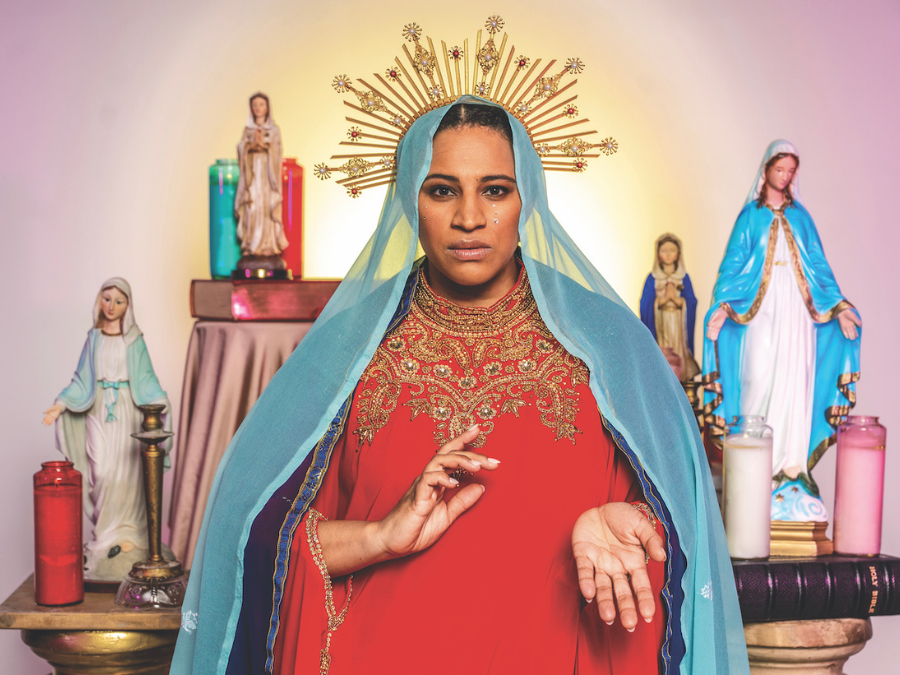
It is this corps of women, separating and then coming together like a school of fish, who make up the centre of Erin Shields’s new play, the aptly titled Mary, Mary, Mary, Mary, on now through May 3 at Crow’s Theatre in Toronto. Rather than trying to puzzle out which one is which, she leans into their nebulous nature, using it as a vehicle to explore what it means to be a powerful woman in a story written by men.
Shields — whose work has won many accolades, including the Governor General’s Award for English-language drama — has a long-standing interest in feminist reinterpretations of classic texts. This can be seen in her 2018 adaptation of Milton’s Paradise Lost, in which Satan is a woman (with a more complicated and sympathetic narrative than is typically presented); in her 2022 stage play Queen Goneril, a prequel to Shakespeare’s King Lear that focuses on his daughters; and in last year’s Ransacking Troy, which looks at the Trojan War from the perspective of the Greek women. It’s a theme (if it can be called that) as inexhaustible as the western canon is male.
“I’m drawn to these stories because of the language, the characters, the stories themselves — they make me very excited.” says Shields. “But often I find that I am missing, or big parts of myself are missing, from those stories.”

When it comes to the Bible, Shields points out that people have been interacting with it through art for thousands of years. It’s a bit akin to fan fiction, she says, allowing artists to see themselves in those characters and narratives, while also serving as a lens through which they can understand their own times. And it’s something that feels apropos when it comes to the Marys, whose images have been shaped by elements that aren’t found in the Gospels.
Take Mary Magdalene, for example: nowhere in the Gospels does it say that she was a sex worker or a fallen woman, just that Jesus drove seven demons out of her. The idea that she had committed some kind of sexual sin came instead from a sixth-century sermon by Pope Gregory the Great. But even after the Catholic Church officially disavowed that narrative in 1969, she continued to be portrayed that way in pop culture. This, says Shields, is partly because the idea that Mary Magdalene is a reformed sex worker is a “helpful storytelling device,” showing her as repentant and redeemed. “And that’s the story of Christianity, in a way — you can be the worst of the worst, like slutty Mary Magdalene, and then still get to be so revered by God and by Jesus that you are the first person to whom he reveals himself [after the resurrection].”
More on Broadview:
- How HBO’s The Pitt portrays faith in a non-preachy way
- Trump’s Jesus-style AI image fuels global backlash and Vatican tensions
- There’s a Jewish community in Iran?
Shields grew up in both the United Church of Canada and the Anglican Church, a background she credits with instilling an early interest in spinning (and unravelling) complex yarns.
“It really set the stage, in many ways, for my love of theatre and my love of stories,” she says. “The Bible is really this wonderful collection of stories that are contradictory and metaphorical and illuminate things about the human condition, and also there are really troubling, complicated things in there that I don’t agree with and can’t get behind.”
Part of that complication comes from the reality of who got to tell those stories in the first place and their seeming lack of interest in the lives of women. In spite of this, some of the details we’re offered are tantalizing — for example, the Gospel of Luke says that Jesus was travelling around Judea and Galilee with not only his 12 apostles, but also a group of women who were “helping to support them out of their own means.” So women were clearly involved in (and paying for) Jesus’ ministry, and yet we’re told next to nothing about them; meanwhile, the Gospels contain plenty of extraneous details about the apostles. This discrepancy, along with the abundance of women with the same name (Shields jokes that she imagines the Gospel writers saying, “What was her name again? Oh, just say Mary”), forms the central tension of the play.
“What I’ve been trying to do, and part of what I’ve been interested in, too, is really digging into what it is to be part of a collective and part of a political movement as well,” she says. “Because it was such a revolutionary thing that they were doing, actually.”
Mary, Mary, Mary, Mary tells the story of what it means for these women to be poised between the new world and the old. To be devoted (and independent) enough to leave their families and follow Jesus, but not be given a seat at the table during the Last Supper. To question the status quo, but not quite know how to leave it behind. To be an important character in the story, but still just one of the Marys. To be seen, but yet, somehow, not seen.
One of the best lines in the play comes not from one of the Marys, but from Salome, who shows up fresh from demanding the head of John the Baptist be served to her on a platter. She’s looking for tips on how to wield power as a woman and is dismayed to discover that the Marys can’t (or won’t) see how gender influences how their story will be told.
“You’ve been acknowledged by [Jesus] as an equal, as a leader, and if you can do it, then why not Mary or Mary or Mary or Salome?” she says to Mary Magdalene. “Men are going to hate you for that. Trust me, sister, they’ll call you a whore.”
***
Anne Thériault is a journalist in Kingston, Ont., and co-host of the Broadview podcast And Also Some Women.
Thanks for reading
Independent journalism rooted
in faith and justice is under threat
Broadview is the only media organization in Canada offering thoughtful, values-driven journalism from an inclusive, progressive Christian perspective. But our work depends on your support. If you value what you've just read, please act now.
A gift today helps keep this journalism alive tomorrow.
With gratitude,