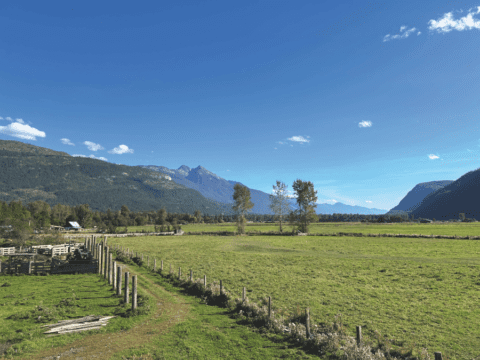
On her farm north of Cranbrook, B.C., Penny Ohanjanian crosses a sturdy wooden bridge over a stream, unlatching a metal gate that leads to a meadow. The late September sun casts an orange glow over the peaceful green pasture, framed by the Rocky Mountains farther west.
“This is where most of the murders happen,” she says.
You may unsubscribe from any of our newsletters at any time.
Today, the scene bears no evidence of foul play. But in 2024, at the height of the killing spree on her 160-acre farm, two prized sheep were nabbed every few nights, Ohanjanian recalls.
“Thirteen in total were killed,” she says, noting that the last attack happened alarmingly close to her house. That night, her two white long-haired Maremma guardian dogs barked through the night, but she didn’t want to venture outside alone in the dark. “I just knew something was going on.”
The next day, she found evidence: a carcass three quarters eaten. The culprit, based on the puncture wounds, seemed to be a good-sized grizzly bear.
As a temporary safety measure, she moved her 245-sheep flock to a neighbour’s property. Ohanjanian — a retired wildlife biologist who has farmed on this land since 1997 — had seen the occasional grizzly pass through before. But prior to the summer of 2024, they had never taken her sheep.
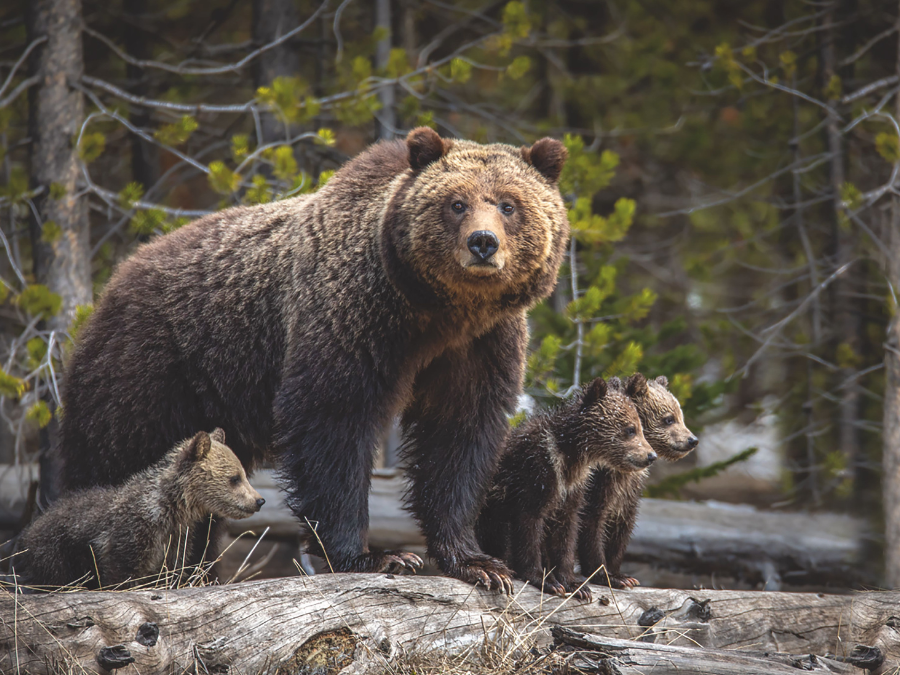
Today, the situation is changing — not just in British Columbia, but in Alberta, Montana, Wyoming and Idaho. After more than a century of being hunted and pushed out of much of their range, grizzlies are returning to their former homes, now dotted with farms and small towns. At the same time, the climate crisis is reshaping ecosystems, nudging some populations farther north — even as far as the High Arctic. As their numbers rebound and their territory expands, encounters with humans are becoming more common.
Attacks on livestock are one sign of this growing overlap, but they aren’t the only concern. Incidents involving people have also made headlines — most notably last November, when a grizzly bear attacked a group of elementary school students on a field trip near Bella Coola, B.C., injuring 11, including three children and an adult who were hospitalized with serious injuries. All those who were injured ultimately recovered, but the encounter underscored a pressing question: when two species share similar needs for food, shelter and safe places to raise their young, what will it take to not only avoid conflict, but coexist?
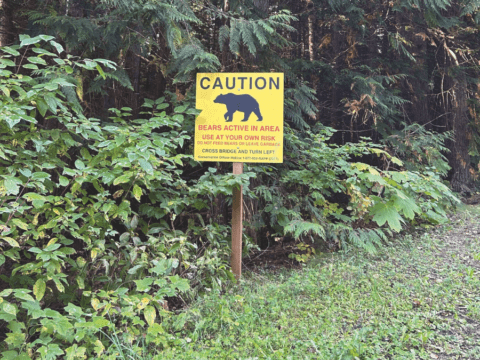
Ohanjanian’s experience is one that a growing number of experts feel we could avoid with careful preparation. As those living in rural and small-town British Columbia have learned, living among bears isn’t easy, but with the right measures in place, it is possible.
***
Grizzly Bears once roamed across much of western North America, from the Arctic through the Prairies and south into Mexico. For millennia, Indigenous Peoples coexisted with them across this vast territory, with many Nations revering them as stewards and guardians of the land.
That relationship changed during colonization. As Indigenous Peoples were displaced from their lands to make way for agriculture, railroads, mining and towns, economic opportunities drew an increasing number of settlers west. Grizzly bears, seen as obstacles to “progress” — especially on the Prairies — were treated as vermin and systematically wiped out. “We were outright poisoning and shooting them,” says Clayton Lamb, a grizzly biologist and wildlife scientist affiliated with the University of British Columbia Okanagan.
By the 1800s, the distribution of grizzlies from their historic range across North America had been cut in half. Even in British Columbia and Alaska — which remained rare strongholds, likely due to their vast, sparsely populated landscapes — grizzlies were steadily pushed back. In British Columbia, they were driven out of agricultural heartlands like the Okanagan and largely confined to two narrow regions: one along the interior Rocky and Columbia mountain ranges and the other along the Coast Mountains.
Bears naturally disperse, Lamb explains. “It’s evolved in their genes to get away from the place they were born and go somewhere else.”
Today, in the southern interior of British Columbia, a small number of grizzlies occupy fractured and isolated patches of land. That reality contrasts with range maps produced as recently as 2024, which show an almost grizzly-free peninsula stretching from south of the U.S. border into British Columbia’s Okanagan Valley. In just a few years, those maps have become outdated, says Mackenzie Clarke of the Okanagan Nations Alliance (ONA). She has the camera footage to prove it.
Clarke is currently a senior tmixw (the nsyilxcǝn word for all living things on Earth) biologist for ONA, a group representing eight First Nations communities. As part of their effort to restore and advocate for healthy, resilient grizzly populations, they track and record grizzly sightings in the region using a range of sources, including Facebook pages and an ONA-led network of 100 cameras randomly distributed across a grid of Okanagan habitat types.
Since they started collecting data in 2018, there have been multiple sightings, including at least one female and cubs. Knowing where bears are moving can help communities anticipate and prevent conflict before it happens.
Garth Mowat, a large carnivore specialist for the province, says bears now appear to be eyeing additional territory in Joe Rich, B.C. Located east of Kelowna, the community of suburban homes and small farms was once part of the grizzlies’ historical range.
“That’s new,” says Mowat, “but not unexpected.” He notes that a similar story played out in other parts of British Columbia 30 years ago. Typically, adult and younger males show up first to survey the area; females arrive later with cubs.
While the appearance of grizzly bears might surprise newer residents, Clarke says the name Kelowna is derived from ki?lawna? — meaning grizzly bear in nsyilxcǝn. In Syilx territory, their presence is more than symbolic. According to an ONA tribal council resolution, grizzlies are considered an indicator of the health of the land and the people.
The ONA team is still analyzing preliminary data from their camera traps in the Okanagan Highlands, but tmix biologist Emily Matthew, a member
of the Simpcw First Nation, says that so far, they’ve confirmed nine sightings between 2023 and 2025. They’ve also recorded 13 grizzly bear sightings from other trail camera projects in the region, plus 43 sightings from social media.
Mowat predicts that grizzly populations will continue to recover in the eastern Okanagan. Further west, they could potentially expand in the North Cascades if reintroduction plans move forward. In April 2024, a binational project involving the B.C. government, NGOs and the ONA — working with the U.S. National Park Service and Fish and Wildlife Service — received U.S. government approval to reintroduce grizzlies on both sides of the border. But the project has since stalled under the current U.S. administration and, at the moment, “has no clear timeline,” according to the U.S. Fish and Wildlife Service.
As bears push into new territory on their own, Clarke says it’s time to help people be more bear aware. “I think a lot of people don’t carry bear spray in those areas,” she says, adding that perhaps they should.
While awareness is a good first step, Mowat says the boundaries of the grizzly range maps also need to be updated. “[It] may not have a lot of impact on the ground, frankly, but mentally, it tells people that, ‘Hey, you know what?…You actually live where there are grizzly bears now. You haven’t seen one yet, but you might see one tomorrow.’”
Informing people without scaring them is a tricky balance, adds Clarke, who does social media outreach and organizes webinars and presentations on human-bear coexistence with the goal of building relationships between organizations like ONA and residents. Beyond education, she has consulted colleagues in areas where coexistence programs have worked well and tried to adopt the tools they’ve used. One place with lessons to offer is the Elk Valley, a current B.C. hotspot for grizzly conflict.
***
The Elk Valley is a busy landscape, crisscrossed by roads and railways. Tourists flock to its town of Fernie to ski, mountain bike and hike, while many residents live and work up the valley in Sparwood and Elkford, drawn by jobs in mining and forestry. Alongside the Elk River, vast open-pit coal mines scar the land. Yet despite this human footprint, bears continue to inhabit the valley
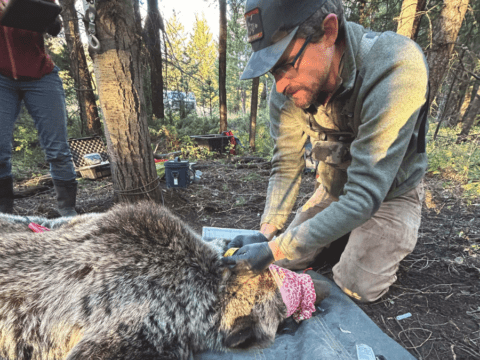
In 2016, the UBC Okanagan’s Clayton Lamb began attaching GPS collars to grizzlies to better understand how they navigate a habitat littered with human hazards. Since then, he has followed 76 bears.
What Lamb found was “some of the most interesting bear data that you can imagine,” he told an April 2024 public meeting in Fernie about coexistence. Each satellite-linked radio collar relays the animal’s movements. If the bear stops for five or six hours, Lamb receives an email. “Sometimes the collar just fell off,” he says. Other times, the data reveals that a bear has died.
Some of his collared bears, however, did “all kinds of crazy things,” says Lamb, manoeuvring through towns, railways, highways, ski hills and encounters with mountain bikers and people fishing. “They’re in people’s backyards in the middle of the night, and then they’re up in the mountains during the day. They navigate a very challenging landscape,” says Lamb. Those nocturnal-timed forays are no accident. Bears keep a low profile and visit at night because of the reduced chance of detection. His data suggests bears living in high-density human areas shift to nocturnal behaviour to survive.
There’s a widespread idea that grizzlies pose a threat to humans — and sometimes, that’s true. But more often than not, says Lamb, we’re a danger to
them, too.
When a bear dies, Lamb’s team investigates the cause. Of the bears they’ve tracked, 50 percent died prematurely — most often after being drawn to human attractants like garbage, livestock, chickens or unsecured fruit trees. In some of these instances, the animals were shot by landowners after being deemed a threat. Only five percent of bear deaths were natural.
The Elk Valley is “a conflict hotspot,” says Lamb, but it also has a particularly high density of bears — more than twice as many as in Banff National Park, 100 kilometres to the north. Taken together, these two facts seemed contradictory at first. “How could you be killing all these bears but also have the most bears?” asks Lamb.
Using both collar data and other data from neighbouring agencies in Alberta, Montana and Idaho, Lamb found that despite the high mortality rate, bears were being replaced by “immigrants from outside,” coming from wilder places like Banff, Kananaskis or the Flathead Valley.
There’s a widespread idea that Grizzlies pose a threat to humans — and sometimes, that’s true. But more often than not, says Lamb, we’re a danger to
them, too.
In Elk Valley, the high mortality rate has created persistent vacancies. Bears who move in to fill these gaps end up in what scientists call an ecological trap — essentially a revolving door that turns newcomers into casualties. A lot of jurisdictions in British Columbia have implemented bear-resistant garbage bins, but for chickens and livestock, “we really don’t have that figured out,” says Lamb.
***
Gillian Sanders has lived in Kaslo, B.C. — a town on the west shore of Kootenay Lake — since 1994. After spending years raising honeybees and small livestock, she was determined to reconcile her love of food production with her commitment to wildlife. To protect both, she installed electric fencing around her hives to keep bears out.
After seeing bears in her community shot during conflicts — and realizing electric fencing had wider applications — Sanders began looking for ways to install it for others. Prices can range anywhere from hundreds to thousands of dollars, depending on the size of the area, so she also sought out cost-sharing opportunities to make it more accessible. This led to the creation of Grizzly Bear Coexistence Solutions, a program that shares 50 percent of the cost of electric fences with residents and promotes bear-aware practices in the community.
Today, working as an independent consultant in wildlife coexistence in nearby Meadow Creek, she has helped hundreds of landowners and farmers set up electric fencing around chicken coops, small livestock pens, orchards, beehives, composts and anything else you want to keep bears out of.
For operators like Margo Supplies, based in High River, Alta., providing hardware and installation expertise for electric fencing has become a niche business opportunity. The company also sells other deterrents like bear spray, bear bangers, sirens and rubber bullets. It has installed electric fencing around agricultural properties in Elk Valley and Bella Coola as well as campgrounds like Liard River Hot Springs Park. Jared Marley, director of business development, says that “a bear fence doesn’t exclude a bear by being a big physical barrier. You exclude bears by delivering a negative stimulus” — in this case, an electric shock.
More on Broadview:
- Filmmaker captures untold stories of Black caregivers in Canada
- Bears inspire adoration, reminders of tension between wild and tame
- The last words of an ancient world
Bears and humans have similar tastes when it comes to habitat selection and diet. “We like nice river valleys with a lot of fruit. We like to be near water. We use these areas. And we made them even more attractive to bears by being kind of sloppy with our own waste,” says Marley.
“We’ve taken these pretty attractive habitats and loaded them with food,” he adds, citing vegetable gardens, chicken coops and apiaries as examples. Unless those places are secured, we’re going to invite conflict, he says, “which no one wants to see.”
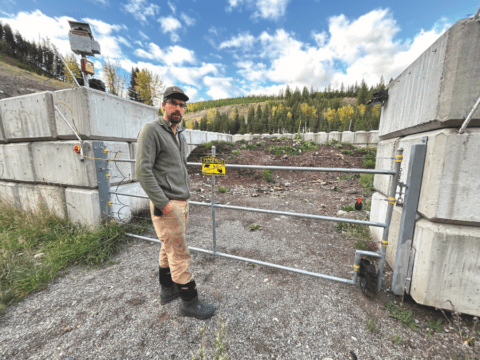
When it comes to attractants, another major issue is carcass pits — repositories of animals killed in road traffic collisions that are tossed by transportation managers into concrete pits to rot away. In the past, pits near busy roads have lured bears into places where their chance of being killed in a collision is high. On the side of the main highway east of Fernie, Lamb stops to peer at one of these concrete pits, pointing at the newly built electric perimeter wiring.
Lamb tells me that after someone inadvertently left the fence electrification switched off, one opportunistic bear would launch over the gate to feast at the roadkill café. “He was accustomed to not being wary of the fence,” says Lamb. When the electricity was switched back on, however, the same bear “rocked up, like the day before…got smacked and never came back.”
Lamb’s colleague, provincial biologist Sean O’Donovan, shows me a video of another electrified roadkill pit near Creston, B.C., where a big male grizzly going after a dead cow on the other side of the wiring gets knocked off his feet with the unexpected zap. It’s tough love, he says, but it works.
There are places where people have been coexisting with bears for a long time, says Michelle McLellan, a postdoctoral fellow at the Wildlife Science Centre at UBC Okanagan. McLellan herself has coexisted with grizzlies since birth, joking that she never really chose to be a grizzly bear biologist. She was born and raised in a grizzly research camp in British Columbia’s Flathead Valley, where her father, a wildlife ecologist, studied the animal for over 40 years.
“There are things you have to shift,” says McLellan, adding that living in bear country requires constant vigilance. “I ask my teenage kids to carry bear spray and know how to use it.”
***
Sarah Elmeligi, now a member of the legislative assembly for Alberta’s New Democratic Party, studied human-grizzly bear coexistence as part of her master’s. During her studies, she was struck by the amount of variation among the bears she encountered. “They are individuals with personalities. They’re capable of learning,” she says. Plenty of research shows that bears learn from their mothers, but they also learn from their own lived experience — much like us. When we make assumptions about bears based on age or sex, Elmeligi says we’re doing them a disservice.
Because the reasons for conflict can vary between communities, situations and bears, “you really need to get on the ground and understand where the conflict is coming from,” she says — both from the human and bear perspective.
In Banff National Park, Parks Canada staff know which individual bears like to hang around town. They manage them in a different way than they would a bear in the back country that doesn’t often interact with people. But Elmeligi says you can only really do that when bear populations are small.
When a human and bear interact, the bear processes the interaction before deciding what to do next. “Our responsibility as people is to help that bear decide not to be violent, not to charge us, not to attack us, but to just go on its merry way,” she says. “The most effective way to do that is by altering our behaviour. To be quiet, non-threatening and get out of there.”
In places where grizzly populations have disappeared or were drastically reduced, bears are not coming back quickly, says McLellan. Grizzlies take a long time to reproduce. Females in British Columbia mature at five to eight years of age, with intervals of two to three years between litters of cubs. “In these areas where we’re seeing recovery start, we’re just seeing it now, but the changes that led to this started about 40 to 50 years ago,” she says.
As bears reoccupy their historical range, they’ll improve the ecosystems around them. As top predators, they help keep large herbivore populations in check, reducing overgrazing. Their presence can also reshape predator dynamics, creating new opportunities for small to mid-sized predators. And through activities like digging, they aerate soil, boost nitrogen levels and stimulate plant growth.
***
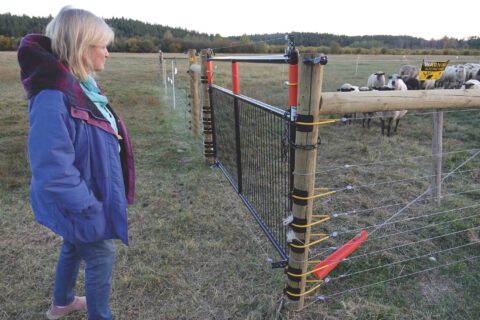
After the incident with the sheep-eating grizzly bear, Ohanjanian built a night pen and installed a solar powered electric fence — a solution she hoped would protect both her livestock and any nearby bears. The fence was put in place as part of a cost-sharing pro- gram with the B.C. government, co-led in the region by O’Donovan.
The night after the fence was installed, Ohanjanian’s livestock guardian dogs were on duty when the unsuspecting bear showed up. In the chaos of the attack, the panicked sheep burst through the fence, and Ohanjanian later discovered a tooth-sized puncture wound in one dog’s side. They’ve since added more wires — and the bear hasn’t been back.
Now, as the sun sets, Ohanjanian whistles. Guided by her impeccably trained sheepdogs, the flock comes galloping across the pasture into the safety of their electrified night pen. “That’ll do,” she says to her dogs. Sheep in. Bears out. Current switched on. She safely closes the gate.
***
Lesley Evans Ogden is a science journalist in Vancouver.
This article first appeared in Broadview’s May/June 2026 issue with the title “The Bears are Back.”
Thanks for reading
Independent journalism rooted
in faith and justice is under threat
Broadview is the only media organization in Canada offering thoughtful, values-driven journalism from an inclusive, progressive Christian perspective. But our work depends on your support. If you value what you've just read, please act now.
A gift today helps keep this journalism alive tomorrow.
With gratitude,