
To say it’s a strange time to be a queer and trans person in America is an understatement. Reconciling the current cultural and political moment in the United States with faith, which to me is all about hope, isn’t easy.
Living in Portland, Ore., I’m mindful that the city offers a bubble of safety in a country where I am frequently under threat. While anti-2SLGBTQ+ policies are on the rise in general, the attack on transgender people in the United States has been particularly focused and harmful. In 2025, 616 anti-2SLGBTQ+ bills were moving through state governments. This includes anti-trans bills that would deny access to health care, remove legal recognition on identification and restrict access to public bathrooms. I recently had to surrender my own passport, which had an X gender marker on it. U.S. authorities forced me to exchange it for a passport with an F, matching my birth certificate.
You may unsubscribe from any of our newsletters at any time.
I grew up very religious outside of Portland, Ore., a complicated mix of Catholic and Lutheran, but journeyed away from organized religion in my 20s and 30s, feeling like there wasn’t a place for me in the church. A couple of years ago, in my 40s, I joined Westdale United in Hamilton, Ont., where a close chosen family member, Rev. Evan Smith, is a minister. I mostly attend via livestream, except when I’m visiting Canada.
As a professional queer artist and journalist, I live a very public life. Even in queer spaces, I stand out with my blue hair, facial piercings and heavily tattooed body. On the other hand, I’ve generally kept my faith journey quite private.
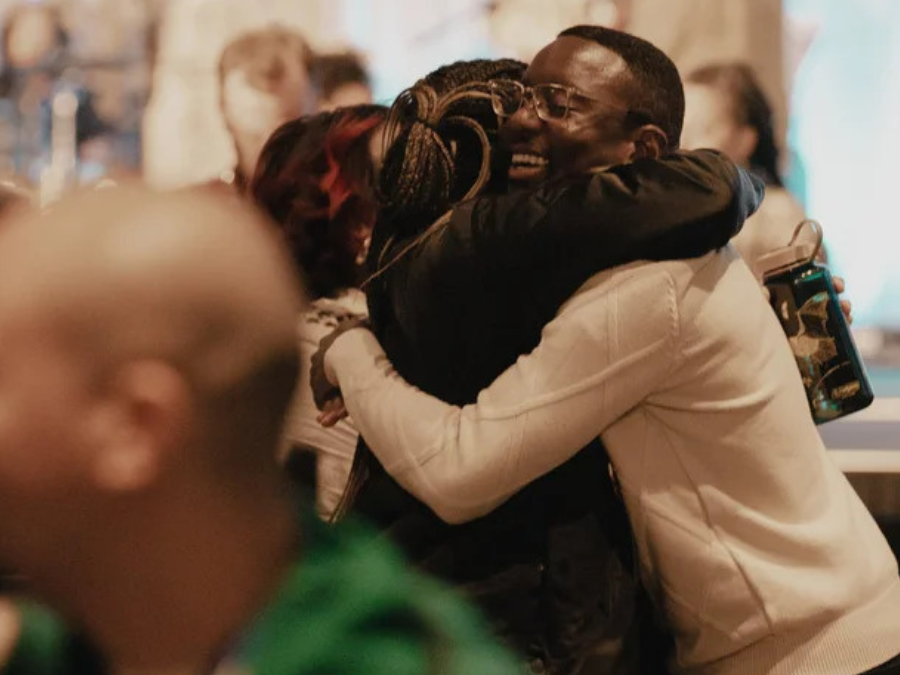
So this past January, it was a new and exciting experience for me to bring my Christian and queer identities together at Q Christian Fellowship Conference, a four-day gathering of around 1,000 queer people of faith in Portland. It was my first time at a conference like this, and I didn’t know what to expect.
On the first day of the conference, I was delighted to learn that transgender representation at the conference went beyond having pronoun buttons at registration. I joined an affinity group of trans and non-binary people — a fantastic opportunity to share experiences, frustrations and hopes. I first came out as transgender/genderqueer as a homeless queer teenager 25 years ago, so at the conference I was struck by how powerful it must be for someone who is newly walking a gender-expansive journey to see out and proud transgender clergy who are serving faith communities.
The keynote from Micah Melody Taberner, a transgender woman who is the co-executive director of Community Engagement for Transmission Ministry Collective, felt particularly salient for me. She spoke candidly of her experience grappling with burnout and exhaustion in the face of so much anti-transgender political violence, but also about the importance of leaning on others to support ourselves, our work and our faith.
***
On the second morning of the conference, a friend leaned toward me during a session and whispered: “Someone was just murdered in Minneapolis.”
At first, I didn’t believe it. Even as an American who has become somewhat numb to gun violence, I couldn’t fathom a second killing in Minneapolis after Renee Good’s death by ICE agents only two and a half weeks earlier. Everyone began getting news alerts on their phones, and it was all any of us could talk about.
By Saturday afternoon, anti-ICE protesters had assembled outside the Hilton hotel where we were meeting. ICE agents had booked rooms at a Hilton hotel in Minneapolis until the venue opted to cancel their reservations. Hilton later dropped that hotel from its system. The juxtaposition of events was all a bit jarring: people dying in the streets of Minneapolis; the hotel in Portland locking doors in response to a peaceful protest; the warmth and connection among the attendees at the conference.
We began to ask ourselves what it means to bear witness to growing violence in the United States as queer Christians. I heard many clergy at the conference grappling with the arrests of their protesting peers in Minneapolis, and commenting on the viral video of New Hampshire Episcopal Bishop Rob Hirschfeld urging protesting clergy to prepare their wills and other affairs. As queer people, and especially as trans people, we are used to living with both fear and violence. And as both have intensified, so has our need to showcase diversity in response.
More on Broadview:
- Iraq’s child brides
- Film project centres the lives of young people killed by fentanyl
- How Albertans of faith are countering separatist, anti-immigrant sentiment
Keynote speaker Sammy Ramsey — a professor at the University of Colorado, a National Geographic Wayfinder Award recipient and an National Public Radio entomology correspondent — best captured the divine beauty of human diversity of gender and sexuality. Pointing to the natural world — specifically his passion for bugs — he drove home the idea of not blending in, not backing away from the differences that make us ourselves.
The conference ended on Sunday with a profound keynote from Jae Bates, a transgender preacher from Minneapolis. Bates shared that Alex Pretti was murdered in his neighbourhood, near where he gets his hair cut. There is much work to be done, he said, much horror to fight against, but also so much hope. He evoked a line from one of Lucille Clifton’s poems: “come celebrate with me that everyday something has tried to kill me and has failed.”
In the weeks since the conference, my biggest takeaway has been that Christian communities must make a place and space for all levels of queerness. When people are gunned down in the streets, and the right to exist as queer people is under attack, it’s urgent that churches become not only affirming, but also willing to centre what some people consider the “fringes” of queerness — including those who are polyamorous or part of various kink communities.
When we create space for all flavours of queerness, we make it safer for everyone to feel included. I found queerness in all its messy, beautiful, sexy forms as a homeless teenager. I found God through the brilliant joy and survival of other queer people and the connections we share.
To paraphrase Cliffton’s poetic verse: may the world keep failing to kill us. May we keep living queerly.
***
Thanks for reading
Independent journalism rooted
in faith and justice is under threat
Broadview is the only media organization in Canada offering thoughtful, values-driven journalism from an inclusive, progressive Christian perspective. But our work depends on your support. If you value what you've just read, please act now.
A gift today helps keep this journalism alive tomorrow.
With gratitude,



I’m still wondering how conservative Christians are holding onto faith amid rising political violence.