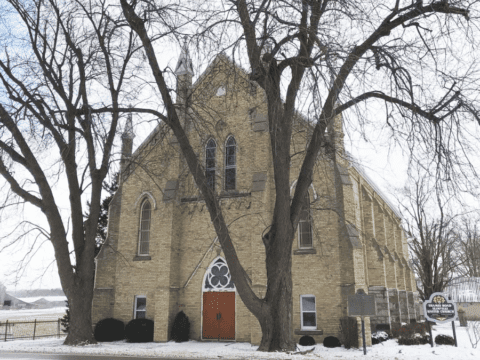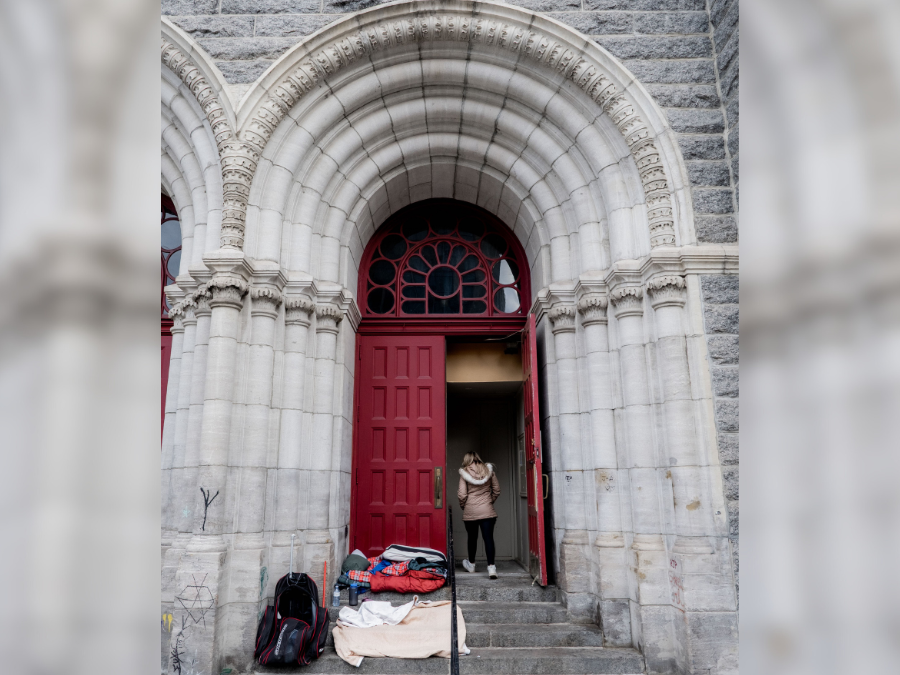
Église Saint-Roch is an imposing Catholic church in Quebec City named for the patron saint of outcasts. It’s both a city heritage site and the beating heart of a vibrant neighbourhood at the crossroads of working-class history and gentrification. Fittingly, it’s also home to Le Répit Basse-Ville (“the Lower Town respite”), a day centre for homeless people and others with nowhere else to go.
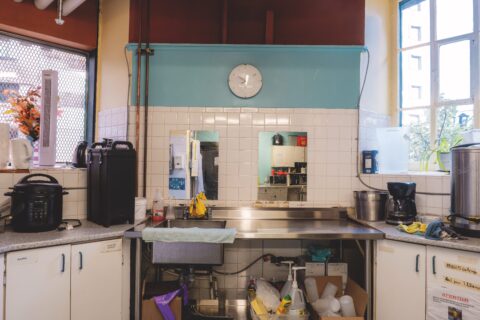
In a garage-like but well-lit room in the church’s labyrinthine basement, outreach worker James Herrera is everywhere at once, listening to one man vent, charging another’s battered phone and tidying the kitchen before a group of nuns arrive with food. “Every day is different,” he says with a cheerful shrug. “When people get too upset, we tell them to take a walk and come back. There are conflicts, but people are happy to be here, so they make it work.”
You may unsubscribe from any of our newsletters at any time.
Église Saint-Roch has hosted this day shelter since at least 2000. That year, a nearby shopping mall called the Mail Saint-Roch was demolished, leaving unhoused people with nowhere to hang out during the day. A partnership emerged between Église Saint-Roch and a local outreach organization, and a “rec centre for homeless people,” as one person describes it, was born.
The day shelter was a much-loved neighbourhood spot for two decades. But when the pandemic hit in 2020, it brought rampant inflation, a worsening housing crisis, evictions, closures of other gathering places and — critically — a more toxic drug supply. Suddenly, a far more vulnerable and unpredictable clientele was knocking at the door.
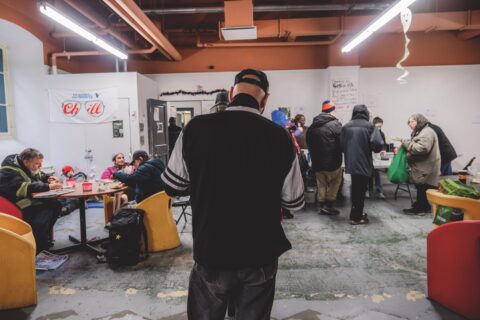
The day shelter’s outreach staff were then recalled to a larger city shelter nearby, and the coalition of community organizations that replaced them struggled to meet the growing demand for service. Some parishioners — particularly seniors — no longer felt safe around the church and stopped attending mass. Complaints from businesspeople and residents of a nearby public housing complex mounted, as did damage to the church building, which the struggling parish could ill afford to repair.
In June 2022, the parish ended its partnership with the coalition, suspended shelter operations and appealed for help. Knowing the city didn’t want the service to be interrupted, the parish gave municipal officials an ultimatum: take ownership of the shelter or face its permanent closure. “We decided we could only [continue to] rent the space if the city got involved,” remembers Nicolas Marcil, general manager of the parish. “They were the only ones solid enough to deal with this.”
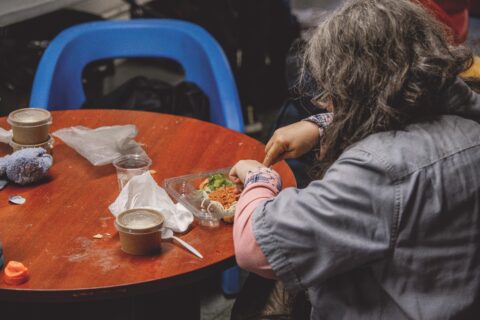
Quebec churches have long helped people experiencing homelessness in the province. But with churches closing and falling into disrepair, many are unable to continue to serve in this way. Outreach organizations are stepping into the gap, often operating from deconsecrated or underused church buildings. As charities, however, they too struggle to meet both the demands of the unhoused and the high costs of building maintenance. “The church teaches that we should help the poor, but we need to do it in a balanced way,” Marcil says. Meanwhile, church buildings are disappearing from the landscape as the number of homeless people soars.
A new pilot at Église Saint-Roch may be the answer to saving Quebec’s historic church buildings while providing shelter to those in need. It involves municipal government funding and support — in partnership with the church and an outreach organization. And its success is beginning to draw attention around the province.
The men Herrera greeted at Église Saint-Roch that day were hardly the first Quebecers to seek safety and a listening ear inside a church. The Roman Catholic Church was at the centre of community life, medical care and education in Quebec from the early days of French colonization until well within living memory. In the 1960s and ’70s, as the province closed asylums and left mentally ill people to fend for themselves, churches were the first stop for many. “The priest helped them as best he could,” Marcil says of the Église Saint-Roch clergy of the day.
However, around the same time, Quebecers pushed back against religious influence in a period of social upheaval known as the Quiet Revolution. Church attendance plummeted from 90 percent in the 1950s to just 14 percent in 2019. With fewer parishioners, congregations have struggled to maintain enormous buildings like Église Saint-Roch. Heating costs alone can run into the tens of thousands of dollars. Maintenance expenses, says Marcil, are “a bottomless pit.”
This past June, the religious heritage non-profit Conseil du patrimoine religieux du Québec — which in 2024 offered $20 million in grants to restore and repurpose 89 religious buildings — had its funding suspended by the province, aggravating an already dire situation. But even this popular grant program was never enough to cover all the ongoing church repairs and upgrades, says CPRQ vice-president Yves Grondin. “The problem,” he sighs, “is that there just isn’t any money.”
Between 2003 and 2023, according to the CPRQ, ; others have simply been abandoned. The “survivors” are striving to continue to help those in need, with fewer resources, fewer staff and growing concerns about cohabitation between homeless people and their fellow citizens.
More people than ever need help. According to the Quebec Ministry of Health and Social Services, between 2022 and 2024 alone, homelessness in the greater Quebec City region rose by 16 percent. At Lauberivière, Quebec City’s largest shelter, longtime director Éric Boulay says more than seven in 10 users are newly homeless. “And I can’t put more than one person on a bed.”
In Montreal, Luis-Carlos Cuasquer knows all too well the tremendous challenges of trying to help homeless people within former church buildings. Nearly every day, he drives by growing tent encampments in the city’s Hochelaga-Maisonneuve neighbourhood on his way to work. Cuasquer is the executive director of PAS de la rue, a non-profit working with homeless seniors. The organization opened a day shelter in the deconsecrated Église Sainte-Brigide last year after its main day shelter became overcrowded.
Église Sainte-Brigide held its last mass in 2005 and housed a circus arts school until the pandemic. In 2022, PAS de la rue began working with the Centre culturel et communautaire Sainte-Brigide, the non-profit that owns the building, to create an affordable housing development for people coming out of homelessness. That’s still the long-term plan, but for now, Cuasquer has pivoted to create a day shelter with tables and chairs, lockers, board games and rest areas in the former sanctuary. He estimates the annual cost at around $330,000 — of which $130,000 goes to heating. “That’s a lot of money for a non-profit that hasn’t got any…but if we weren’t there, we’d have to give the church to the city because no one would be there to preserve it.”
The day shelter “keeps people dry when it rains and inside when it’s freezing,” says Cuasquer. “But it’s not adapted [for all their needs]. We’re all about human dignity and giving people clean, beautiful spaces that make them want to say, ‘I still have something to offer to the world.’”
Not far from Montreal’s Olympic Stadium, Michelle Patenaude serves as executive director of the non-profit CAP St-Barnabé, founded in 1991 by parishioners who wanted to breathe new life into Église Saint-Barnabé — yet another vast, underused church in the city’s east end. Today, CAP runs two emergency shelters, both in churches, along with a transitional housing facility in a former YMCA. The two church basements allow CAP to house dozens of people who might otherwise sleep outside; a single dorm at Saint-Barnabé holds 60 people overnight.

However, like Cuasquer, Patenaude doesn’t see church basements as a long-term solution to getting people off the street. Converting the basements into shelters requires an enormous amount of work and funding. Cubicles are needed to separate men and women and to give residents privacy. Plumbing is a particular challenge: pipes designed to supply a few washrooms a few times a week must supply multiple washrooms, showers, a commercial kitchen and a laundromat, around the clock. Repairs to windows and roofs are expensive. Even when start-up costs are covered by grants, day-to-day maintenance falls to Patenaude and her staff, and something always needs fixing. When the city of Montreal offered CAP St-Barnabé a third deconsecrated church — Église Sainte-Bibiane, which the city purchased from the localparish in early 2024 — for use as a shelter, Patenaude said no. “We have our hands full with the two others.”
CEO Sam Watts of Montreal’s Welcome Hall Mission also turned down the city’s offer of Église Sainte-Bibiane. “Churches are not adapted to do most of the things community organizations would want to do with them,” says Watts, a 40-year veteran of transitional housing in Montreal. “They’re usually full of asbestos, and they often have plumbing and electrical issues….It’s also bureaucratic beyond belief to do business with a religious institution.”
At Église Saint-Roch in Quebec City, a more hopeful story has emerged. The municipality accepted Marcil’s ultimatum in spring 2023 and signed a deal that fall, smoothing over with the stroke of a pen many of the concerns Cuasquer, Watts and Patenaude describe.
The city agreed to a 10-year lease on the church basement at an initial monthly rent of $185,000. It also approved $11.9 million in renovations to bring the basement up to standard for accessibility, fire safety, electricity and plumbing, and to turn the remaining unused space into meeting rooms for community organizations. Further, the city committed to keeping the building insured and handling community relations concerns as they arise, explains city councillor Marie-Pierre Boucher. The renovations are expected to begin in 2026; during that time, the city will be responsible for finding a temporary space for the centre.
After 14 months of closure, the Saint-Roch shelter reopened in December 2023 as an overnight warming centre. In the milder months, it’s open during the day. Outreach staff are provided by Le Répit Basse-ville, a non-profit funded by the local public health authority. The public health authority also provides emergency backup staff and plays an advisory role. The project is a four-way partnership between the city, the parish, the public health unit and Le Répit. “We co-built this together,” Boucher says with evident pride.
Ariane Desharnais is the administrative co-ordinator of Le Répit, which manages day-to-day operations at the Église Saint-Roch shelter and a second shelter in a former office building nearby, offering refuge to a combined 170 people. “We couldn’t do this if the city wasn’t involved,” she says. “The city takes a huge financial weight off our shoulders, so we can use our money to buy food and other things…and whenever there’s a problem, they say, ‘What can we do together to solve it?’”

The day shelter is buzzing with activity and chatter on a late fall afternoon. Stéphane, who declined to give his surname, is a middle-aged regular who lives in a nearby rooming house but comes to Saint-Roch most days to enjoy a hot meal and joke around with his friends. “Hey, it’s better than watching the giggle box all day,” he says. “That’s what we’d be doing if we weren’t here, sitting around not talking to anyone — and that’s dangerous. It’s bad for your mind.”
Ronald, who also opted for first-name only, is a former cook in his 60s who became homeless two years ago. He sometimes ducks into the train station for a bit of peace and quiet or goes to a nearby shelter for a shower. He is eagerly looking forward to November, when the facility switches from a day shelter to an overnight warming centre, to give people an escape from the biting cold of the Quebec City winter. “That’s the whole point of this place,” Ronald says. Before Le Répit reopened the Saint-Roch site, he sometimes spent the night outside. “We’re like parasites, us homeless people; they don’t want us too close to the others,” he says. “Everywhere you go, the cops will tell you to move along. Everywhere but here.”
Desharnais explains further: “In the winter…people are going to try first to get a bed somewhere, and if they can’t, they come to us. The warming centre offers respite to people who might otherwise end up sleeping outside, something Desharnais wants to avoid — because that’s a health risk, and also just inhumane.”
Cohabitation remains a concern. Marcil says some parishioners still avoid the church, uncomfortable with begging or aggressive or unpredictable behaviour. Desharnais and her colleagues meet three or four times a year with nearby residents, businesspeople, the police and anyone else who wants to discuss issues that arise.
More on Broadview:
- Toronto condo lawsuit against street ministry is deeply cruel
- United Church leader who delivered landmark 1986 apology dies
- Brampton threatens legal action against church supporting vulnerable residents
A new venture opening this winter suggests that cohabitation is becoming somewhat more manageable. Moment Factory, a Montreal-based multimedia studio, is bringing an immersive show to the sanctuary of Église Saint-Roch in the evenings — a tourist attraction that, combined with rental income from the city for the shelter and meeting rooms in the basement, will allow the church to keep the lights on for the foreseeable future. It will be a challenge to ensure the stone forecourt of the church, known as le parvis, is inviting for both visitors and people who need the warming centre, Marcil acknowledges. “We don’t want to sweep people off le parvis, but we do want to make something a little joyful for the people who come to see the show.”
In March 2025, at a press conference outside a Montreal church on a bone-chillingly cold day, the Québec Solidaire party called for the creation of a network of warming centres inside the province’s churches, modelled on the vaccination centres created during the COVID-19 pandemic.
“In 2021, I was vaccinated in a church basement that was rented for that purpose by the [public health authority],” Québec Solidaire housing critic Guillaume Cliche-Rivard said to the assembled journalists. “Nothing like that had ever happened before, but suddenly, it was possible.…Facing the housing crisis, we can do it again. We can transform churches into resources.”
Although the idea of a Quebec-wide shelter network has gotten little traction with provincial government officials, Cliche-Rivard told Broadview the Église Saint-Roch project is “exactly the kind of thing we’ve been talking about.”
Heritage advocate Yves Grondin of the CPRQ has also been following the project closely. As a city councillor in Drummondville, between Montreal and Quebec City, and a pastoral agent at his local parish, he’s able to look at the project from multiple angles. He says he believes the partnership model that led to the creation of Le Répit at Saint-Roch could be adapted elsewhere, under the right conditions.
“The parish needs to be on board. There are issues of cohabitation and equipment, and you need to have professional outreach workers to support people – you can’t rely only on volunteers,” Grondin says. “But a church that decides to open its doors and lead by example could do something quite significant.”
Marcil, the soft-spoken parish director whose call for change gave rise to the Saint-Roch project, sees things in a similar light. “If we succeed, we’ll be a model, I think, because we’ll have the religious celebrations, we’ll have the Moment Factory [show] and then we’ll also have the human aspect, helping the poor. It’s not easy, but I think there’s a way to do it.”
***
Ruby Pratka is a freelance journalist and editor in Montreal.
Thanks for reading
Independent journalism rooted
in faith and justice is under threat
Broadview is the only media organization in Canada offering thoughtful, values-driven journalism from an inclusive, progressive Christian perspective. But our work depends on your support. If you value what you've just read, please act now.
A gift today helps keep this journalism alive tomorrow.
With gratitude,