

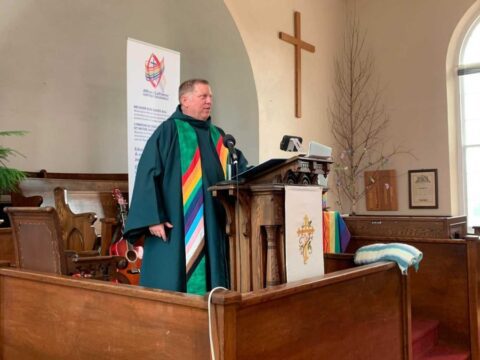
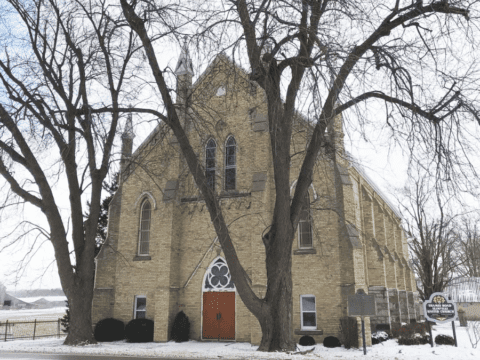
Rev. Geoff Wilfong-Pritchard was closing in on retirement when his plans were upended. A minister at St. Andrew’s United in Edmonton since 1993, Wilfong-Pritchard was informed in September 2023 that he was under review due to complaints from two of the congregation’s board members. A concern of “ineffective ministry” was the only information he received when an assigned reviewer from the United Church’s Office of Vocation invited him and other congregants, also without further explanation, he says, to share reflections on his ministry.
After the review process escalated to suspension in February 2024, Wilfong-Pritchard completed several months of remedial work to return to St. Andrew’s in good standing. He says the church’s process lacks relational awareness and was devastating for the congregation. “Part of emotional intelligence is ‘you don’t set up triangulation,’ right? But the whole process is based on that,” says Wilfong-Pritchard. “St. Andrew’s has always been a very strong-willed congregation. There had been disagreements over the years that were handled internally before, but the congregation was just devastated, and that’s just all the doing of the Office of Vocation.”
You may unsubscribe from any of our newsletters at any time.
Wilfong-Pritchard is one of a number of ministers raising questions about the Office of Vocation, the national body born out of the United Church’s 2019 restructuring to streamline the accreditation, oversight and discipline of ministers. Unifaith — a community chapter of clergy organizing under Unifor, Canada’s largest private-sector trade union — claims that the office is ineffective at handling disciplinary processes, reviews and remediation. The Office of Vocation, however, says its procedures are fair.
“I would say absolutely our process allows due process,” says diaconal minister Marlene Britton, who was the OV’s director until October 2025. The body has 13 people on staff and is located at the General Council office in Toronto, although several of those staff work in Regions around the country. Other bodies work under the umbrella of the OV, including the Board of Vocation, the response committee and the remedial committee. In 2024, the OV’s response committee addressed 23 new cases.
At the 45th General Council this past summer, Unifaith leaders prepared two proposals for reform: the Faith Workers Bill of Rights, a list of 10 articles outlining the rights of all United Church employees to a respectful and safe workplace; and the Vocational Review and Discipline Accountability Policy, which calls for an independent body to oversee the OV’s own conduct.
Unifaith president Rev. Alison Miculan, a minister at two United churches in Hamilton, was a commissioner at GC45 and both proposals’ designated clarifier. Citing the unique nature of ministers’ covenantal and employment relationship with the church, she says that clergy need stronger protections. Miculan also worries that the OV’s current approach to conflict resolution leaves ministers vulnerable to systemic harassment and bullying.
“[The OV] fails to provide due process, and its disciplinary procedures rarely end with mutual understanding or growth,” she told Broadview. “Ministers often walk away spiritually broken. Some take leave. Some consider suicide. Some leave the ministry altogether.”
One of Unifaith’s initiatives since its inception in 2014 has been supporting clergy who are navigating review or discipline procedures, employment negotiations or complaints with their congregations or the national church. These include cases of alleged misconduct and cases where the minister is the complainant. Before restructuring, Presbyteries and Conferences were responsible for the oversight and discipline of ministers. Miculan, who was initially hopeful the new office would handle conflict cases with consistency, says the centralized body is erratic in its processes, in addition to being far-removed from congregations’ local context.
“As is the case now, some regions were great at dealing with conflict [before] and others were not,” Miculan says. “It’s worse since restructuring, because of the distance involved. There is no personal connection with the congregations or the clergy anymore.”
More on Broadview:
- United Church leader who delivered landmark 1986 apology dies
- Presbyterians reassess office-share deal after Anglican exit shakes ecumenical plan
- Why churchgoers should question every text message
Karen Valley, the United Church’s program co-ordinator for pastoral relations and remedial processes, says the OV tries not to wade into conflicts too quickly. “If [a concern] comes to us and it hasn’t been looked at by the local ministry and personnel committee, by the regional council…, we encourage them to work through [the conflict] to see if there’s an informal or a low-level resolution,” Valley says.
Wilfong-Pritchard, who says he was never formally offered the chance to resolve the conflict with the complainants, disagrees. He argues that the review and remediation evolved into a “nebulous” process, irrelevant to the complaints that initiated them and more concerned with whether he was an obedient minister of the church.
The OV’s procedures stipulate that once a concern is deemed eligible for a review, the reviewer, an independent contractor who can either be clergy or lay, must gather facts to produce a report for the remedial committee outlining whether the minister in question is effective, ineffective or if there are reasonable grounds for discipline. Reviewers are only notified of the general nature of the alleged issue. The minister under review may request specific people to be interviewed and gets the chance to respond to all the information that the reviewer has gathered.
The OOV conducts both reviews and investigations — a review, which Wilfong-Pritchard underwent, relates to effectiveness, while investigations are processes of discipline that look into alleged misconduct, which is a breach of the ethical standards.
Miculan, who has accompanied numerous ministers in reviews and discipline procedures, calls the review stage a “fishing expedition” that can cause irreparable division and conflict in the congregation. She says Wilfong-Pritchard’s case follows a familiar pattern at the OV.
“Because they’re ministers…they’re very pastoral. [They say], ‘Well, I should have done this differently. I could have done that differently,’” says Miculan. “And we’ve got a reviewer that’s just taking notes.” Afterwards, she says, they get a letter from the Office of Vocation telling them they have violated the ethical and professional standards in a handful of ways.
“It’s absolutely mind-blowing,” says Miculan. “Take a look at the ethical and professional standards. Could you live up to every single one of those? Who could as a human?”
The six-page standards list sets out 76 expectations for ministers, covering everything from community outreach and pastoral care to personal relationships and conflicts of interest. Unlike misconduct, which is generally understood as violations of the United Church’s policies, such as harassment, discrimination or sexual abuse, there is no specific definition of “effectiveness” in any of the OV’s policies, the Manual or other church documents, although the list of ethical and professional standards generally captures it.
“Take a look at the ethical and professional standards. Could you live up to every single one of those? Who could as a human?”
For some members of St. Andrew’s United, the lack of transparency and communication surrounding Wilfong-Pritchard’s disappearance was frustrating enough to prompt a letter to the OV and the local regional council in March 2024, followed by a list of recommendations, which was drafted just over a year later and signed by 34 congregants, including one trustee, to reduce collateral damage to congregations during review processes. “In the midst of an information vacuum, we are shocked, confused and deeply saddened. A number of our congregation have walked out the door,” the initial letter reads.
The OV declined to comment on Wilfong-Pritchard’s case, citing privacy legislation, but the General Council office emphasized that the recommendations were received and feedback is taken seriously.
According to the OV’s procedure, once a review concludes, the applicable report or information is forwarded to the minister, after which the minister presents their own case to the remedial committee. Wilfong-Pritchard says this was the first time since receiving the notice of review two months earlier that he finally learned both the nature of the complaints and the identities of those who filed them. A regional council minister emailed him the exact complaints, and the reviewer sent him the final report.
“I was just dumbfounded because one of the complaints was almost entirely fabricated,” he alleges.
If a minister is found ineffective, as was the case for Wilfong-Pritchard, one of five standard courses of action may follow: remediation, full retirement (if the minister is already receiving a pension), the minister voluntarily discontinuing service, moving the case to the formal hearing committee to decide on a disciplinary sanction, or another action to be determined.
Wilfong-Pritchard, who planned to retire in 2023 before the review began, says he was suspended and could not retire in good standing, so he chose to undergo remediation instead. He completed his program from May to October 2024.
During the remedial process, a separate committee designs a program to improve the minister’s pastoral skills. Only once they’ve completed it and had a final meeting with the remedial committee can they return to good standing.
Britton, who moved into a position with the Centre for Christian Studies in November, describes the remedial process as very “co-operative” and “conciliatory.”
“Every minister who goes through the remediation and participates fully… has the opportunity [to share] what their experience has been like and is invited to contribute to improving the system,” Britton says. “The truth is that the remedial committee cannot take away the credentials of any minister in The United Church of Canada.” She says ministers are “free to say whatever they want,” and the feedback does not affect their standing.
In Wilfong-Pritchard and Miculan’s view, the cards are stacked against ministers. Miculan says she receives monthly messages from ministers under review whose “stories are just atrocious and gut-wrenching.” But Britton rejects claims that the OV is unfair or fails to assume innocence.
“We do have to take complaints seriously, as in every single profession,” she says. “Ministers are allowed to and are invited to bring support persons to…walk with them, even as the Office of Vocation offers them pastoral care.…The OV assumes a lot of financial responsibility when these processes are in place, and that is to support the minister.”
The OV reimburses pastoral charges for ministers’ salaries while they are under review or investigation and while they complete their directed program, says Rev. Adam Hanley, the OV’s acting co-director of policies and programs for ministry personnel.
Broadview consulted Christian Malleck, head of human resources consulting at the Canadian Centre for Christian Charities, to review the OV’s structure and responsibilities document. He echoed Britton’s characterization that the thorough process demonstrates the United Church’s commitment to handling complaints seriously.
At the same time, he agreed with concerns that the review and discipline processes are bureaucratic and inaccessible. The policy “doesn’t convey warmth or individual attention.…It feels like a bunch of high-level disconnected leaders that just want to put it through a system,” Malleck said. “If your organization is relational, if it’s loving and caring, then that should come through in the communication.”
In addition to recommending the current policies be redrafted in laypersons’ terms, Malleck suggested more Christian practices be interwoven into the policy. “There should be a mention of prayer, forgiveness or seeking of reconciliation. ‘We don’t jump to conclusions, we don’t assume the worst, but we value people’s input.’…You have to say those things, otherwise people aren’t sure if they even exist.”
Both Unifaith proposals directed at the Office of Vocation were shelved at GC45 after the Way Forward Committee recommended “no further action.” Nearly all discussion groups at GC45 were opposed to the proposals, stating that they duplicated existing church policies. Some worried that the Faith Workers Bill of Rights would reframe the relationship between United churches and clergy as secular work. The structural change evaluation steering group, which is reviewing the OV’s performance as part of its overall review of the United Church’s 2019 revamped governance, is expected to release a report to the General Council Executive by early 2026.
After completing his remedial work, Wilfong-Pritchard returned to St. Andrew’s United in good standing in November 2024 and immediately announced his retirement. He’s still frustrated about his ordeal.
“The thing that embitters me the most is that this whole process must have cost close to $150,000, and the OV has no idea whether I truly am remediated or whether I was just being performative,” he says. “I got an extra year of salary and benefits, had a chance to practise retirement, and the people who tried to damage my character weren’t successful.…I got away pretty much scot-free, but other people have not, and that’s the real tragedy. People have had their whole sense of vocation called into question.”
EDITOR’S NOTE: This article has been updated to note the location of some Office of Vocation staff and that the body also includes the Board of Vocation and committees like the remedial and response committee. Information about reviews, investigations and discipline processes has also been added, along with the fact that reviewers are only notified of the general nature of a concern.
***
Ghazal Azizi is a journalist and fact-checker in Montreal.
Thanks for reading
Will you help support United Church reporting?
Broadview is the only media organization dedicated to telling the stories of The United Church of Canada — its big decisions, perspectives and the faithful people and communities at its core. But this essential work depends on you.Make a tax-deductible gift today — 100% of your donation goes directly to supporting United Church coverage.

With gratitude,








This was enlightening. One of the reasons I left the UCC and joined a “free” Church denomination. Different issues, but a lot less “politics”.
and as “free” churches demonstrate – not at all prone to any abuse, malpractice or cliques… Please!
Different issues, but a lot less “politics”.