
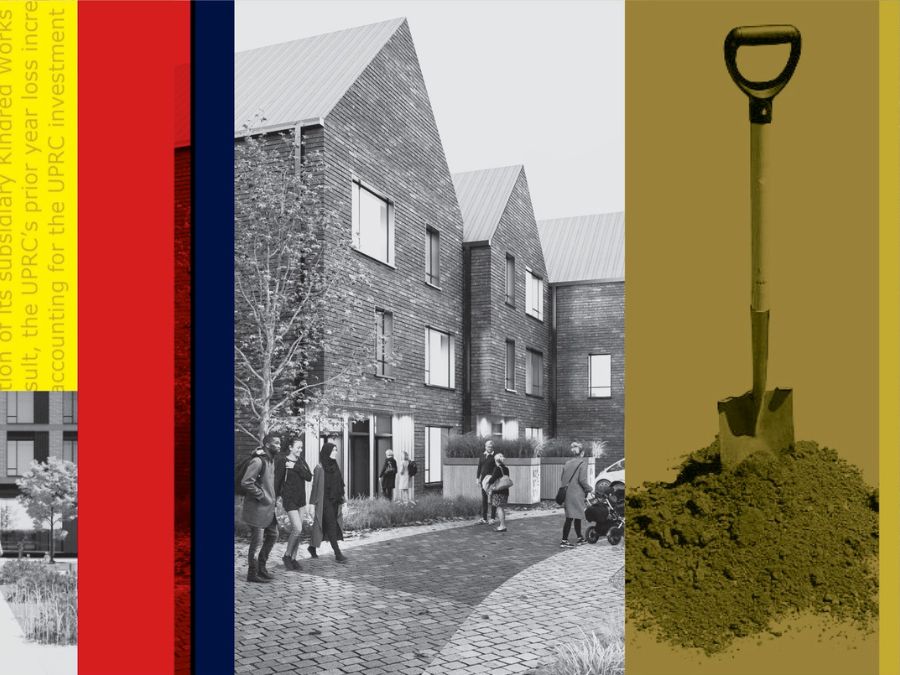
About five years ago, accompanied by news-release fanfare and a $20-million line of credit from Canada’s federal housing agency, The United Church of Canada announced that its property redevelopment arm, the United Property Resource Corporation (UPRC), would be building as many as 5,000 affordable homes across Canada over the next 15 years. Many United churches were closing their doors, but their valuable properties would help create much-needed rental housing.
While most of the townhouses and apartments would be rented at open-market rates, one-third would be affordable, which Canada defines as housing that costs tenants less than 30 percent of their before-tax income. Mixing affordable and market-rate rental homes means rental income covers building costs and ensures long-term financial stability.
You may unsubscribe from any of our newsletters at any time.
After five years, though, the church and UPRC’s development manager, Kindred Works, were on track to complete only 131 homes by 2026. That’s roughly 1,600 affordable homes short of the pace needed to reach the church’s 15-year goal. And while the church has invested $10 million and overseen additional loans to help make these projects happen, Kindred Works is tight-lipped about many of the details of its work (apart from information about its sustainability goals), making it difficult to evaluate how money is being used.
The United Church established UPRC in 2019 to help congregations repurpose properties and to reach the church’s affordable housing goal. UPRC initially claimed access to “over 200 strategic sites in the United Church of Canada’s land inventory.” Its then-CEO Tim Blair said that property and the federal government’s funds would let UPRC realize “our vision to develop open resilient sustainable communities.”
UPRC and its five staff continue to offer congregations advice on property decisions and redevelopment and also hold property from closing congregations for future redevelopment. But in 2022, seemingly seeking a more aggressive approach to its goal of turning churches into rental housing, the United Church’s housing development work turned to Kindred Works, which is a for-profit company with the United Church as majority shareholder; management, employees and option-holders own the rest, according to the company.
Currently, the Kindred Works website displays 31 members of the company’s team, with specialties including planning, development, finance, community engagement and construction. Former UPRC CEO Tim Blair is listed as a “founding partner.” He declined an interview but said over email last spring that the company has “approximately 25” full-time employees. Don Hunter, the board chair of Kindred Works, has United Church ties. Hunter is a longtime church volunteer, former chair of General Council’s division of finance and retired partner at PwC, a global business services firm.
Kindred Works’ website also shows 14 projects, with most in various stages of zoning or site plan approvals. Tim Blair said in an email exchange that Kindred Works had “successfully navigated complex regulatory environments, secured financing, and moved more than a dozen projects through pre-construction and into development.” Only three projects were actually under construction in 2025, with one other likely to begin early this year.
The three projects that appeared to be nearing completion by late last fall were a 48-unit complex in Orillia, Ont., on the site of the former Regent Park United; a 44-unit building at St. James United in Waterdown, Ont.; and a 39-unit development beside Westminster United in St. Catharines, Ont. At the two latter locations, congregations continue to meet amid the busyness of construction projects nearing completion. In Orillia, where the congregation amalgamated with a nearby church eight years ago, the old building is gone and dozens of tradespeople rush to put finishing touches on new grey-sided buildings.
For the churches whose projects have yet to reach the construction phase, frustration is mounting.
***
While developing new affordable housing is difficult, the need is clear. Recent Statistics Canada research shows that almost half of Canadians are very concerned about rising housing costs, with increased concern among lower-income groups and renters. As United churches across Canada close or consider ways to better use their valuable property assets, many see affordable housing as an ideal goal.
Those considering redevelopment have options when looking for affordable housing partners.
Kindred Works is touted as a national initiative, but almost all of its projects are in Ontario.
In Newfoundland and Labrador, Stella’s Circle — named for United Church deaconess and social housing pioneer Stella Burry — is still closely connected to the church and one of the province’s largest affordable housing providers, with 133 units.
More on Broadview:
- Is the Office of Vocation’s discipline process fair? Some ministers don’t think so.
- How congregants from a small-town church gave it an ‘extended life’
- United Church plans $2 million in cuts as it moves to triennial budgeting
In British Columbia, the church’s Pacific Mountain Region staffs two housing societies with a history of providing affordable housing: Three Point Housing Society and Community Renewal Society. Don Evans, director of both societies, says two projects that were completed in 2022 include affordable rent-geared-to-income apartments: the 75-unit Mountain View Suites in Coquitlam, with land contributed by Como Lake United, and the 74-unit Brechin Hill project in Nanaimo, on land from Brechin United. The Nanaimo project took 10 years to complete, including pre-construction. A change of builders partway through contributed to the delay. The Coquitlam apartments experienced similar contractor issues.
Unlike Kindred Works, which declined requests to release project costs and funding sources, citing its status as a privately held company, the B.C. groups readily provided this information, and Stella’s Circle produces annual reports as a requirement of being a non-profit.
In Vancouver — with some of Canada’s highest property prices and costliest rents, rivalled only by Toronto — a housing project in Pacific Mountain Region, delayed by the COVID-19 pandemic, broke ground on construction in late 2025. With more than $11 million in land and cash from Lakeview Multicultural United, the six-storey, 104-unit project on East Vancouver’s Semlin Drive will cost about $70 million and provide 31 rent-geared-to-income homes. The project received about $53 million in funding, including $3.5 million from Pacific Mountain; several mortgages cover the rest. Lakeview will have meeting space in the new building.
***
Across Canada, creating affordable housing means manoeuvring through minefields of municipal planning and rezoning bylaws and responses from existing communities. Then projects need low-interest financing and construction completed within budget and on time. United Church congregations can provide land and goodwill to help projects succeed. Some churches also receive financial returns in the form of annual income to help fund their ministry. For congregations contributing land for affordable housing, the projects are good news. But their neighbours don’t always agree.
In the Hamilton suburb of Waterdown, Kindred Works is building 44 three-storey rental homes, including 12 affordable units. But at a public information meeting in 2024, several local residents voiced concerns about the lack of parking spaces (one per unit) and said the development would become “a slum,” according to an article in Flamborough Today. The buildings, now under construction, will be finished at some point in 2026, according to Kindred Works’ website. Just to the south, a local community association was collecting signatures for a petition opposing Kindred Works’ 12-storey, 176-unit building, with 53 affordable homes, being built near McMaster University on the site of former Binkley United.
In Georgetown, Ont., a suburban town west of Brampton, Kindred Works is developing a six-storey, 157-unit building for Norval United. Residents of the mainly single-family home community launched a petition to stop the project or change its design.
So far, protests have not halted the projects, but neighbourhood resentment could linger.
In London, Ont., where White Oaks United is the site of a planned 113-unit Kindred Works project, with a six-storey apartment building and 10 townhouses, no construction start date has been set.
It is unclear how Kindred Works ensures that its projects are built in the most economical fashion from start to finish, since the company does not issue public tenders for construction.
Some Kindred Works clients find the building process painfully slow, especially where planned payments are expected for ministry. At Portland United in Saint John, N.B., such payments will potentially contribute to the congregation’s operating budget once the housing project is finished. But with the project in limbo, it’s difficult for the congregation to plan ahead.
In the Ottawa suburb of Orléans, the Queenswood United congregation began looking at affordable housing with a property consultant in 2019, then church-related consultants at EDGE, then Kindred Works, whose current project, for an 81-unit apartment and townhouse complex, may break ground soon.
The congregation’s property development chair, Rose Marie MacLennan, says Queenswood “knew [the housing] would be a legacy to the community, for the common good.” During the lengthy development process, she says, the congregation slowly lost money as rental tenants learned of the development plan and moved out, and members left. Queenswood held its last worship service last summer and began discussions about disbanding, which would have happened regardless of Kindred Works’ progress. Says MacLennan, “We couldn’t enjoy the fruits of our work, but others will.”
Even where congregations and neighbours agree on the need for a project, financing is challenging. The United Church pumped about $10 million (half loan and half cash) into Kindred Works to get it started. In 2020, the church also arranged a $20-million, 15-year low-cost loan from the federal Canada Mortgage and Housing Corporation (CMHC) and provided those funds to UPRC. The church pays two-percent annual interest on the loan and is responsible for repaying it.
CMHC provided $20-million in low-interest loans for the Kindred Works project in Orillia. Heartwood Trust, described on the Kindred Works website as an investor, may be providing funds for at least eight Kindred Works projects, including the one in Orillia, according to the builds listed on Heartwood Trust’s website.
Below: The Kindred Works Orillia project as seen in 2024
View this post on Instagram
As General Council general secretary Rev. Michael Blair (no relation to Tim Blair) explains it, both the church and CMHC recognized that government could not provide enough capital to complete the church’s housing projects, so more capital had to be raised. Heartwood Trust — created by Kindred Works’ two “founding partners” Tim Blair and David Constable — has provided part of that solution, raising money through capital markets. Whether that capital is in the form of mortgages on church rental properties or other investment instruments is not clear.
Also unclear is how Kindred Works ensures that its projects are built in the most economical fashion from start to finish, since the company does not issue public tenders for construction. Edmonton-based Chandos Construction is building the Orillia project; Oak and Noble Development Inc., based in Waterloo, Ont., is building the projects in Waterdown and St. Catharines.
As recently as his February 2023 accountability report to the General Council Executive, Michael Blair said that UPRC and by extension, Kindred Works, “will begin contributing to church revenues in 2024.” In his March 2025 report, he referred to increased construction costs and said in a May interview that a return on the church investment could come as early as 2026.
“I think frankly what happened is that we designed something that we didn’t know how to design,” Blair says. “So we pipe-dreamed a little bit, but it won’t be in some ways initially what we had thought.”
Because General Council is now pursuing its housing strategy through a private company whose management does not disclose financial details, there is no way to know how much profit is coming from projects, how much is being used for Kindred Works’ fees or how much is earned among employees who are minority shareholders.
United Church members’ donations could be supporting Kindred Works too, as opposed to a non-profit organization like the denomination that is legally obligated to be transparent about its finances.
“The church needed to and did something bold and daring, as in the language of our call,” says Blair. “And we are figuring it out…that’s as much as I can say.”
***
Mike Milne is a journalist in Owen Sound, Ont. He is the 2025 recipient of a Lifetime Achievement Award from the Canadian Christian Communicators Association.
This story first appeared in Broadview’s March/April 2026 issue with the title “Closed-door policy.”
Thanks for reading
Will you help support United Church reporting?
Broadview is the only media organization dedicated to telling the stories of The United Church of Canada — its big decisions, perspectives and the faithful people and communities at its core. But this essential work depends on you.Make a tax-deductible gift today — 100% of your donation goes directly to supporting United Church coverage.

With gratitude,







Thank you, Mike Milne, for this very important and illuminating article. It’s well-researched and well-written, and I applaud you and Broadview for having the courage to publish it. It’s vital that all of us, not only vocal Clergy but people in the pews as well, become aware of some of the decisions that are made by General Council leadership.